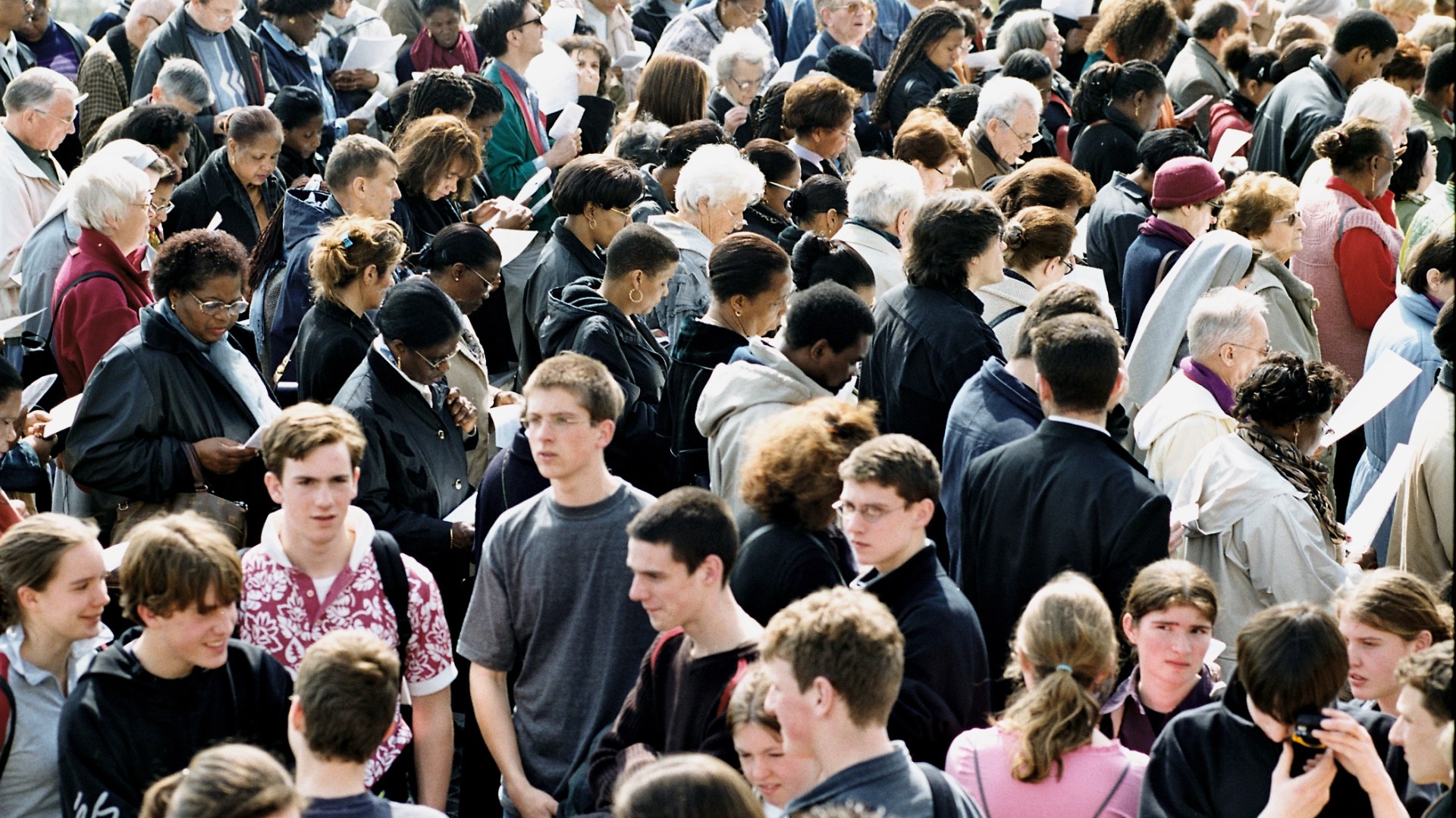
Multiracial churches—congregations in which less than 80 percent belong to a single racial group—are supposed to demonstrate the unity of the church for the sake of the gospel.
They’re also supposed to bring “common understanding of issues across race, which can in turn lead to real change in racial issues,” according to Michael O. Emerson, sociologist and provost at North Park University in Chicago.
And at first, they did. Early versions of multiracial congregations saw white attitudes changing to resemble those of minorities like African Americans or Latinos, Emerson said. Whites in multiracial congregations thought differently than whites in primarily white congregations.
But that’s less the case now, according to two studies published in religious journals this year.
The first study looked at what congregants think are important factors in explaining socioeconomic differences between blacks and whites. Racial discrimination? Inadequate access to quality education? Blacks’ lack of motivation or willpower?
The study found that 72 percent of African Americans in predominantly black churches believe that the reasons for racial inequality are structural, rather than an individual’s lack of motivation. But only about half (53%) of African Americans in multiracial churches believe the same thing.
The percentage closely tracks with whites and Hispanics in multiracial congregations, 54 percent of whom believe racial inequality is structural.
“The typical African American outside of the multiracial congregation is fairly aware that there are structural issues in place that continue to perpetuate inequality,” Kevin Dougherty, a Baylor sociology professor and one of the study’s authors, told CT. “But African Americans within multiracial churches don’t report that same level of structural awareness.”
Instead of the predominantly white majority changing its views, Dougherty said, “it appears that African Americans start to think more like whites about the origins of inequality.”
“Racial divisions are almost constant across any context, and to find they aren’t is surprising,” Ryon Cobb, the study’s lead author, told CT. “Race and inequality thoughts are subject to the context in which people worship.”
People who attend multiracial congregations view structural inequality with almost the same amount of skepticism as those in mostly white churches, where 56 percent of whites, 55 percent of Hispanics, and 49 percent of blacks believe inequality is structural.
“Currently, in the aggregate, multiracial congregations are doing exactly what pastors of color tell me they fear—that they will serve merely as a tool into white assimilation,” Emerson said. “The end result is this: Multiracial congregations are ‘underachieving,’ or to put it another way, not living up to their promise.”
One reason is that multiethnic churches are often megachurches, Emerson said. Large churches have grown both in numbers and in diversity—evangelical churches with more than 1,000 weekly attendees were five times more likely to be diverse in 2007 than they were in 1998, according to Emerson’s research.
“Among such congregations, research finds that nearly one-third are multiracial,” he said. “Large congregations [find it] difficult to make massive personal change in people. Attendees of these congregations can select to be in like-minded groups (rather than with diverse groups), limit involvement more readily to simply attending worship services, and typically have less personal contact from pastors.”
The numbers back him up. The same researchers ran another survey on megachurches, again asking whether socioeconomic differences between blacks and whites were due to discrimination, lack of educational opportunities, or a lack of black willpower.
“Even controlling for religious affiliation, size is related to attitudes toward racial inequality,” Dougherty said. “The bigger the congregation, the less likely you are to see that racial discrimination is a source of inequality.”
That may be a good thing, said Mark DeYmaz, president of Mosaix Global Network. “Assuming these minorities are having a positive interaction with the church, that would inform their belief in this regard,” he said. In a healthy, truly diverse church, the structures of racism are eliminated, he said. And so it makes sense that congregants would be more likely to believe that disparity is caused by individual choices.
“I think that’s totally encouraging,” he said. “That’s what everybody wants.”
However, he said, the studies left out one enormous factor that could account for the similarity of opinion: economics.
“It’s one thing to create large, suburban, wealthy churches filled with people like us,” DeYmaz said. It’s far more challenging, but just as important, to pursue financial as well as racial diversity, he said.
Large, diverse churches can be attractive to financially successful, well-educated minorities, said Trinity Grace Church pastor Bryan Loritts. Blacks who pursue higher education are likely on diverse or predominantly white university campuses, taught by mostly white professors.
“That type of person is going to be comfortable in environments that are ethnically diverse,” he said.
Those minorities are more likely to blame individual choices for disparity, since they successfully navigated and overcame structural inequalities to achieve their success, DeYmaz said.
“The end zone answer is that absolutely there are structural reasons” behind the economic disparity between blacks and whites, Loritts said. But “a healthy church would have divergent viewpoints on which we can enter into dialogue.”
Churches can facilitate those conversations by preaching the beauty of the Cross and reminding people that their highest allegiance isn’t to their ethnicity or their culture, but to Jesus, he said. Purposefully desegregated small groups can also be safe places for members to learn about challenges facing other races.
Racial issues need serious, critical discussion from the church, Emerson said. “We now need to study and focus on congregations that are not simply demographically diverse … but those which are reflecting a new Christ community.”