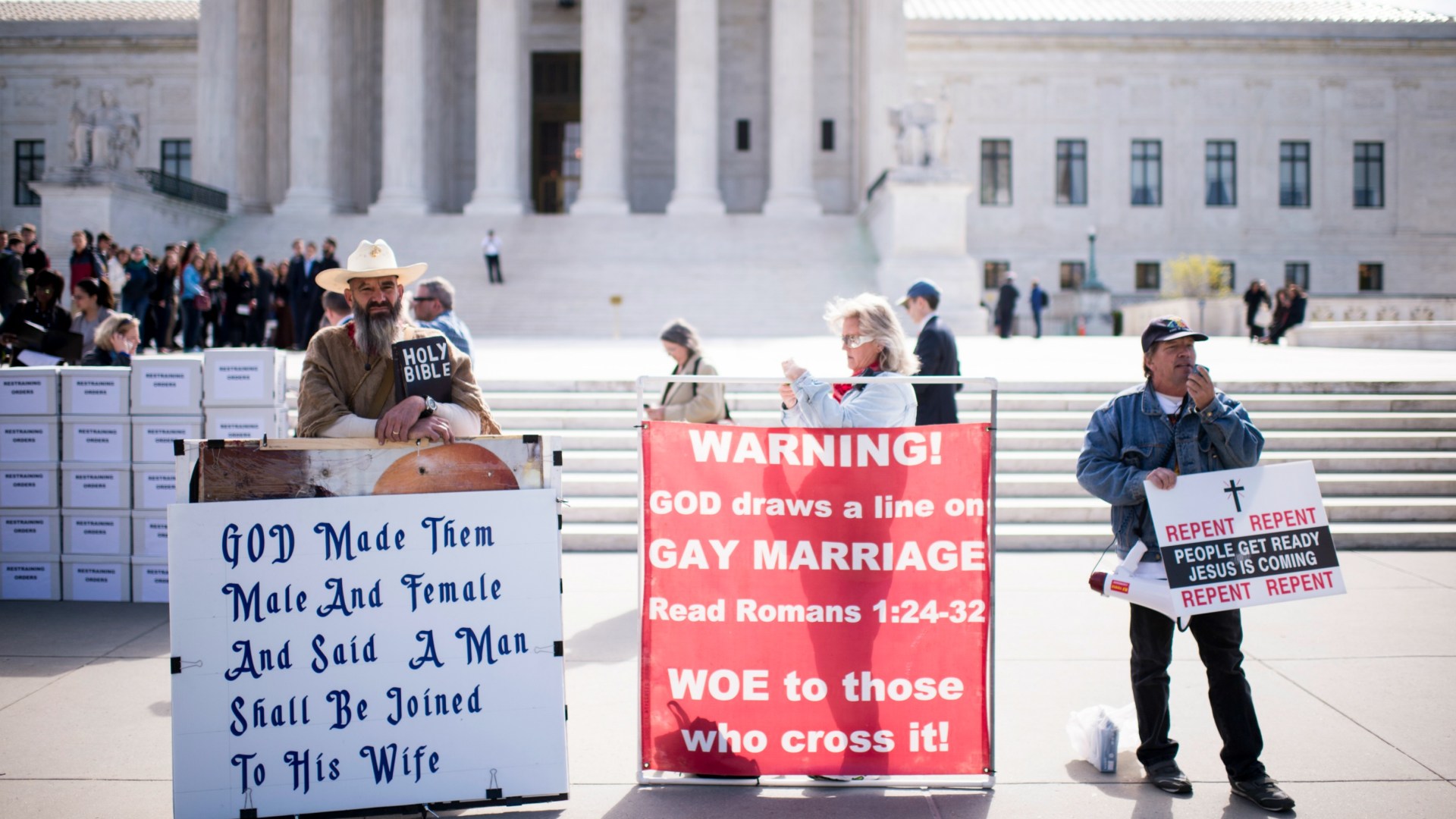
A recent New York Times feature discussed how evangelicals interpret a few Bible passages in support of or against same-sex marriage. The pro-con format of the Times feature supplies anecdotes, but it doesn’t answer the question of how people are applying the Bible to the debate on a wider scale.
For that, we have to turn to data.
The site OpenBible.info has a topical Bible that allows people to vote on and suggest Bible verses they think are relevant to a particular topic. Since 2007, the topics of homosexuality, same-sex marriage, and gay marriage have received over 30,000 votes across 940,000 pageviews, providing a reasonably broad window into the passages that people–largely evangelical Christians–apply to the debate.
The statistical patterns of these 30,000 votes reveal 60 Bible passages that commonly enter the discussion, falling into ten thematic clusters:
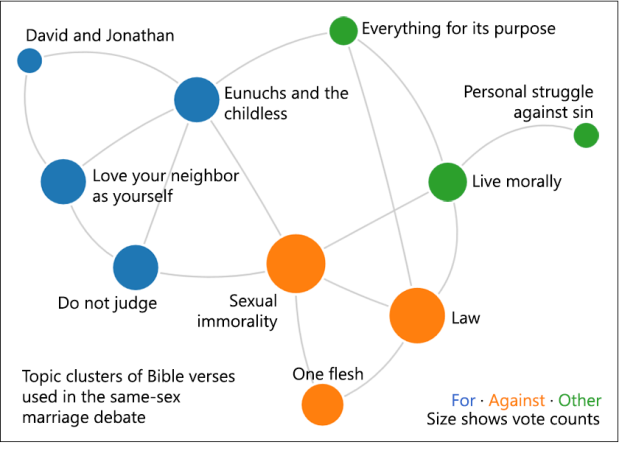
This chart shows the strongest statistical connections among the ten clusters. Three of these clusters are used against same-sex marriage: 19 passages about (the largest cluster), four relating to the , and three about man and woman becoming in marriage.
Four clusters are used to justify acceptance (or at least tolerance) of same-sex marriage: seven passages about , five about , four about , and four about valuing .
The final three clusters don’t deal directly with the topic: 10 passages about , two about how , and two about .
We can also examine how the popularity of each cluster has changed since 2011:
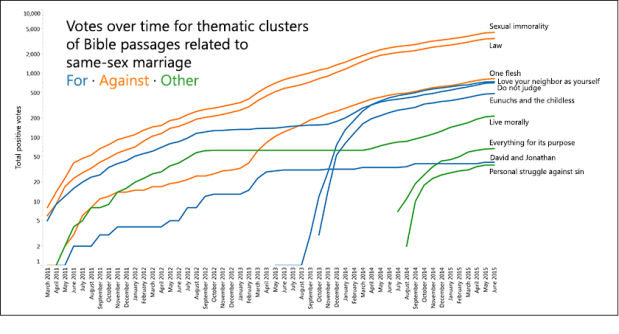
(This chart uses a logarithmic scale to better distinguish the lower vote counts; the top lines have much higher vote counts than the lower lines.)
This data is hardly scientific since it depends on visitors to a single website and doesn’t necessarily indicate culture-wide rhetorical shifts. With that caveat in mind, however, we can observe a few trends.
First, the three clusters with the most votes are all against same-sex marriage. The “one flesh” cluster gained speed in March 2013, when the US Supreme Court heard arguments about California’s Proposition 8 and the federal Defense of Marriage Act.
Second, the three most-popular clusters in support of same-sex marriage started earning substantial numbers of new votes at the end of 2013, when Hawaii, Illinois, and New Mexico legalized same-sex marriage, and a judge ruled Utah’s ban unconstitutional. A Christianity Today article from the time indicates that at this point evangelicals started to recognize that same-sex marriage would probably become legal everywhere and began to change their rhetorical strategies.
The above chart suggests a shift in tone at this time away from “do not judge” to “loving your neighbor” and applying to the debate passages about accepting eunuchs and the childless.
Third, the chart shows a more-recent (and still nascent) rhetorical shift to comparatively ambiguous positions. The general command to “live morally” can apply to both sides of the debate, for example.
These shifts are consistent with recent polls that suggest opposition to same-sex marriage is softening among evangelicals. Just looking at the topical Bible vote counts above, in October 2013, 95 percent of votes were for passages used against same-sex marriage; by May 2015, this percentage had fallen to 72 percent.
These trends suggest to me that many people who use Bible verses in the debate are adapting to a shifting rhetorical landscape. They’re attempting to discern how the Bible can remain relevant to the conversation and are in turn changing the mix of passages they cite.
Bible technology guru Stephen Smith blogs at OpenBible.info. He was the subject of a 2014 CT cover story, “Hacking the Bible.”
For more on today's Supreme Court decision legalizing gay marriage, visit CT's Gleanings blog.