“The worst possible thing you can do when you’re down in the dumps, tweaking, vaporous with victimized self-righteousness, or bored, is to take a walk with dying friends. They will ruin everything for you.”
So begins Anne Lamott’s latest offering, Small Victories: Spotting Improbable Moments of Grace. “They bust you by being grateful for the day, while you are obsessed with how thin your lashes have become and how wide your bottom.”
Especially over the past several months, Kara Tippetts ruined my pity party and busted my ingratitude, modeling an eternal-minded dependence on Christ like I have never seen. I am one of thousands of readers who took a virtual walk with Tippetts through her blog and book, The Hardest Peace, as she battled the inexorable progress of breast cancer.
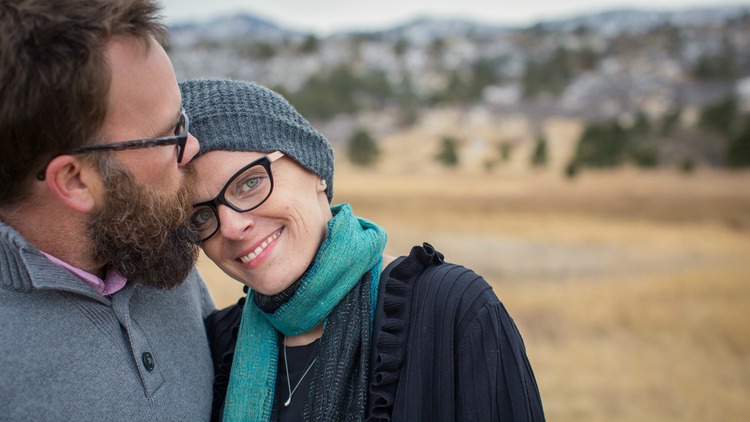
Tippetts, 38, entered hospice care as 2014 drew to a close, and passed away Sunday, March 22. She is grieved by her pastor husband Jason, their four young children (Ella, Harper Joy, Lake, and Story Jane), as well as the many readers who were touched by the grace wound into both her living and dying.
Tippetts mustered a vulnerability and beauty in the deep, kind love she lavished on friends and family through her last days, a capacity deepened rather than dampened by cancer’s unwelcome intrusion into her life. “Loving big in new corners always grows a spirit in strength,” wrote Tippetts, first diagnosed with cancer two and a half years ago, at 36.
But what about those of us who did not know her? This is a woman who posted Facebook updates, shared YouTube videos of her reading from her book, and wrote blog entries even through her final weeks. Is it emotional voyeurism to watch with such rapt attention?
Is following the enduring testimonies of patients like Tippetts or J. Todd Billings a form of rubbernecking: staring at the suffering of others with rapt attention? I sobbed watching the three-minute documentary made of Kara and Jason Tippetts in the last month of her life, moved once again by the grace in the midst of their suffering, even they were strangers to me.
There’s a reason beyond emotions or sentimentality that draws us to stories of dying. Even Tippetts herself was drawn to the stories of dying, writing an open letter to terminal brain cancer patient Brittany Maynard to discourage her from physician-assisted suicide.
For Christians, the promise of salvation is real, and so is the difficulty of suffering and leaving. But even this unbearable final-days struggle points us to Jesus. Tippetts wrote in her letter, “Knowing Jesus, knowing that he understands my hard goodbye, he walks with me in my dying…. In his dying, he protected my living. My living beyond this place.”
Funeral Director Caleb Wilde believes that becoming better acquainted with the uncomfortable, eye-opening realities of death makes us more human. “Perhaps there’s no greater freedom than to live life with a healthy relationship with death,” he writes on his blog, Confessions of a Funeral Director. “Death makes us better people,” says Wilde. “The more we embrace mortality, the more human we become. We look deeper into things: our lives, our relationships, the earth even. We value these things more.”
In this, Wilde echoes the words of the Sage in Ecclesiastes: “It is better to go to a house of mourning than to go to a house of feasting, for death is the destiny of everyone; the living should take this to heart.” (Ecc. 7:2) In other words, paying attention to the stories of the dying can move us toward a more whole-hearted living.
Kara Tippetts knew this better than most. With the house of mourning clearly in view, she took the business of living and dying well to heart. “I want to share the story that suffering isn’t a mistake, and it isn’t the absence of God’s goodness. Because he’s present in the pain,” said Tippetts.
Her story of her own mundane faithfulness and Jesus’ abundant faithfulness to her in the midst of cancer drew hundreds of thousands in: readers choosing her words of reflection in tragedy over the entertainment of click-bait. We are better off for it. We love more deeply. We are that much more aware, and grateful. We are, for a moment, aware that our opportunities to live and love are, as Ecclesiastes teaches us, short-lived. The merest breath.
We are grateful for Kara’s gift: her gentle reminder to love well and fully, because our days are numbered. Far from pulling back from this world and those she loved in the face of death, she pressed into love more fully. The work of grace in the midst of life’s hard means embracing life in all its beautiful, messy glory; and loving God all the more in it.
Read “Cancer May Take My Life, But It Can Never Take My Hope,” an excerpt from Tippetts’s book posted at Today’s Christian Woman.
Bronwyn Lea is a South African-born writer-mama, raising kids in California and raising questions about faith, family, and culture at bronlea.com. Her writing has appeared at RELEVANT, Momastery, Start Marriage Right, and Think Christian. Find her online on Facebook, Pinterest, and Twitter (@bronleatweets).