In this regular series, we share innovative practices from the world of stock photo ministry.
You may know what the Latin phrase a cappella signifies—but do you know what it really means?
Yes, we know it refers to music sung without instrumental accompaniment. Literally translated, though, it means “of the chapel.” There’s a reason for that—instruments didn’t really start to work their way into church worship until after a thousand years of Christian history, and it took them another 500 years to gain wide acceptance (most Eastern traditions still don’t use them at all). From there, it was basically a hop, skip and a jump to fog machines and laser light shows.
Of course, it would be easy to get cynical about this apparent slippery slope. So I will.
I count myself lucky to attend church at a local congregation that’s about as traditional as churches in the Western world get: every Sunday morning, it’s the traditional Latin rite, complete with chanted Psalms. And yet, even my church features loud organ blasts throughout nearly every service. The only major exception to this is our chrism mass, which takes place on the Wednesday of Holy Week. “It’s traditional,” our pastor tells us, “for the organ to be silenced from Palm Sunday till Maundy Thursday.”
That Chrism Wednesday service is always beautiful, but also predictably shaky, unsure of itself. When you only have to sing a cappella one day a year, you never really learn how to truly sing. It almost makes me jealous of my friends in the Church of Christ and other instrument-free traditions who sing unaccompanied every day, who really learn to blend, to harmonize, to worship.
The Church Fathers regarded a cappella as the final evolution of worship, and it wasn’t all that hard to see why: at a time when Heron of Alexandria was trying to spice up pagan services with automatic doors and pyrotechnics, the Christian Church had nothing to prove. They simply raised their voices to the God who had walked the earth a mere generation or two ago. No flash, no production—and, of course, no instruments.
Now, the guitar has replaced the pipe organ as the musical symbol of Christianity (the surest sign that guitars are no longer cool). But as our worship has evolved to incorporate both power chords and fog machines, one truth remains: nothing we can do can substitute for, or compete with, the majesty of the presence of God. Sometimes you simply must take off your shoes and fall on your knees, because you stand on holy ground.
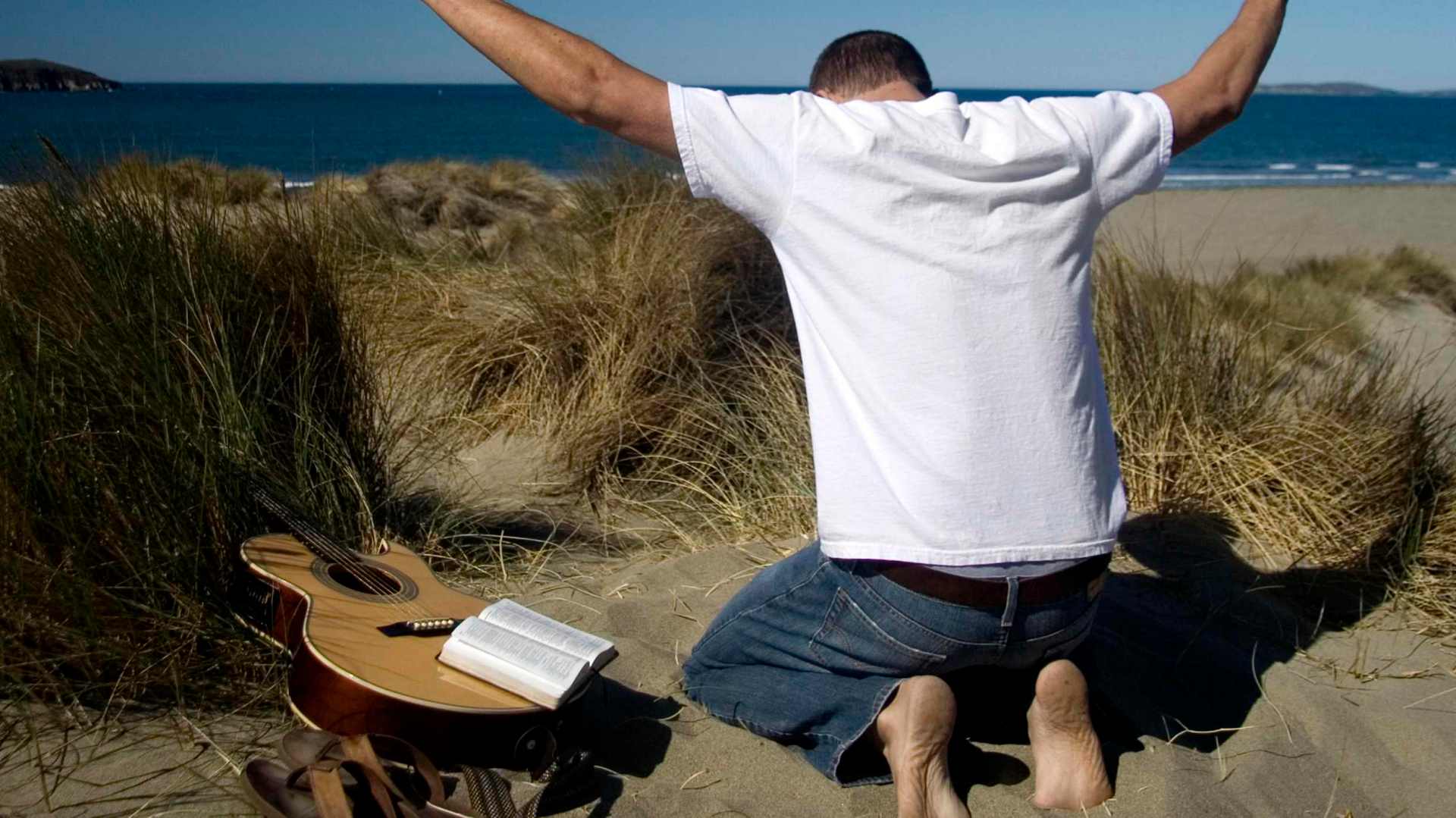
What I love, then, about this otherwise pretty terrible stock image, is that it somehow looks both spontaneous and planned. The sandals are thrown down . . . but, y’know, neatly. The guitar looks casually tossed off . . . but the Bible is carefully propped on top of it. What’s this apotheosis of the White Worship Leader thinking?
Perhaps our friend simply knows what the rest of us know instinctively: that the presence of God is neither something you can plan nor something you can conjure with your own spontaneity. God, after all, can and does move on His own, and He keeps His promise to be present wherever His people are gathered to worship. Like the Chrism service at my local church, we all see it coming on the calendar, and we all dutifully shuffle into the pews—but at the one moment when we hit that perfect, magical harmony, supported by only Breath, it’s nothing short of a miracle.