
Every Christian storyteller has a dilemma. When you want to communicate the history of your people—your church, your denomination, or the church as a whole—how do you frame it? As an encouraging story of corporate faith, courage, obedience, and success? Or a chastening story of God’s faithfulness and mercy despite corporate sin, confusion, and stubbornness?
If you’re casting vision or fundraising, you’ll want the former. Everybody likes hearing their victories celebrated and their sacrifices noted. But if you’ve read the Old Testament recently, you’ll notice how often the latter approach prevails. If anything, the Hebrew prophets and poets go out of their way to replace cheery pep talks with cold, hard looks at human intransigence and divine grace.
The storyteller’s dilemma is how to do justice to both. Simply repeating the encouraging version on loop (or whenever you need money) risks blowing smoke, and Pelagian smoke at that; people will assume their good works have merited God’s blessing. But hammering home the chastening version risks despair and apathy. If we’re all such miserable failures, riddled with incompetence and sin, then why bother?
Scripture provides a fascinating way through. Hidden in the Psalter at the end of book 4 lie two adjacent songs that tell Israel’s story in opposite ways. Psalm 105 gives encouragement, depicting an Israel that never puts a foot wrong. Then Psalm 106 chastens, with Israel getting hardly anything right. If we didn’t know the full Old Testament background, it would be hard to credit both portrayals as true.
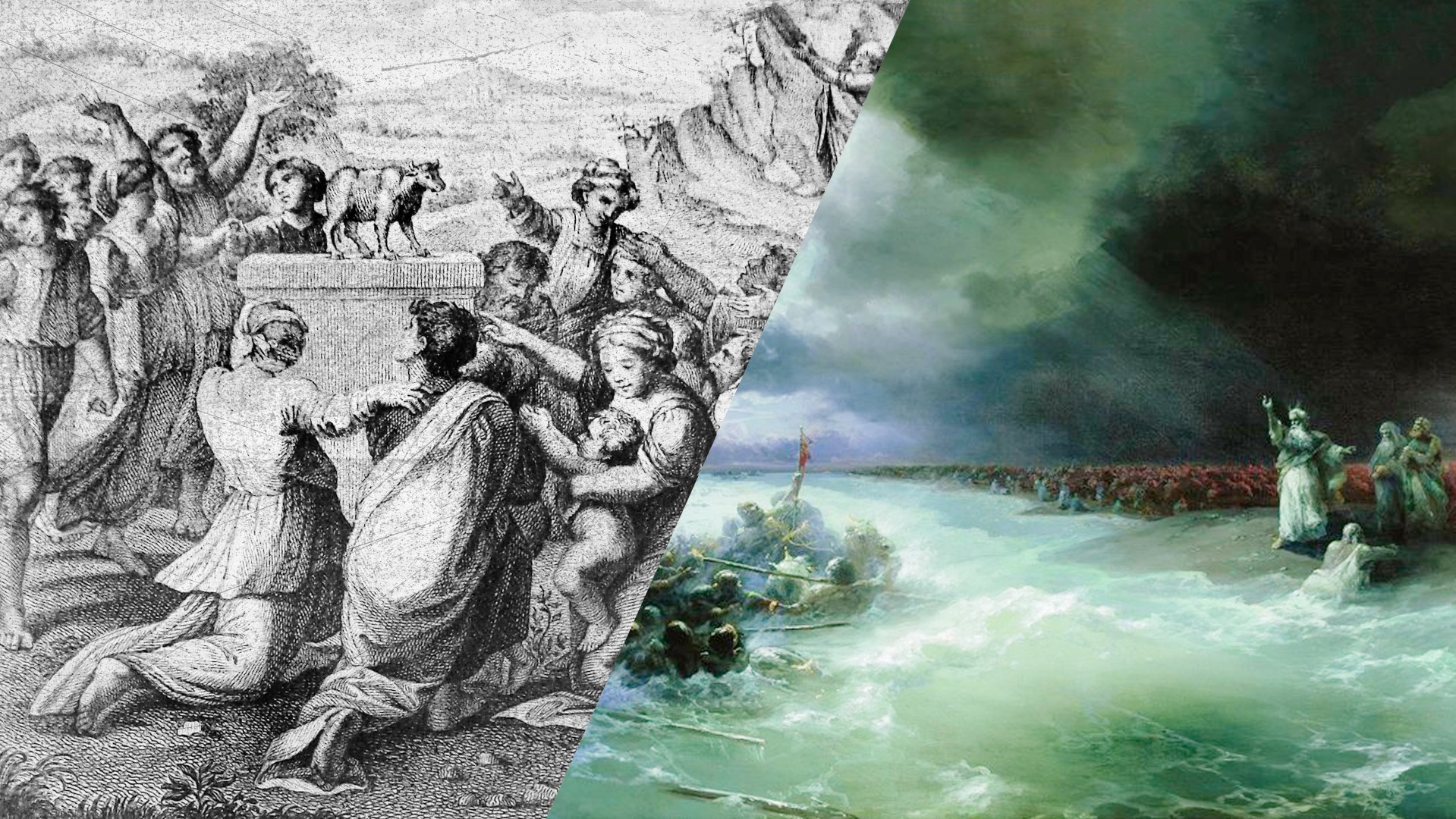
In Psalm 105, the successes of the patriarchs (vv. 7–25), and especially of Israel during the Exodus and Conquest (vv. 26–45), provide reasons to praise God and remember his wondrous works (vv. 1–6). There is no mention of Israel’s failures, of grumbling in the wilderness, unbelief, or worshiping of the golden calf. “They asked, and he brought them quail” (v. 40) is a remarkably generous account of a fairly colorful incident. So is the psalm’s conclusion (vv. 44–45): “They fell heir to what others had toiled for—that they might keep his precepts and observe his laws. Praise the Lord.” It almost reads like a whitewash.
Then we turn the page and encounter a very different version of the story. Psalm 106 is a litany of disasters. “We have sinned, even as our ancestors did; we have done wrong and acted wickedly” (v. 6). Our fathers rebelled by the Red Sea (v. 7). You rescued them, but they quickly forgot about it (vv. 13–15), craving meat and putting you to the test (a rather different spin on the quail story). Our ancestors were jealous (vv. 16–18), idolatrous (vv. 19–20), forgetful (vv. 21–23), unbelieving (vv. 24–27), immoral (vv. 28–31), and disobedient (vv. 32–35)—to the point of sacrificing their children (vv. 36–39). The only reason we have not been destroyed is that God “remembered his covenant and out of his great love he relented” (v. 45).
Reading the two psalms in sequence is discombobulating. It prompts the disturbing question: Which version is true? The answer, of course, is both. Each focuses on some things and omits others, as all stories do. But both are faithful accounts of what happened, and both ultimately have the same objective, with their opening and closing lines calling Israel to praise the Lord. Did Israel trust God for deliverance from Egypt and the provision of land? Yes. Was Israel guilty of all sorts of evils along the way? Yes.
Here lies the solution to the storyteller’s dilemma. There is a place for honoring heroes of the faith and celebrating the courage and generosity that brought us this far. There is also a place for looking our sin and idolatry squarely in the face, acknowledging that God would have destroyed us long ago were it not for his gracious mercy.
We need both stories. When either is neglected, we can slide into a triumphalist hubris or a self-loathing torpor. But when both are told together, with successes appropriately celebrated and failures duly acknowledged—which is roughly what we see in Psalm 107—we are chastened and encouraged as we remember how God’s grace carries us across mountaintop and valley alike.
Andrew Wilson is teaching pastor at King’s Church London and the author of God of All Things. Follow him on Twitter @AJWTheology.