This piece was adapted from Russell Moore’s newsletter. Subscribe here.
Even after several years of unpredicted chaos and suffering, the last three weeks have hit hard.
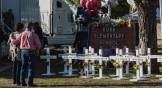
A white nationalist terrorist gunned down nearly a dozen Black shoppers in a Buffalo supermarket. Another shooter attacked a Taiwanese congregation during a Sunday luncheon. And then another brutally murdered 19 children and two adults at a school in Uvalde, Texas.
After each of these horrors, people often ask, “How long until something is done?” And yet, the sad truth in light of all these atrocities is the declining attention span of the American people.
Axios points to research on the sustained attention of the public—showing that horrors like the Sandy Hook shooting or the Parkland school shooting do not rally the nation’s attention beyond a matter of days. Some might suggest that the country is numb to such tragedies since they happen with such frequency compared to the rest of the world.
But Axios argues that what we are seeing is a people not necessarily numb to horror but overwhelmed by it. The sheer weight of all these incidents can lead to a shutdown in many people, in which they simply give up trying to comprehend it all and move on to something else.
In some ways, the country’s response is similar to how individuals sometimes respond to trauma in their own lives. One reason the book The Body Keeps the Score sells so many copies is because it explains a reality that many people experience. Even after we try to forget an awful event—or numb ourselves with alcohol or drugs or career advancement or something else—our response often shows up in other physical or neurological ways. The mind may forget, the argument goes, but the body remembers.
Sustained attention is so difficult with trauma and tragedy because we don’t want to think about such darkness. There’s a reason why most people turn their heads away when they see a mangled body in a car accident along the highway. We would rather pretend that such horrors don’t, or can’t, happen. And we do this not just with the terrors in the world but with our own personal apocalypse—our impending death.
Blaise Pascal argued that we all know we are going to die, so we try everything we can to distract ourselves from that reality. This conclusion, of course, was anticipated by the writer of Ecclesiastes—who admitted his own search for fulfillment through work, wealth, pleasure, and wisdom, only to find these to be nothing more than vain pursuits.
The writer of Hebrews further revealed that this submerged fear of death is precisely the power that the devil has over us (Heb. 2:14–15). To keep from acknowledging that we are perishable flesh, we pursue fleshly desires with abandon—in a way that just leads to more death (Rom. 8:5–13).
The root of our focus on triviality, pleasure, and diversion is not so much hedonism as it is fear (Rom. 8:15). We are afraid of death, so we look for idols to protect us from that—or at least to numb us to its reality (Gal. 4:8–9).
Our tendency to become overwhelmed in the aftermath of so many horrors is heightened by our sense of powerlessness. Even when we identify actions that could curb the problem, we know that almost nothing is accomplished in a civic and political system as broken as ours. And so, many of us simply “move on.”
This principle has a personal parallel too. How many of us have descended into patterns and habits we know to be wrong and self-destructive because we have given up on pursuing virtue and health? Once a person concludes that he or she is a “lost cause,” with no hope for change, the path ahead is bleak.
Yet a response of overwhelmed numbness can lead to more people getting hurt. Jesus continually confronts us about the ways that we want to look away from the hurting, whistle past injustice, and make the suffering invisible. The sores of Lazarus were no doubt unsettling to the rich man who passed by him each day at his gate (Luke 16:20).
It was easier for the leaders to accuse the blind man of bearing punishment for his own sin than to acknowledge that blindness can happen (John 9). In fact, these leaders were so callous to the blind man’s plight that the problem, for them, became not his suffering but his healing.
We are indeed overwhelmed by much darkness, all around us and inside us. Sometimes we will disagree on the exact steps to take to address the problems. And there will always be powerful forces around who don’t want us to address them at all. So, we just “move on” until the next horror—after which we will move on again.
As the people of Jesus, we dare not fall prey to that tendency. Jesus, after all, is the one who never turned away from even the most terrifying realities—leprosy, bleeding, and suffering of all sorts. One of the most remarkable things about Jesus is not just that he healed those who bore great difficulty but that he saw them in the first place. He sees us.
Jesus moves on, but not without carrying a wounded sheep on his back. We should go and do likewise.
Russell Moore leads the Public Theology Project at Christianity Today.