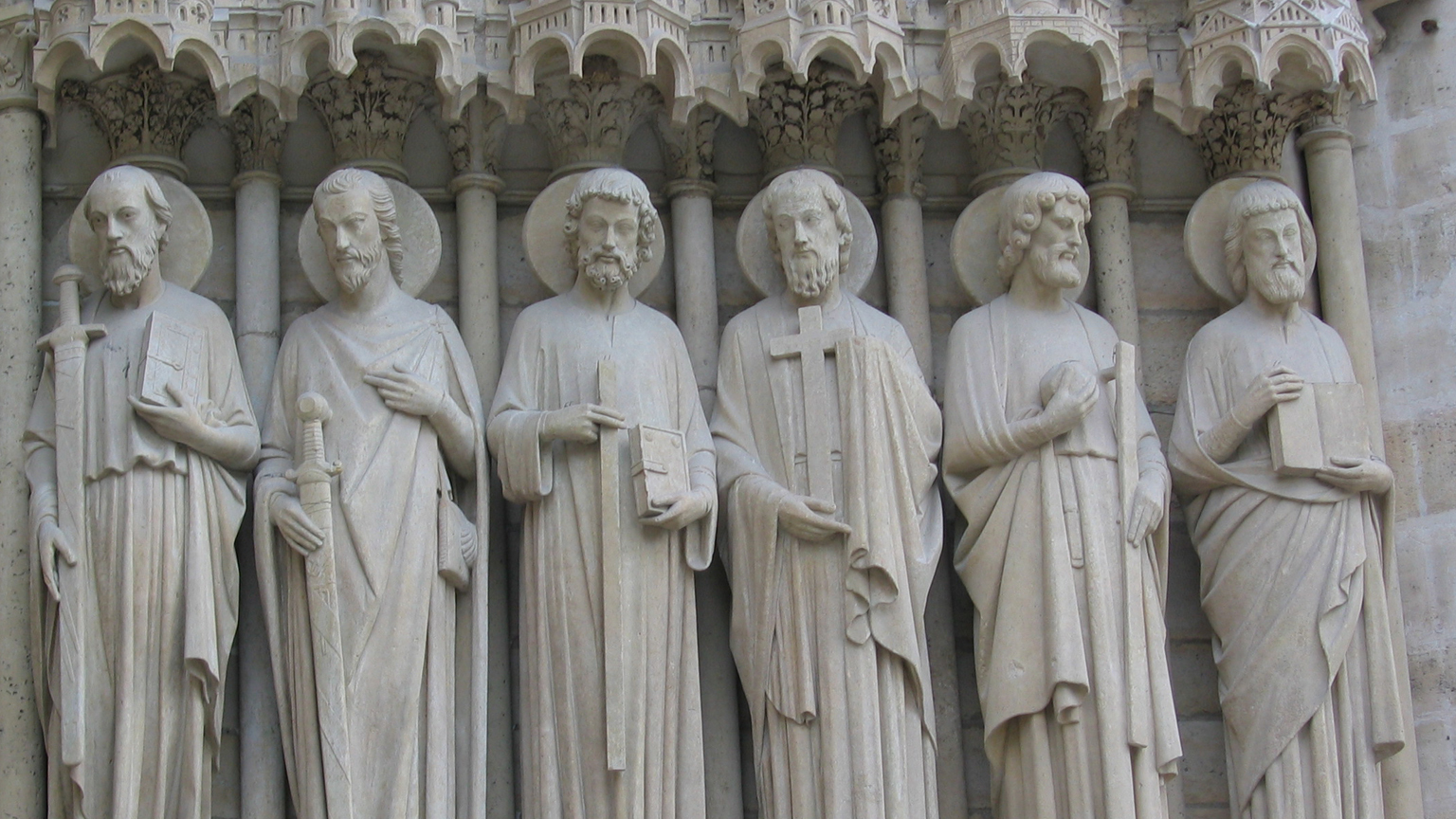
How do we know that every apostle except John died for his faith, and are those sources reliable?
—Hillary
The tradition of apostles' martyrdom goes back at least to the beginning of the third century. In his third commentary on Genesis, Origen of Alexandria (ca. 185-254) writes that the apostles divided up the work of evangelizing the world between them—Peter, for example, took Pontus, Galatia, Cappadocia, and Bithynia, and at “the last came to Rome, and was crucified head-downwards; for he requested that he might suffer thus.” According to Origen, other apostles went elsewhere; Thomas was assigned Parthia (today’s India), and John was given “Asia.”
Scholars debate as to where Origen picked up his information—some argue that he drew from the roughly contemporary Acts of Thomas, an apocryphal book relating Thomas’ adventures as a missionary in India. That book states that Jesus’ original 11 disciples “divided the countries among them, in order that each one of them might preach in the region which fell to him and in the place to which his Lord sent him.”
But there are other sources to consider as well. Eusebius (ca 260-341) wrote perhaps the most complete history of the apostles, though he merely quoted other bishops for his authority. Acts 12: 2 tells us, for example, that Herod Agrippa had James, the brother of John, executed. To this, Eusebius adds the story told by the bishop Clement of Alexandria (d. ca. 215)—Origen’s mentor—that “the person who led James to the judgment-seat was moved when he saw him bear witness, and confessed that he himself was also a Christian.”
Or take the death of Philip, which bishop Polycrates of Ephesus (130-196)—again via Eusebius—wrote that Philip “has fallen asleep in Hierapolis, [as have] also his two daughters who grew old in virginity.” It’s debatable whether Polycrates actually meant Philip was martyred, since he also mentions that the apostle John “has fallen asleep at Ephesus.” (Tradition has it that John died peacefully in his old age, after being returned from his exile in the island of Patmos.)
Are these sources reliable? Can Christians stand on the testimony of these early church fathers to make the case for these martyrdoms? We can, if we accept that in the first couple centuries of the church, much of the Christian story was passed on by word-of-mouth, and bishops of the church would guard these stories zealously—especially with heretical sects threatening the church.
*If you’re looking for brief summaries of the apostles' missionary journeys and martyrdoms, check out The Martyr's Mirror, a 17th-century Mennonite panorama of Christian martyrs.