 Courtesy image / Amazon
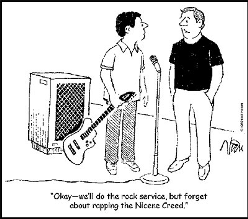
The Church Laughs e-newsletter frequently brings me a chuckle. A couple of years ago the lead cartoon featured a pastor talking to his worship leader. "Okay," says the pastor to the guitar-clutching musician. "We'll do the rock service, but forget about rapping the Nicene Creed." (Oh, the challenges of "blended worship"!)
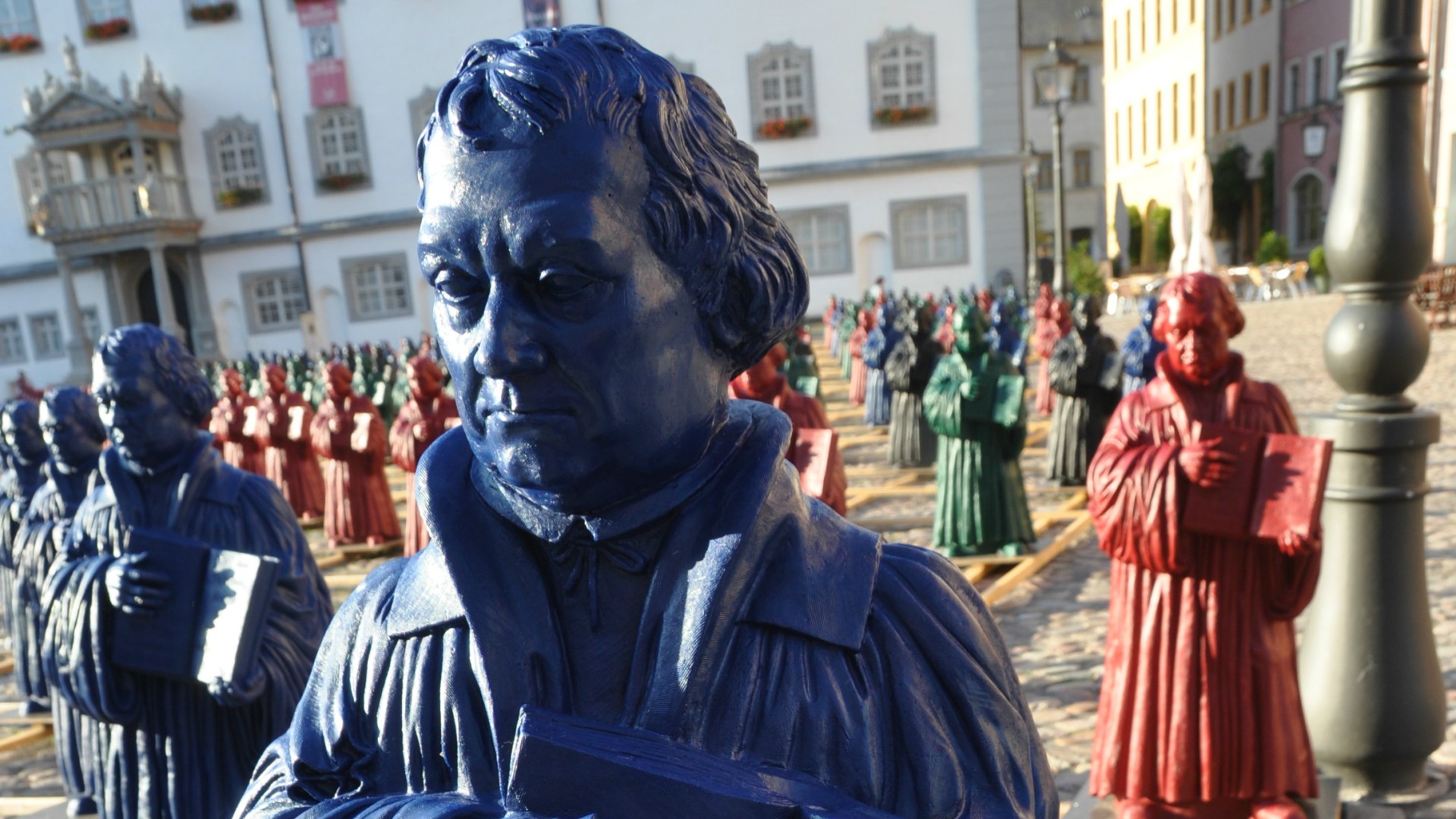
As soon as I had chuckled at the cartoon, I realized there was a historical precedent. Others had already had set the creed to rhyming, rhythmic verse, hoping to make it memorable for worshipers. Tobias Clausnitzer (1668) and Cyril V. Taylor (1941) are among the lesser known writers to attempt this. The most famous was clearly Martin Luther ("We All Believe in One True God," 1524).
Now Martin Luther didn't write rap. Rap is not just rhyme and meter. Rap is also improvisation (and therefore a vehicle for personal statement and an opportunity to show off just a bit).Yet Luther, like rappers, placed a premium on the words over the music. Among his many hymns were didactic songs that helped the people learn their faith.
Luther's Shorter Catechism is well known as a brief and digestible guide to the faith. It was organized around what he considered the basics: The Ten Commandments, the Creed, the Lord's Prayer, Baptism, Confession, and the Sacrament of the Altar. If one understood these things, one could be an informed believer. One would be equipped to understand the gospel and to resist superstition.
It isn't surprising then that Luther would also write a hymn to convey each of these truths. The American Edition of Luther's Works comments on his Ten Commandments hymn ("These Are the Holy Ten Commands"):
We have become so accustomed to think of poetry as an expression of the personal feelings and emotions of the writer that we cannot conceive of a merely "utilitarian" use of poetry. Hymnody in our own age has been defined as "lyrical religion." We find it difficult to think of a merely didactic hymn without sentimental overtones.
But Luther proceeded from different premises. Very soberly he thought of the hymn as a means of instilling the Word of God in the people. While some of his hymns were born out of his most personal experience and reflected the struggles and victories of his own faith, others were mere versifications of the Catechism.
His setting of the Creed seems a little less didactic than the Ten Commandments hymn, because it is the bold declaration of a common faith.
We all believe in one true God,
Maker of the earth and heaven,
The Father who to us the power
To become his sons hath given.
But the didactic purpose is still blended with the joyous celebration of truth.
Luther relied on an earlier medieval attempt to versify the Creed, but that poem tried to cover the creed in a single stanza. Luther expanded the structure to three stanzas to reflect the three parts of the Creed, one for each person of the Trinity. That larger structure required more material, and so he infused the hymn with additional truth (as in the brief excerpt above, where he inserted the idea from John 1:12 that we have been given the power to become children of God).
Luther wasn't just interested in teaching the faith; he was interested in teaching the young. He was worried about the things that seduce young people away from the faith. And so he explained in a preface to a 1524 hymnal:
These songs were arranged in four parts to give the young – who should at any rate be trained in music and other fine arts – something to wean them away from love ballads and carnal songs and teach them something of value in their place.
That makes him sound like one of the architects of Youth for Christ in the 1950s!
P.S. So what do I think about rapping the Creed? Well, the main thing I have against it is that rap isn't a communal form of expression, while the Creed is the statement of a community of belief. But if we all had a good enough sense of rhythm, we might be able to rap it together.
Concordia Publishing has published a 4-CD set of Luther's Hymns, Ballads, and Chants. You can here a short bit of "We All Believe in One True God" here and another excerpt of "These Are the Holy Ten Commands" here.
This blog post adapted slightly from a Nov. 27, 2007, posting on the Ancient Evangelical Future blog, applying the 2006 Call for an Ancient Evangelical Future and the legacy of Robert E. Webber to the life and mission of the church in North America.