




The Luddites were a band of British millworkers who destroyed laborsaving textile machinery because they thought the machines would steal their jobs. I think they were on to something. But it’s not my job I’m worried about; it’s my soul. That’s why I refused to buy a cell phone until my wife finally made me.
And that’s why I hoped Shane Hipps would roundly denounce electronic media in Flickering Pixels: How Technology Shapes Your Faith (Zondervan, 2009). Alas, he doesn’t. Instead, he intends the book to “[train] our eyes to see things we usually overlook”—in this case, the way media affects how we perceive ourselves and God and ultimately alters the message of the gospel.
Flickering Pixels is Hipps’ second book on the influence of media, and it covers some of the same ground as The Hidden Power of Electronic Culture (Zondervan, 2005) but is a bit more accessible and intended for a broader audience. The profound truth at the center of both books turns conventional wisdom on its head. Following Marshall McLuhan, Hipps insists that the medium is the message. For Christians, that means that when we articulate the gospel through different media, we essentially “reshape the gospel.”
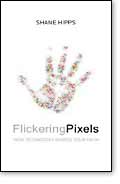 |
Flickering Pixels: How Technology Shapes Your Faith Shane Hipps Zondervan, 2009 208 pages; $16.99 |
Consider this: Before the majority of people could read, the Church emphasized Bible stories that could be communicated through illustrations and stained-glass. This meant they privileged the Four Gospels over the theologically weighty Epistles. However, literacy spread with the advent of the printing press, and with it the expectation that most people would think abstractly. This is both good and bad. On the one hand, it made the Protestant Reformation possible. On the other, it made it easier to reduce the gospel story to a system of doctrines.
Writing “technology” has other consequences. Print erodes the human need (and capability) for memory. Before things were written down, people had to remember stories and information accurately in order to transmit them accurately. Remembrance and transmission was a communal affair. But reading is intensely private. Thus print encourages individualism as it rewires the way the brain processes information.
Visual media, of course, rewires the brain again—this time away from abstract thinking, which is both good and bad. You can see where this is going.
Hipps doesn’t tell us how to feel about technology. He simply wants his reader to be aware that because every technology re-creates us in some way, the real danger is ignorance. Hipps is a success; he lays the issues out in plain and engaging language that makes it clear that media is anything but neutral.
At the close of every chapter, Hipps includes a brief discussion of implications and application of the material he just covered. And, in the final chapter or two, he offers something of an answer to the question, “Where do we go from here?” But for the most part, he leaves the reader to draw her own conclusions.
This means that pastors will benefit from Flickering Pixels best if they take the time to ponder the questions it raises: How might the ways we communicate the gospel to our congregation—in print, person, and online—influence the content of the gospel? Should we be preaching or teaching differently to counteract the ways new technology changes our people’s perception of the gospel? And a question Hipps addresses: What does it mean that Christ—and now his church—is both the medium and the message?
Shane Hipps has tapped a rich vein that now needs to be mined with greater care. The book should be read and discussed in community. If I could do it over again, I’d read Flickering Pixels with a friend or staff member, so I’d have someone to ask, “What did you think of that? What’s next?” After all, the Christian community is a medium itself, that must carefully consider how to communicate its most important message—the gospel.
Copyright © 2009 by the author or Christianity Today/Leadership Journal.Click here for reprint information on Leadership Journal.