



 The following story was shared by Ed Salmon, a pastor from South Carolina, who passed away in 2016:
Just yesterday, I went out for lunch. When I got to Forest Park, there's usually a homeless man or two standing there, and there was this terribly disheveled man standing there with his sign, "I'm homeless." And of course, he was going by the cars, and nobody looked at him. He got to my car, and I rolled down the window, and I said, "I don't have any money with me, but my wife is going to take me to the airport in about an hour and a half, and I'll have something for you then. And do you know what he said to me? He said, "Thank you for looking at me." Didn't say a word about money. He said, "Thank you for looking at me."
Salmon then gave the following charge to his fellow ministers (although this can apply to every Christian): "You see, the Good Shepherd is raising you up so that the world you minister to can look at you and say, "Thank you for looking at me, because in that, I see the glory of God."
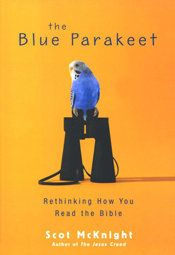
For Scot McKnight, the title creature in his recent book The Blue Parakeet represents biblical passages (and personal experiences) that make us think all over again about how we are reading the Bible. For example, evangelicals tend to be fairly lax about resting on the Sabbath (whether we observe the right day is another question). Yet in the Decalogue God says, “Remember the Sabbath day and keep it holy.” Our task as Bible readers is to decide whether this is a valid command for today or a context-specific regulation that we can more or less ignore. How you answer that question says a lot about your understanding of biblical interpretation.
McKnight hopes his book will help us recognize that all of us pick and choose which of the Bible’s commands apply to us and which ones do not. It’s not a how-to manual for exegesis. But it offers insights into three foundational principles of biblical interpretation.
In the first section, McKnight identifies five approaches or shortcuts that cause Christians to misread the Bible. (You can read about those here.) McKnight’s solution is reading the Bible, from Genesis to Revelation, as a single story. Each of the 66 books in the middle serves as a wiki-story–an individual, unique retelling of this main story. This is a key principle for McKnight, because it helps us understand why some commands apply for all time and others don’t (this becomes clearer in the example below).
In his second section, McKnight explores what it means to “listen” to the Bible. He begins by making the excellent point that Christians must have a relationship with the person of God, not with the Bible itself.
In the third section, on “Discerning”, McKnight argues that the key phrase for biblical interpretation is “that was then and this is now.” Here, again, application is the main goal; the discernment process is when we decide how (or if) a passage of Scripture can be put into practice in the present.
He continues by addressing several biblical issues about which discernment is necessary and describes some principles Christians use to determine how to apply the passages that deal with them.
Part 4 is a long case study of discerning the Bible’s teaching on “Women in Church Ministries Today.” This section uses the principles from the other sections–story, listening, and discerning–and introduces a few tools that go unmentioned for the rest of the book, things like original-language research and extra-biblical resources that help construct historical context.
The Blue Parakeet is a great introduction to the challenges and pitfalls of Bible interpretation. It raises some difficult and necessary questions, but it leaves a few hard ones unanswered. You can read my take on the book’s strengths and shortcomings here.