



 Are Americans becoming less religious? It depends on what you mean by "religious." According to an article in the New York Times, there's plenty of evidence to suggest that the "religious mind" is still very much alive. The article notes:
Consider that roughly 30 percent of Americans report they have felt in contact with someone who has died. Nearly 20 percent believe they have been in the presence of a ghost. About one-third of Americans believe that ghosts exist and can interact with and harm humans; around two-thirds hold supernatural or paranormal beliefs of some kind, including beliefs in reincarnation, spiritual energy and psychic powers.
These numbers are much higher than they were in previous decades, when more people reported being highly religious. People who do not frequently attend church are twice as likely to believe in ghosts as those who are regular churchgoers. The less religious people are, the more likely they are to endorse empirically unsupported ideas about U.F.O.s, intelligent aliens monitoring the lives of humans and related conspiracies about a government cover-up of these phenomena.
One of my first editorial assignments–long before I was actually an editor–was helping my pastor grammar-check and proofread a small-group workbook he developed for use in our congregation. The editing process was a joy; but the real treat was working through the material with my small group.
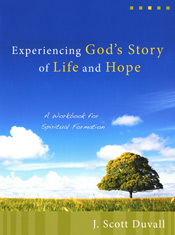
That curriculum, titled Experiencing God’s Story of Life and Hope, by J. Scott Duvall, is now available for use in your church. And I highly recommend it. The workbook leads a small group through 12 topics of theology, including the authority of the Bible, the Trinity, the human condition, sin, and the church. What makes it distinct is that every topic consists of three parts: Believing, Behaving, and Becoming.
In the Believing section, readers are introduced to an important theological concept. Let’s take the first one, for example: the Authority of the Bible. In the Behaving section, they explore a behavior that results from our theological convictions on the subject–in this case, studying the Bible. In the Becoming section, readers are directed to the spiritual formation that results from believing and behaving according to those convictions. Regarding the Bible, they become people characterized by truth.
The great value of this resource is that it brings together two often exclusive disciplines–theology and spiritual formation–and it does so in a way that is completely accessible. There were people in our small group who had considerable theological training and some who had none. But all of us were equally challenged and equally equipped to engage the material. As you’re planning your small group for 2009, you’d do well to consider Experiencing God’s Story of Life and Hope.