 When NASA posted a job opening for a "Planetary Protection Officer," a position responsible for the microbial footprint of humans during interplanetary exploration, word about the "coolest job ever" was picked up and spread widely by the media. Of course, the position has extremely stringent qualifications and demands an expertise in just about every discipline of science possible: physics, biology, chemistry, mathematics, and engineering.
However, those requirements didn't stop 9-year-old Jack Davis from submitting a handwritten note to NASA as his application. "I may be nine but I think I would be fit for the job," wrote Jack. "One of the reasons is my sister says I am an alien. Also, I have seen almost all the space movies and alien movies I can see." He then cited his plans to watch Men in Black as further reason why he should get the job. "I am young, so I can learn to think like an alien," he concluded. Although the informal application did not result in a job offer, it did merit a response from NASA's Director of Planetary Science Jim Green, who wrote back: "We are always looking for bright future scientists and engineers to help us, so I hope you will study hard and do well in school. We hope to see you here at NASA one of these days."
Potential Preaching Angles: We may have trouble remembering this, but in his perfect sovereignty God does not need us to accomplish his will. However, through his grace and love for us, he chooses to allow us to help build his Kingdom on Earth-like a parent with a toddler, or NASA with a fourth grader. May we all have childlike faith to pursue his Kingdom eagerly and faithfully.
By Summer 2008, nearly everyone had heard of The Shack. Not long after that, nearly everyone had read it; William Young’s runaway first novel has been on the New York Times Best Sellers list for months.
Back in June, I wrote a short survey of the response The Shack was eliciting from theologians and pastors. As you can imagine, for every word of praise for the novel, there was a criticism. No doubt you have heard both from the people you minister to.
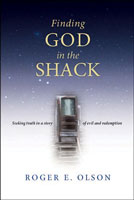
If you’re still uncertain what to make of the book, help may be on the way. Roger Olson’s Finding God in the Shack: Seeking truth in a story of evil and redemption (IVP, February 2009) is an effort to address the major theological questions the novel raises. Here are some chapter titles: “Where is God in Senseless, Innocent Suffering?” “Is God Really a Family of Three?” “Can God Be in Charge but Not in Control?”
Olson addresses several places he believes the novel can be misleading. But overall, he finds a helpful, and theologically sound, message of hope and truth in The Shack. You can take a look at Finding God in the Shackhere.
In the meantime, I’d love to hear what you think of The Shack and what resources you’ve used to help the people you minister to interact with it.