Planting trees. Ah. One of life’s most satisfying experiences. When my wife and I decided to buy a house, we couldn’t wait. Literally. The place was vacant. Who would know? So a full week before the real estate closing, Susan and I bought four small fruit trees and boldly carted them into the back yard that was soon to be ours.
We dug holes, added top soil and peat moss, and planted our mini-orchard: two apple trees and two pear trees. It was an act of faith. They were scrawny saplings, but I could already taste the fruit they would eventually bear.
Standing back to admire our work, I quoted the line attributed to Martin Luther. When asked what he would do if he knew he was going to die the next day, the robust Reformer replied, “I would plant a tree.”
A week later, the house and the yard were legally ours, and the saplings were already taking root.
Over the next few years, we planted more trees: arborvitae for privacy, Colorado blue spruce for greenery when snow covers the ground, sugar maple for brilliant fall foliage of reds, orange, and yellows.
I fully subscribe to the folk proverb: “The best time to plant a tree was 20 years ago. The second best time is now.”
When we grieved the deaths of two of our children, four years after moving into the house, we planted memorial trees-two flowering crabs that burst into bloom each spring, an annual symbol of resurrection that reminds us that out of death comes new life.
We’ve been in the house more than 16 years now, and the trees continue to bear fruit (some seasons in abundance, some seasons not at all). They continue to provide privacy, shade, greenery, fall color, and an annual celebration of new life.
Planting trees also represents to me the process of raising new leaders within the church.
Yes, new leaders will emerge, whether we do anything about it or not. But the quality and usefulness of new leaders, like trees, is usually enhanced when they are cultivated and well-placed.
The years that I neglect the spraying, pruning, and nourishing of my fruit trees are the years that the fruit is poor and worm-eaten.
Likewise, I’ve seen churches whose leaders have not been cultivated, and their fruit is bitter and hard. They do things “the natural way,” which usually means either naivete or selfish exercise of power.
Churches that take seriously the need for fruitful leadership in the days ahead begin cultivating leaders now. Yes, the best time to develop leaders was 20 years ago. The second best time is now.
Identifying and developing emerging leaders is an act of faith. It may be several years before we enjoy the fruit. But by cultivating healthy Christian leaders, we help fulfill Christ’s Great Commission to make disciples of all nations.
I’d like to think that if someone asked what I’d do if I knew the next day I was going to die, I’d have the grace to say, “I’d keep cultivating Christian leaders.”
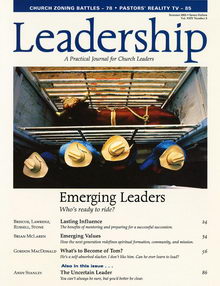
That’s what a journal named Leadership is always about. But it’s especially true of this issue, which spotlights the wisdom and experiences of those who are identifying, placing, and cultivating today’s emerging leaders.
When leaders are well placed, it means they get the nourishment they need. They are, as Psalm 1 puts it: “like a tree planted by streams of water, which yields its fruit in season and whose leaf does not wither.”
Cultivating means doing the necessary pruning, staking, and protecting that keeps emerging leaders growing in the right direction, not squandering strength by branching out in unfruitful directions.
Sometimes those who cultivate leaders stay around long enough to enjoy the result. Other times the investment is made for people we will never meet.
“The true meaning of life,” wrote Nelson Henderson, “is to plant trees under whose shade you do not expect to sit.”
Whether you’re an emerging leader or a cultivator of them, you’ll find help here before you leave.
Marshall Shelley is editor of Leadership.
Copyright © 2003 by the author or Christianity Today/Leadership Journal. Click here for reprint information onLeadership Journal.