



I have to give Stacy credit. It takes courage to speak directly to the pastor about a fault with his sermon. Most church members prefer to spread their criticism peripherally around the congregation. Stacy chose the narrow way.
She was upset with a quote I used. It came from a Christian author whom I credited in my message. “He’s a part of the emerging church,” she said with disdain. “And the emerging church is heretical.”
“First of all,” I asked, “did you disagree with the content of the quote?”
“No, I’m just upset that you would quote a heretic,” she answered.
“Stacy, I can assure you the leader I quoted is not part of the emerging church. And even if he were, not everyone associated with that is automatically a heretic.”
“Sure they are,” Stacy insisted. “Chuck Colson said so, and he’s on the radio.” The words “and you’re not” were absent from the end of her sentence but present in her tone. I didn’t bother challenging her interpretation of Mr. Colson’s comments, which I suspected was flawed, nor did I defend the reputation of the author I had quoted. I knew I’d lost this battle.
This radio show had more authority in Stacy’s life than I did. What authority I possessed had been built through years of sound teaching and the vetting of denominational leaders. But it was no match for the authority granted by Stacy to a speaker she heard on the radio.
In marketing lingo it’s called platform. The logic is simple—the magnitude of your platform determines the scope of your authority. Someone with an audience of one million has more authority than someone with an audience of one hundred. The assumption: the larger platform is a result of the person’s competency, intelligence, or character. That, of course, is not always the case.
Today authority is granted to those who have simply proven they can build a platform. Consider Oprah Winfrey. No doubt she is very competent when it comes to the media business, but I’m guessing the Queen of Talk is a lot less savvy about digital cameras. Still, when she featured a new Nikon on her “Favorite Things” show and called it “one sexy camera,” it started to fly off store shelves. Why? Platform. Millions of people listen to Oprah, so she must be right … even about digital cameras.
How does this relate to pastoral ministry? Authority is best established through proximity—being in close personal contact so that trust can be built. Marriage is an example. A man and woman in proximity over time (a.k.a. dating) develop enough trust to then commit to life-long mutual submission (a.k.a. marriage). This is what Paul has in mind when he tells Timothy to choose leaders who are respected by all, and who have proven their faithfulness over time (1 Tim. 3:1-7). Authority is predicated upon knowing those we submit to.
Sadly, as our culture’s capacity to engage and maintain meaningful relationships has deteriorated, we have seen a rise in celebrity-based rather than proximity-based authority. This same trend is evident within the church. Just because someone has an expansive ministry doesn’t mean we should automatically grant him authority over our life, faith, or congregation. As many entertainers, politicians, and church leaders have proven, it is possible to build a large platform and yet lack the character, intelligence, and competence to influence others faithfully.
Still, we foolishly think that gaining more Twitter followers, Facebook friends, church attenders, or podcast subscribers will prove our value and grant us more authority. And we may be right, but it will be a shallow authority based on the size of our platform rather than the gravity of our soul.
And in the process we will miss the opportunity to establish the more hardy and biblical kind of authority that comes when we spend our time in close proximity with those we are called to lead.
This is where I had failed with Stacy. In my time at the church, I’d had little personal contact with her or her family. Because my proximity had not established much authority in Stacy’s life, celebrity entered to fill the vacuum.
The solution is not to strive for a bigger platform by getting on the radio or selling more books. The antidote to celebrity-based authority is the quiet power of pastoral presence.
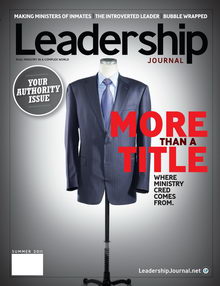
Skye Jethani is senior editor of Leadership Journal and author of With: Reimagining the Way You Relate to God (Nelson, 2011).
Copyright © 2011 by the author or Christianity Today/Leadership Journal.Click here for reprint information on Leadership Journal.