



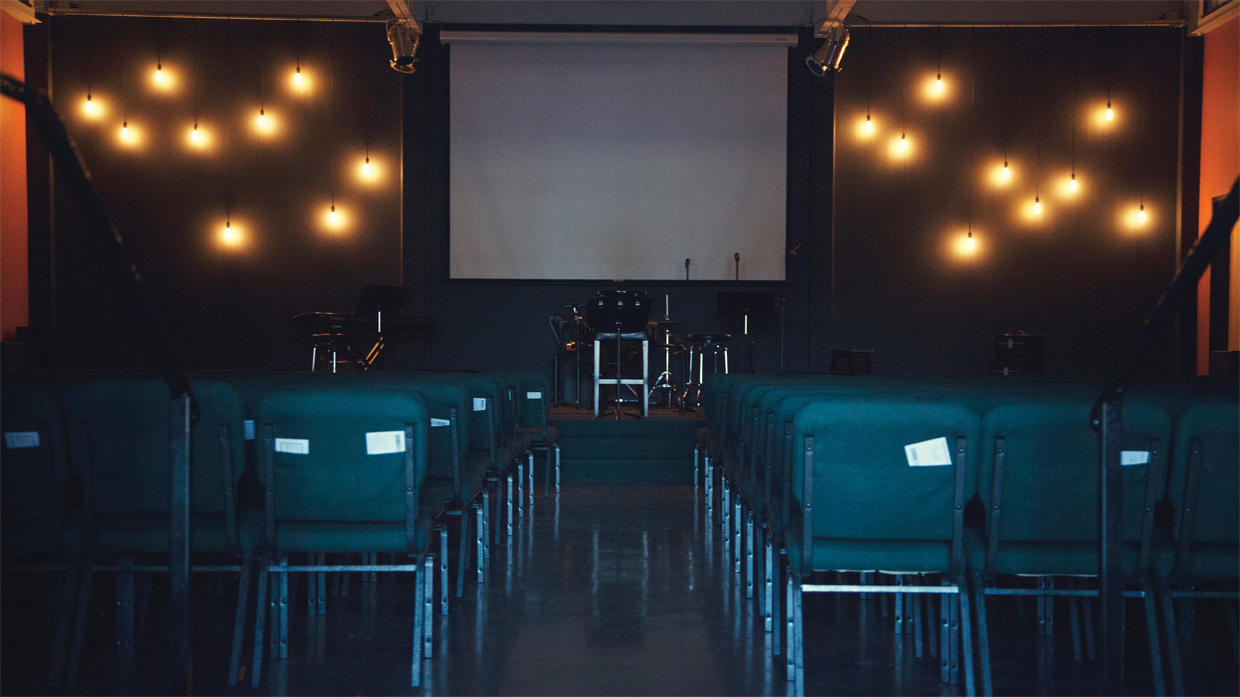
On a Sunday morning in Raleigh, North Carolina, The Summit church attendees filter out and into the doors of the North Raleigh campus, departing from the 10 a.m. service or arriving for 11:30 a.m. worship. A worship band plays Chris Tomlin songs and a few originals, the lyrics splayed on a broad screen for the 150-200 attendees.
A short video testimonial transitions from the worship, and as the video winds down, senior pastor J.D. Greear appears on-screen, asking for "all our campuses to put your hands together."
At the Brier Creek location, one of six other campuses, Greear preaches live at four of the Saturday evening and Sunday morning services, but the 11:30 a.m. service is pre-recorded. At the end of Greear's sermon, the worship leader for the North Raleigh campus returns to the stage and taps out a piano accompaniment to Greear's prayer.
Visitors are caught off-guard by the virtual model, and some don't return. It's "too weird," some say, to have a pastor teaching from afar. They want a more tangible teaching experience.
The Summit is a frequently cited model of success for multisite churches—single church bodies made up of campuses that meet in several locations. Many of these choose to present their sermons through video during the service.
While some churches handle growth by dividing, sending, or expanding, the multi-campus model has exploded in popularity in the last decade.
In 2012, a Duke University study found that about 5 million U.S. Protestants worship at more than 8,000 multi-campus churches of all sizes, although about 90 percent are made up of more than 500 congregants.
Pastors are still figuring out the best strategies for being present among their members. While Greear speaks through video, Tim Keller rotates preaching at Redeemer Presbyterian sites in New York City on an unpredictable basis. Campus pastors preach when he is at the other locations.
The Freedom to be Present
One growing method includes various hybrids of live-teaching and video presentations.
Willow Creek Community Church in South Barrington, Illinois, is led by Pastor Bill Hybels and launched their first of six regional campuses in 2001.
When they surveyed congregants about their spiritual growth in the church, leadership discovered that although members desired to come for the teaching, attendees farther than a 30-minute drive struggled to be active in church life.
In response, the church continued to plant campuses where needed. Now, Hybels or another teacher broadcast to 25,000 people across the Chicago suburbs on a given Sunday.
According to Steve Gillen, acting as a campus pastor frees him up to be fully present among his congregation.
According to Steve Gillen, who has pastored at the North Shore campus for seven years, acting as a campus pastor frees him up to be fully present among his congregation. He feels relieved from the duties of teaching and can instead disciple and care for members in their homes. At least eight weeks out of the year, he takes the opportunity to pastor from the pulpit as well.
"It frees me up to spend time with people," he said. "From a discipleship standpoint, you can reprioritize your time in ways that aren't [focused on] sermon prep."
Chuck Milian, the senior pastor at Crossroads Fellowship Church, a non-denominational church in Raleigh and Wake Forest, advocates for several locations.
He's pastored for 15 years at Crossroads. As it flourished in the '90s, the staff kept adding satellite rooms. Finally, in 2010, they added a second location and now serve 10,000 active participants.
Under their model, he and his associate pastor preach at those two locations under the same outline with their own personal style.
"We were able to reach a whole new demographic," Milian said. "And we were close enough that they could be part of an active church life."
The Challenge of Presence
Of course, it's not always easy to convey adequate pastoral presence equally to every church campus.
"Don't underestimate how hard it is for people to grasp multisite," Milian said. "It's a shift in thinking. Every time you have a recognition, event, commissioning, or short-term teams (for mission trips) you have to think about how do this at both campuses."
Their most significant challenge, Milian said, was cultivating new habits. It took his team about two years, after six months of training, to reach the new mindset.
Lisa Martin and her husband began attending Crossroads around the same time their new Wake Forest campus launched in 2011.
For her, a temporary simulcast set-up combined with the initial launch at a high school auditorium made the adjustment challenging, even as the church slowly transitioned into a live-preaching format.
Still, Martin feels that pastoral presence that is felt beyond the church building, and finding both pastors accessible is equally as valuable as the method of their teaching.
"They have a way of communicating that is relatable … they are very reachable. Very real … like someone sitting down across the table," she said. "I always felt acknowledged."
The Intentionality of Presence
While charisma doesn't hurt in a simulcast situation, pastors can find other ways to be intentionally available for members.
"The little things help too," Milian said. "In the old days, the pastor would stand at the door at the end. I stand at the beginning, shaking people's hands, praying with people, meeting their families. People feel like I'm accessible. Afterward we're up front, and people come up for prayer."
The Summit's model is to keep Greear as the teaching pastor, and several "discipleship elders" who come alongside the campus pastors at the seven locations. Under each campus pastor, dozens of small group leaders disciple their members.
The campus location is limited, too—after a certain number of miles away from the Brier Creek location, the church becomes an autonomous plant rather than another campus.
Milian argues that for Crossroads, each additional campus creates more leaders who are able to convey presence in their respective context. For him, especially with a church location in a seminary town, mobilizing leaders is more on his mind than attempting to be everything to everyone.
"I don't build the church around me," Milian added. "The church is about God. I'm dispensable. I don't lead by myself."
In the future, Milian has no intention of slowing the spread of Crossroads Fellowship campuses and hopes to add another campus within the next three years where there is a need.
"We have centralized support systems, so it's less difficult and costly," he said. "Church planting is good, but this is what we feel God is calling us to do. Having different campuses in the Triangle (Raleigh-Durham) enables us to reach more people without having to duplicate more things … we're not reinventing the wheel."
Meanwhile, Gillen points out that multisite is still a new model—a "brand-new innovation in church history"—so leaders should be alert as it shifts and evolves.
"All of us should be watching—what's the 50-year plan?" he said. "But for a 15-year plan, it's great."
Kara Bettis is a Releigh, North Carolina, based reporter and a regular freelancer for Relevant Magazine, Christ and Pop Culture and others on topics of faith, politics, and culture.
Copyright © 2015 by the author or Christianity Today/Leadership Journal. Click here for reprint information on Leadership Journal.