



Years ago I worked for a visionary pastor who saw ‘the city on the hill’ that he believed our church could become and then he proceeded to lead us there. Using his preaching, pastoral care and personal charisma, he got everyone – or nearly so – focused on the one main goal of impacting our city for Christ. And because of his single-minded devotion, in time his vision became a reality. The church prospered, the community was blessed, and hundreds of lives were touched with the Gospel.
 Cameron Perrin, a 26-year-old software engineer, talks about his experience with the productivity hack known as "monk mode:"
As a person who can easily fall into procrastination and a lack of focus, I found myself constantly struggling to achieve my goals — and I couldn't afford to be so distracted. Every workday, I would start strong but would soon get derailed by scrolling social media, reading articles, or just aimlessly browsing the Internet. By the time I caught myself, my train of thought would be gone and I'd have to spend five minutes just figuring out where I left off.
Then I came across an article about "monk mode," which is a method for giving your full attention to whatever you are working on for a set period of time. (The article describes “monk mode” as adopting the isolation and self-discipline practices of monks).
I began by committing to two-hour blocks of monk mode at a time. I eliminated as many distractions as I could. I turned off my phone notifications and blocked social-media sites on my laptop since I knew I was spending way too much time on these activities. I calculated I was (wasting) one to two hours a day. And when factoring in the time it would take to refocus and pick up where I left off, it was roughly three hours of time wasted.
To help maximize my results with the technique, I created a strict routine. The night before each workday, I made a list of the tasks I needed to accomplish the next day and set a time frame for how long I would commit to “monk mode.” Then I woke up at 5 a.m., had coffee, read my Bible, and then entered “monk mode” to begin tackling that list.
“Monk mode” changed my life by showing me how powerful my time really is when I'm disciplined and sticking to a routine. By eliminating distractions, I was able to dramatically increase my work productivity and truly enjoy my downtime.
Possible Preaching Angle:
This technique is not only important for a career, but it can also apply to our spiritual life. Distractions can easily divert us when we are trying to read the Bible and pray. Intentionally isolating ourselves from the phone, internet, social media, and other interruptions can help us focus and enhance our time with God.
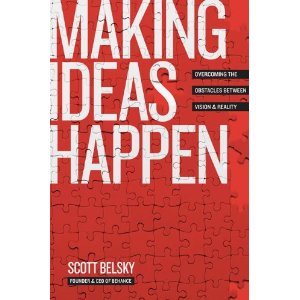
Unfortunately, that was the extent of his success. In subsequent years he lost his way. He regularly generated new ideas and strategies but hardly focused at all on the need for more organization and structure. He continued to change out staff and lay leaders, but spent almost no time building community with the ones who stayed. And he gave too little attention to the necessary practice of self-leadership. That, unfortunately, resulted in a tragic moral failure. Too bad Scott Belsky’s book Making Ideas Happen wasn’t around then. It might have saved our pastor, his family, and the church a lot of heartache and wasted resources.
Belsky’s passion is to help people put their best ideas into action. As the founder and CEO of Behance, a company devoted to empowering and organizing the creative world, he and his team interviewed hundreds of productive people and teams over a six year period to discover the principles behind their success. The result of their empirical research is this book, a systematic presentation of the necessary steps needed to bring ideas to fruition.
The great inventor Thomas Edison once quipped, “Genius is 1 percent inspiration and 99 percent perspiration.” For Belsky the perspiration part is composed of three overlapping forces: good organization and execution, the solidifying power of community, and capable leadership. Each of these is explained by a series of “mini-chapters” that demonstrate exactly how to bring your ideas from the world of creativity to the world of real life. In the author’s view, only by using all three forces can individuals and their organizations overcome such ever-present obstacles as disorganization, perfectionism, and undisciplined creativity.
One of the many strengths of this fine book is its counter-intuitive pragmatism. Some of its most useful suggestions are: when it comes to ideas “less is more”; momentum must be maintained by acting on ideas “without conviction”; both team and interpersonal conflict are not only good but essential for projects to come to fruition; “nagging” others really does help to get things done; and when it comes to being productive, competition can be your best friend. All of these principles – and more – are neatly explained and illustrated with engaging examples from Behance’s research. This makes the book a quick and enjoyable read.
In my opinion, a great number of pastors and Christian leaders could readily benefit from Making Ideas Happen. We’re often creative, idea-oriented types who love to cast the vision or promote the mission of our church or organization. But, as one noted Christian leader has said about vision sermons and mission statements, “If it’s hanging on the wall but it ain’t happening down the hall, it ain’t happening.” Belsky has given us an accessible guide to creating church and ministry systems that will produce what we’ve preached and promised.
Moreover, this book is a helpful and necessary corrective to the “great man (or woman) theory”of church growth and missional effectiveness. Without question there are some omni-competent evangelical leaders who have been used by the Holy Spirit to make a profound impact for Christ and His kingdom via their preaching, writing, and leadership. But if Belsky is right – and I suspect he is – underlying much of their success are empowered teams of both staff and lay leaders who serve as the hidden forces of Christian community. As he notes, “very seldom is anything accomplished alone” and there is “tremendous power waiting to be unleashed in the network” of most groups. This almost sounds like something the apostle Paul would write! And if Behance’s research is any guide, the implications of these principles are clear for Christian leaders. If more of us would simply begin to work with and through teams, our churches and ministries would likely see both our in-house ministries and external outreach to our communities and cities expand and grow.
At a personal level, my favorite part of the book was the third section, Leadership Capability. Belsky makes a number of stimulating and helpful suggestions such as “Leaders should talk last”, “Develop others through the power of appreciation”, and “Capture the benefits of failure”. This probably isn’t new information but collectively it serves as a necessary reminder that good leadership is a crucial element in making ideas happen. My thanks to Scott Belsky for giving us such a valuable guide as we seek, by God’s grace, to make Christ’s mission to a lost and dying world come to fruition through our work and ministries.