



G.K. Chesterton, in his book, The Man Who Was Thursday, recounts a debate between two poets, Mr. Gregory and Mr. Syme. For sake of space we have paraphrased their dialogue. Mr. Gregory speaks:
“I will tell you why all the passengers in railroad trains look so sad and tired. It’s because they know that whatever place they have taken a ticket for, that place they will reach. After they have passed Sloane Square, they know the next station will be Victoria, and nothing but Victoria. Oh, their wild rapture if the next station were unaccountably Baker Street.”
Mr. Syme answers with equal conviction:
“If what you say is true, your passengers can only be as prosaic as your poetry. For the rare, strange thing is to hit the mark; the gross, obvious thing is to miss it. We feel it is epochal when a man with one arrow strikes a distant bird. Is it not also epochal when a man with one engine strikes a distant station?
“Chaos is dull; in chaos the train might go anywhere. The magic is this: the conductor says, ‘Victoria,’ and lo, it is Victoria. Every time the train comes into the station it has broken past a battery of besiegers and triumphed over chaos.
“You say contemptuously that when one has left Sloane Square he must come inevitably to Victoria. I say one might do a thousand things instead. When one comes to Victoria, he should arrive with a sense of hairbreadth escape; and when he hears the conductor shout, ‘Victoria,’ it is indeed Victoria!”
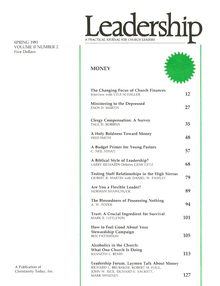
This tale has lingered in our thoughts while we’ve been working on this issue of LEADERSHIP. Our search for practical material about the theme “Money” has led us from one financial expert to another who, like the passengers on Mr. Gregory’s train, dourly project that the turbulent times in which we live will take us precisely from one economic disaster to another. They agree with Alfred Kahn, Jimmy Carter’s inflation-fighting czar, who said, “Anybody who isn’t schizophrenic these days just isn’t thinking clearly.”
But on the horizon, chugging steadily toward us through the black clouds of chaos, is Mr. Syme’s train, triumphantly heading toward Victoria Station. The throb of its pistons rhythmically proclaims:
“Do not worry about your life, what you will eat, what you will drink; or about your body, what you will wear.
“Who of you by worrying can add a single hour to his life?
“It’s the pagans who run after these things, O you of little faith.
”Seek first God’s kingdom and his righteousness, and all these things will be given to you as well.”
All things are in Christ’s control, and we need not fear a political, economic, and moral world run amuck. But while we look at this miracle of God moving through the economic turbulence of our times, we must do more than just hang on to his sovereignty. He hasn’t released us from our personal responsibility to his word. Jesus said more about money than the cataclysmic event that will overshadow all of history-his personal return. Why? He wanted to teach us that how we think about money is a very tangible way to measure our spirituality, i.e., our personal relationship to God as well as to one another.
A.W. Tozer wrote, “The whole question of the believer and his money is so involved and so intimate that one hesitates to approach a consideration of it. Yet, it is of such great importance that one who desires to qualify as a good servant of Christ dare not avoid it, lest they be found wanting in the day of reckoning.”
Subconscious-yea, conscious- preoccupation with things financial that drives people in a mad scramble to hang on to an affluent lifestyle cries out for pastors and people who will dwell on- teach, think, discuss, and implement-a theology of money.
Faith, hope, and love will never be displaced as the core of Christian teaching. And money will never be displaced as a means of measuring our souls to see if those forces are really at work.
In his book, Economic Anxiety and Christian Faith, Larry Rasmussen tells a story about Godfrey Davis, who wrote about the hero of Waterloo, the Duke of Wellington. Godfrey said, “I had an advantage over earlier biographers. I found an old account ledger that showed how the duke spent his money. It was a far better clue to what he thought was really important than the reading of his letters or speeches.”
No, we need not fear the unknown economic times in which we live. God will deliver his train to Victoria Station. Our thoughts and actions must be about what we do understand, and the call is clear: “Where your treasure is, there will your heart be also.”
Copyright © 1981 by the author or Christianity Today/Leadership Journal. Click here for reprint information on Leadership Journal.