



Ed Stetzer recently presented data to the attendees of the Catalyst Conference in Atlanta. Much of that data was shared in the Winter issue of Leadership journal. In this post, Ed Stetzer explores additional information that was, until now, only available to the attendees at Catalyst.
Change. It’s happening at such a pace it has become cliché.
Joel Barker is so 80’s. Yet Barker is still around. A self-described “futurist,” Baker popularized the term, “paradigm” to describe our behavior patterns. Our recent Lifeway Research findings inspired us to go back and consider one of his most famous warnings:
“You can and should shape your own future; because if you don’t someone else surely will.”
Influencing the future begins with assessing our current realities. Predictions of radical change are nothing new. Walt Disney made a nice living imagining the future since the mid-1900’s. Two futures are critical for the church to understand and embrace. Although our ability to control the future is questionable, our influence and response to the future is critical to our effectiveness in God’s mission.
The first future is “inside” the church.In most churches, Boomers will continue to be firmly in leadership.They will work longer and live longer (including pastors, staff, and lay leaders). As difficult as it seemed for previous generations to pass on leadership in the local church (still in process), Boomers may find it more difficult.
Boomers are the “better idea” generation. The technology revolution was spearheaded by Steve Jobs (born 1955) co-founder of Apple and Bill Gates founder of Microsoft (born 1955). The contemporary church movement led by Rick Warren (born 1954) and Bill Hybels (born 1951) inspired a generation of church leaders. Dissatisfied Boomers decided to “go west” to a new contemporary church world. Now, subsequent generations have gone in new directions—too numerous to list here. Things in the church change.
The second future is “outside” in culture. With the onset of the Information Age, vast amounts of knowledge and information have become available to virtually anyone at the click of a mouse (or now handheld devices). Where it took hundreds of years for the volume of information to double in the past, now it happens in months.
For example, one current reality that influences both futures is the social networking phenomenon. The way people socialize and interact is rapidly changing. What some are calling “socialnomics” has emerged—the social media tsunami is here. The way we form and maintain relationships has dramatically changed. Here are some examples of the radical shift in how people interact:
• 96% of Gen Y has joined a social network.
• Number of Years to 50 million users: Radio-38; TV – 13; Internet- 4; and Ipod-3.
• Facebook added 100 million users in less than 9 months.
• IPod application downloads hit 1 billion in 9 months.
• Gen Y & Z consider email passé.
The oceans and boundaries of nations’ borders are no longer communication obstacles.
People from all cultures and ethnic groups are interacting with one another via social media. The world has become glocal—a mixture of global and local. Globalization has flattened the world socially, economically, culturally, and missiologically.
With the emergence of global cities, people from various races, languages, and cultures mix regularly. For example, the greater Chicago metro area is home to over 9 million people. Within that population, over 140 defined people groups and over 200 language groups live in proximity to one another. A dramatic shift from rural to urban has taken place in North America. America is now predominately an urban society.
Things have changed, are changing, and need to change. We all sense it; some with joy and others with reluctance. In a recent survey, we asked one thousand pastors to give their perspectives about change in three areas. A growing anticipation of change was evident in their responses.
1. Change in Personal Ministry
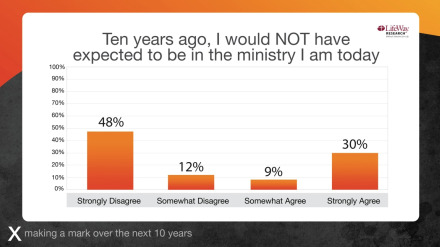
Initially, we asked pastors to think retroactively about their ministry experience and respond to this statement—”Ten years ago, I would NOT have expected to be in the ministry I am today.” Overall, the majority of pastors expected to be where they are now looking back ten years—48% strongly disagreed and 12% somewhat disagreed.
However, a very significant number (30%) strongly agreed with the statement. Almost a third of pastors responded that a significant change in direction had taken place in their lives over the last ten years. Ten years ago, they definitely would not have expected to be in their current ministry role. What circumstances transpired that facilitated the change is unclear. But, change to some degree happened to 4 out of 10 respondents.
2. Change in Future Ministry Role
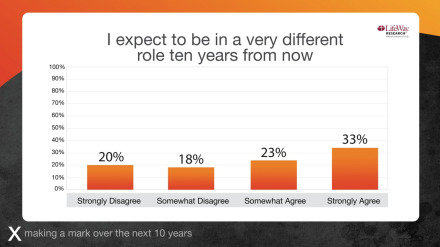
The next statement indicated a growing sense of anticipated change among pastors. When asked to respond about their future ministry roles, many pastors saw change on the horizon. We posed this statement—”I expect to be in a very different role ten years from now.”
While a significant percentage disagreed with the statement, a definite majority agreed—33% strongly agreed and 23% somewhat agreed. Therefore, a majority of pastors expect to be in a very different role ten years from now.
Many factors could be at work here—and we can only speculate. Some might expect church conflict and forced terminations. Others may see a decline in their church and denomination and see it forcing ministers from church based ministry. Also, options to serve God are multiplying outside the church–conflict mediation, cooperate chaplaincy, and business coaching are a few emerging vocational platforms for ministers.
It should be said that vocational ministers who prepare for alternative income options may actually increase their opportunities for local church ministry. One example would be planting a church or being a part of a church planting team. Another example would be staff leadership in a smaller church. Both are important platforms to make a difference for God’s mission.
- Can't finish right now?
3. Change in Future Church
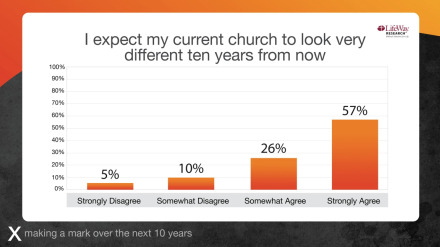
The most profound statement we made to pastors was this—”I expect my current church to look very different ten years from now.” Over 80% of pastors agreed with this statement (57% strongly agreed, while 26% somewhat agreed). Pastors have a sense that change is inevitable. They expect it in their lives, ministry roles, and the churches they serve.
How do they expect their church to look in 10 years? The answer requires further research. No question, current context will influence the changes they expect. Do they anticipate changes in current age of membership, number of attendees, life situation of attendees, or methodological approaches? Who will help them determine trends and implications in their church or community? How will trends and implications inform our strategic plans?
Now, let’s tie this back to the original article in Leadership Journal (I don’t work for LJ, but if you are not a subscriber, you should be—it is consistently helpful). In that article, we discussed thoughts that pastors expressed on the church about investing in leaders, fulfilling ministry, and making a difference. We saw that most pastors still love and value their church. On a lesser level, pastors think the church is a place where leaders are made.
Personally, pastors believe they are investing in the development of leaders. While they have a commitment to the church and to nurturing leaders, they clearly recognize two key issues: 1) The church struggles to reach young adults; 2) The church will experience change in the next ten years.
What’s next? That simple question might be the most important question any church can ask over the next 10 years. In fact, the question should be asked repeatedly. When God is at work and as the world changes the “What’s next?” answer will change.
The questions that follow must be about preparation not preservation. The church in every era has faced changing times and changing people. Choices are made. Even if the church has chosen a “protect and preserve” mode that too was a choice. Make no mistake; there are timeless elements of church that are worth protection and preservation. But preparation is the key to relevancy when the subject is the mission of God. How will God use the church to open the hearts of the next generation to the Gospel of Jesus? That’s the right question.