



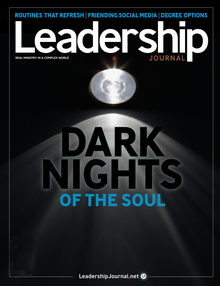
I published a book last year called Spiritual Rhythm. It explores a basic idea, though I’d come to it late: for everything there is a season. The idea, of course, isn’t mine. It’s Solomon’s, or whoever it was who wrote Ecclesiastes. But I’d regarded the notion as rhetoric—the lyrical effusions of a chastened but jaded prodigal.
But then my own heart plunged into winter, bleak and cold. For a long season my world turned bitter, and desperately lonely.
Death brought it on. Carol was my wife’s best friend and my trusted colleague. She was a pastor of extraordinary gifts. Even more, she had a deepness and closeness with God that made you want these things, too. Her prayers stormed heaven. Her preaching opened its gates. Her ways invited you in.
She started tripping, and walking into walls. She forgot the simplest things. Sometimes she seemed dosed with laughing gas, loopy and giddy. She complained of crushing headaches. Her doctor diagnosed those as migraines, but one day my wife caught Carol nursing a blistering headache in a cascade of sunlight. No one manages a migraine that way. My wife insisted Carol get a CAT scan, whose results worried doctors enough to order an MRI.
And the chase was on. Carol had a lump of cancer in her head the size of a baseball. What followed was an ordeal of surgeries and therapies that ended, 15 months later, with a funeral.
Up until then, and even during, I was stout-hearted. I stood week after week in the pulpit, preaching, praying, exhorting. I gave all the updates on Carol’s condition, in a calming voice.
And then I buried her. Even this I did with strength and conviction.
But I woke up a week or so later tired and sad, and I stayed this way a terribly long time.
I thought I needed therapy or drugs, or a career change. I wasn’t entirely clear what I believed. I kept preaching, kept leading, but some days I could barely rouse myself. When people asked me to pray for them, I did but felt stumped, as if they’d posed me a mystery beyond my meager capacities to solve. I was often tongue-tied at these moments, stammering through a tepid prayer, tainted, I’m afraid, by my own doubts and cynicism.
I tried and tried to get out of it, until I realized that there was nothing doing except going through it. I was in winter. It was a season of my heart no more unnatural or preventable—or tolerable—than the winters of the town where I grew up, a place in northern Canada that went dead with cold for half the year. Winter is what happens when the earth tilts away from the sun: it’s still there, just slantwise. A winter of the heart is similar. Something tilts, something shifts, the light diminishes, and everything gets cold, goes dormant.
Awful, but normal. That helped, knowing this.
And so did Psalm 88. That is one dark poem. It is a recitation of lifelong suffering, a protest against God’s apathy and brutality. It hasn’t a shred of daylight in it. It ends with this: “the darkness is my closest friend.” The man (actually, “the sons of Korah,” but they’ve written in first-person singular) has crouched down in the crypt so long that it feels homey. He’s in deepest misery and isn’t going to be coaxed out with easy pieties.
I grew to love him: his bone-stark honesty, his fierce lament, his see-sawing between wild anger and flat-eyed resignation, his willingness to almost taunt God into action.
All that provided a way, not out of winter, but through it. The psalm is a prayer. That was my first clue—after all he’s been through, he’s still talking to God. And my second clue: he confesses, without restraint, his disappointment in God, but asks God to act anyhow.
This became the shape of my own prayers in winter. I told God exactly how I felt, no holds barred, but didn’t stop talking to him. And I kept reminding him, bluntly, of what he could and should do. These prayers were raw and real. They were their own acts of faith.
I don’t romanticize this time. It was hard and bleak, and I was happy to bid it good riddance. But it taught me something I suspect I’ll need again: even the darkness is not dark to him (Psalm 139:12).
Mark Buchanan is pastor of New Life Community Church in Duncan, British Columbia.
Copyright © 2011 by the author or Christianity Today/Leadership Journal. Click here for reprint information on Leadership Journal.