




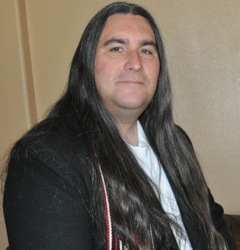
I hope you enjoy this conversation with new friend Corey Greaves, a Blackfeet Indian pastor working with youth on the Yakama nation. Corey is one of a rising generation of sharp Native American leaders who are working to heal historical wounds and bring indigenous theology to its rightful, honored place in Christian dialogue. For opportunities to connect your church to Corey's work, check out S.L.A.M. Trips and Dancing Our Prayers. -Paul
Paul: Thank you for speaking to us. Tell me about your organization, Mending Wings.
We're asking, "What does it mean to follow Christ—the 'Jesus-way'—as an Indian person?"
Corey: We're a Native American non-profit youth organization on the Yakama nation in Washington State. We're all about raising up student leaders, teaching our students to deconstruct Western missiology, and reconstructing indigenous theology for our kids. We're asking, "What does it mean to follow Christ—the 'Jesus-way'—as an Indian person?" That journey looks different, sounds different, smells different, feels different.
We're about healing from historical trauma, addictions, and abuses; about empowering our Native youths and families to walk in wholeness and beauty as followers of the Jesus-way.
You connect a lot with short-term groups?
Yes, but not the way short term trips are usually done. We have a program called S.L.A.M. trips—Students Learning About Mission. We bring in college age youth groups, families from around the country for a "mission trip" on our reservation. We've had folks come from Africa, several Asian groups. Mostly from non-indigenous cultures. But they have to come as learners. They can't come teach a Vacation Bible School, for example.
They come, and we immerse them in the best of our culture for a week, and introduce them to a different model of missions. They work with our elders, helping to fix up yards, chop wood for the winter, and build relationships. That's what it's all about—we don't care if the rake's leaning against the house if they're building relationships. We're a very relational people, not very event or task or time oriented.
I love how you use "the Jesus-way" to describe our faith. What does that communicate to Native believers?
We don't use the word "Christian" because that leaves a bad taste in our mouth. It's a label. The Jesus-way is a way that we walk, a trail that we're following. You get bruised and bumped on that trail, sometimes you can't see because of the brush, but you continue to walk as Yeshua leads.
There's not a lot of piety in it.
Piety's overrated.
[Laughs] Yeah, I think so too. The Jesus-way has a lot of broken words, a lot of Brennan Manning—ragamuffin faith.
While it's a complex story, missions often hasn't been "good news" for indigenous peoples. What needs to happen for that to change?
I think that first, like Richard [Twiss] said, you have to have a theology of presence. You gently make your presence known, then start conversation. Then you have to stay in the conversation. Folks want to come in and bring conversation, but they bring agenda, and they bring their own ideas of what they want that to look like, instead of just being. And then, when the conversation begins and it gets rough and you get offended and you get angry, you bail. It's important to stay in the conversation. It's the only way we'll heal together, and learn from one another.
So, having a theology of being and place, and staying in conversation. Pretty important.
Will that reconciliation, will that beauty ever happen on this side? I don't know. But I sure know we don't have a chance if we don't start there.
What does the Jesus-way uniquely offer to your people?
That's a big question. We know historically what Christianity has meant to Indian people—"Jesus loves you, but he doesn't like you a lot. But he does like white people, so here's how to be a follower: look like us."
We've gone through this replacement-oriented theology, where everything we are has to be replaced with everything the missionaries were. But as we are deconstructing that, we're beginning to see Tamanwithla—Creator—God—not as a foreign god anymore, but as someone who has been in and among and working among our people for years. We're also seeing Jesus-types within our culture.
For one example—we have what we call the Whip-man. Traditionally, the Whip-man would discipline kids in community settings. It wasn't mom or dad or grandma, it was a person who would whip the kid on the head with a stick if they were acting up—but it wasn't really about hitting them, it was about teaching them. Teaching them love, pointing them in the right direction, saying, "This is the way to walk." Often putting them on their knee. The story goes that the original Whip-man once went from village to village. He'd tap his knee, and say, "Come sit on my knee, children—I want to teach you the way that Creator has for us to walk."
Long story short, Whip-man dies, is in his lodge. Three days later, Creator raises him back to life. He has the big picture of Creator and the way he wants us to walk—a full picture. He goes back to the villages, calls the children—"Come, sit on my knee, I'll tell you the rest of the story."
So we understand Yeshua—I love to use his tribal name—as a tribal person. His tribe of Judah was part of 12 tribes and bands that made up the Israeli nation, we have 14 tribes and bands that make up the Yakama nation. They have firstfruit feasts, we have firstfruit feasts. There are all these similarities. All of a sudden, we're understanding Tamanwithla—not as a foreign god, but as someone who's always been here.
Creator has spoken to our people in many ways. Through our elders, through Earth, and then sent his son Yeshua and spoke to us through him. He's another way that God's speaking to us. This time it happens to be the way, the truth, the life.
- Can't finish right now?
So, we don't have to trade in our culture, or who God made us to be like some unwanted coat when we go into church or go to a Christian event. We can enter as he made us to be, because he doesn't make junk. And that's beauty for us. All of a sudden, there's a dignity now to coming to a belief in Yeshua, to follow the Jesus-way.
We don't have to trade in our culture, or who God made us to be like some unwanted coat when we go into church or go to a Christian event. We can enter as he made us to be, because he doesn't make junk.
What does your people's voice give that's otherwise missing in the church?
I think because we're indigenous people, because we're tribal, we get points of biblical theology that Western theology misses. One thing I've seen Western theology do is take the Hebraic worldview and turn it into this Western thing. They've made very cyclical thinkers into very linear thinkers. They've imprinted their thoughts upon Judeo-Christianity. "This is the way it is." Over time, that's become orthodoxy. I think what we have to offer to the church is a really indigenous theology. A theology of the land—like the Hebrews had. We have a view of the world around us, of how our stories and Creator's story interact with each other. We get the Psalms that talk about the mountains and the trees bursting forth in praise. A Western thinker can oftentimes read right over that—"Oh, that's nice." But we find lessons in every leaf and every rock.
When we just look through our own little lens, we have a very small view of Tamanwithla. When we can humble ourselves, and begin to look for Creator through others' lenses also, we begin to get a bigger picture of who Creator is. We have something through our lens, our understanding, our interpretation of Scripture to offer to the church that the church doesn't have. I think the Western church is limping along, without indigenous perspective. They've made God way too small—but they think it's the big picture. We don't have "the way," we have an understanding that we can bring to the table. Yeshua as a tribal person, our relationship to the land—something beyond "stewardship" of the land, but not tree-huggers either—a theology that the earth doesn't belong to us, but that we belong to the earth and the Creator that made us. We're related to the Horse Nation, to the Buffalo Nation, to the Huckleberry People, to the Salmon Nation. There's not really a place within a Western hermeneutic to understand that. There's no language for that. We have a language to bring a bigger picture.
What excites you about the rising generation of Native youth that you get to work with?
Man, what I'm seeing are kids coming to understand Yeshua as tribal. All of a sudden, he's somebody worth listening to. He was somebody who had a similar story—people moving in to his land, conquering his people, trying to stamp out their culture, language, places. The fact that he has Indian names—Bright and Morning Star, Lily of the Valley, Rose of Sharon, Chief Cornerstone.
Kids are starting to recapture their culture, their language, because we know God best when we're true to our culture—that's who he made us to be. He made us diverse. That's joyous.
What's most exciting is to see kids coming to the realization that God is not a foreign god. He's a God who's been active among our people.
What's most exciting is to see kids coming to the realization that God is not a foreign god. He's a God who's been active among our people, and now he's speaking to us through Yeshua, and continues to speak to us through these other things as well. The way they follow Yeshua is unique, man. It's different.
They're coming to put their faith in the Whip-man. And there's such a beauty in that.
Paul Pastor is editor of PARSE.