



 |
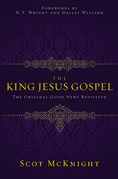
King Jesus Gospel: The Original Good News Revisited ( Zondervan, 2011 ) Scot McKnight |
The what-is-the-gospel discussion continues. The latest contribution comes from New Testament professor Scot McKnight in his new book The King Jesus Gospel: The Original Good News Revisited (Zondervan, 2011). In the preface, N.T. Wright suggests that McKnight is proposing a “revolution” in our understanding of the Good News. Whether this praise is overstated or not, McKnight’s work is a thoughtful and illuminating account of how the early church understood the gospel and its relationship to Jesus.
McKnight’s central critique is that contemporary evangelicals have reduced the gospel to the plan of salvation, or to the question of how an individual gets saved. McKnight is careful not to dismiss the importance of personal salvation or of justification by faith, but he contends that the plan of salvation is not the whole gospel, and that in equating the two, evangelicals have made a dangerous mistake.
McKnight writes that the gospel is “the salvation-unleashing Story of Jesus, Messiah-Lord-Son that brings to completion the Story of Israel as found in the Scriptures of the Old Testament.” McKnight unpacks 1 Corinthians 15, observing how the Good News includes not only Christ’s saving work on the cross but also the rest of the story: the Resurrection, birth of the church, and the fact that we are moving forward to the “full consummation of the kingdom when God becomes all in all.”
This expanded understanding of the gospel shifts the terms of the discussion. In a brief interaction with John Piper, McKnight points out that asking whether Jesus preached Paul’s gospel is a legitimate question, but that the question is backwards. Since the gospel comes from the Gospels, he contends, we shouldn’t be asking if Jesus agrees with Paul, but whether Paul agrees with Jesus. For McKnight the primary presentation of the Good News comes from Matthew, Mark, Luke, and John. To define the gospel as the plan of salvation (and specifically, justification by faith) is to ignore this crucial fact.
McKnight makes his case by examining the creeds of the early church as well. While acknowledging the imperfections of the early church, he shows the way the early church adhered to the narrative of 1 Corinthians 15, even while they expanded upon the details in a desire to clarify the nature of the gospel.
The debate over the nature of the gospel is no academic parlor game. McKnight is not merely calling for a reordering of conceptual categories or a swapping out of exegetical tools. Adopting his definition of the gospel impacts the way we do ministry. It changes what McKnight calls the “Method of Persuasion,” our way of convincing others to embrace the Good News. McKnight suggests that if we get the gospel right, then in addition to challenging others to accept Jesus as savior, we would also summon “listeners to confess Jesus as Messiah and Lord.” McKnight’s close reading of the sermons in Acts provides a template for proclaiming the gospel, and those sermons were framed by the context of Israel’s story, rather than strictly in terms of the atonement.
McKnight’s account of the gospel has the added benefit of making discipleship something more than a mere addendum to the Christian life. If the gospel encompasses more than simply getting people saved, what happens after salvation is just as important as the conversion event itself.
McKnight’s case is persuasive, but he leaves the relationship between the story of the gospel and the way salvation works unclear. Calvin once called justification the “main hinge on which religion turns.” As Calvin’s metaphor suggests, justification may not constitute the whole gospel—but it does represent an essential component. Without it, the broader gospel is in danger of unhinging. McKnight’s corrective is much-needed, but he leaves questions about how this broader gospel relates to key doctrines unanswered. Hopefully McKnight will provide greater clarity on these matters in the future.
The “revolution” that The King Jesus Gospel proposes is not a new way forward, but a way back. While McKnight’s work won’t satisfy everyone, it is a thoughtful challenge to the church to ensure that the order of our proclamation imitates the order of presentation in Scripture, and that in our proclamation of salvation we do not forget the kingship of Jesus over all creation.
—Matthew Anderson is author of Earthen Vessels: Why Our Bodies Matter to Our Faith (Bethany House, 2011).
Copyright © 2011 by the author or Christianity Today/Leadership Journal.Click here for reprint information on Leadership Journal.