



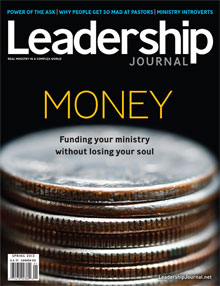
When we talk about finances in the church, there’s a tendency to keep the discussion very practical. We ask questions such as, “How do we encourage people to give? What kinds of fundraisers work?” All too often, we make finances a “how-to” conversation. Yet there are deep heart issues involved. One of them is our unhealthy desire for security.
People will give up salvation for slavery if it comes with the illusion of security. Think of the Israelites. When they were freed from Egypt, it didn’t take long for them to ask, “Why can’t we go back to slavery?” It’s incredible, when you think about it. After experiencing God’s salvation, they pined for slavery.
I’ve watched this principle play out with finances. We say we trust that God will provide for us, but the moment things get tight, we’re tempted to abandon that trust in God and seek security through our own efforts. In other words, we’re not all that different from the Israelites.
When Jesus commands us to pray, “Give us our daily bread,” he’s critiquing this tendency to find security in other things.
We live in a culture that is more like Pharaoh’s empire than God’s kingdom. We’re taught that you are what you make yourself. We get paid according to our effort and talent. We dream of being independently wealthy. We think, Hey, I could be that guy who retires early, but of course we also hedge our bets. We diversify our portfolios to avoid risk. I’m not saying any of that is wrong. But it can get out of hand easily. I have insurance for my insurance for goodness sake! We sit around imagining everything that could go wrong and how we can guard against it. What we’re ultimately doing is trying to find security in a very unstable reality. We still have to work hard; planning isn’t evil. But if we trust this system for our security, we will end up enslaved.
So how do we experience transformation? And how can we lead others away from enslavement and help them trust the Lord with their finances? The only way we’ll really change is when we’re captured by the glory of God. We will only learn to trust him with our finances when we’re confident in his presence, his promises, his salvation. Only when we’re confident that Jesus is for us, that he is more attractive than our own security, can we loosen the death grip we have on our money.
Money is not a bad thing, but the love of money leads to enslavement. Christ frees us from that. He’s the King who breaks into our reality and brings radical salvation. He leads us to freedom because he loves us and wants to be with us. If we are captured by his glory, we’ll see him as this good, righteous, powerful, all-sovereign King who promises us, “I’m going to take care of you. I’m going to provide for you. I’m going to give you what you need on a daily basis. You can count on that.”
But if the glory disappears, if we’re not in love with Jesus, if we’re not captivated by him, there’s only one place to go—back to that illusion of security. Back to slavery.
When we talk about “financial freedom” in America, what comes to mind? We’re all going to be billionaires, right? Or at least millionaires. But the biblical definition of financial freedom is radically different. In the kingdom, freedom means praying for our daily bread and letting go of control. It means being content to live a simple and generous life. That’s what it is. It’s freedom from the illusion of security.
Either we are going to serve this glorious, beautiful God and trust him, or we’re going to serve Pharaoh’s kingdom and trust it. There are really only two ways we can go.
The beauty we encounter in Scripture is the revelation of how amazing our King is. So spiritual transformation that will make us a different people when it comes to money is all about being enraptured by the glory of Jesus—and then trusting that he and he alone will provide for our needs.
If we want financial freedom, let’s love Jesus and encourage the people we lead to do the same.
Rick McKinley is pastor of Imago Dei in Portland, Oregon.
Copyright © 2013 by the author or Christianity Today/Leadership Journal.Click here for reprint information on Leadership Journal.