



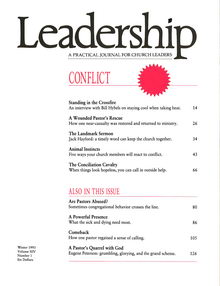
For some pastors, practicing spiritual disciplines comes naturally. They get up at 5:30 A.M., read five chapters of Scripture (translating one from the original languages), then pray for an hour before their morning run. They journal daily, fast twice a week, and take an annual retreat to a monastery for a week of silence.
For other pastors, perhaps most, it's not that simple. While they pray frequently, both publicly and privately, most of the time their prayers are "on the run." They struggle to read the Bible through cover to cover in one year, despite the latest systematic reading program they ordered in the mail. They live with persistent feelings of inadequacy over their "devotional life."
Is there hope for such pastors?
LEADERSHIP contributing editor Bob Moeller found a self-confessed "unstructured personality" in Charles Killian, professor of preaching and drama at Asbury Theological Seminary in Wilmore, Kentucky. They discussed Killian's experiences in developing intimacy with God apart from the traditional regimens.
When a pastor has difficulty maintaining daily spiritual disciplines, is that the sign of a spiritual problem or character flaw?
Perhaps. But for some the explanation may be their basic temperament. Structure comes more naturally to some personality types than others. Some people naturally prefer order and discipline, while others prefer a more spontaneous and unstructured approach to life.
In their book Prayer and Temperament: Different Prayer Forms for Different Personality Types (The Open Door, Inc., 1984), Chester Michael and Marie Norrissey suggest a relationship between our basic temperament and the type of spirituality or prayer that works best for us. I've certainly found that true in my own pilgrimage.
Our personality structure is a gift from God, and we ought to celebrate its strengths and potential rather than agonize over its weaknesses and shortcomings. For many years, I didn't see that.
How did your sense of inadequacy at practicing spiritual disciplines affect you?
I remember weeping myself to sleep many nights as a boy, apologizing to God for failing to read enough of the Bible, not praying enough, or for just not being the person I thought I should be. I saw God as a referee in a black and white striped shirt, ready to call a technical at any moment or throw me out of the game. At best, I saw him as a taskmaster shouting, "Back to the yoke. You haven't measured up yet."
I wanted so much to earn the smile of God's approval, and as hard as I worked for it, I never sensed God say, "Good boy, Chuck." I felt as if I failed the test of what a spiritual person should be.
So some of the guilt pastors may feel over their devotional lives results from a distorted view of God?
I was raised in a good home where my mother took us to church twice on Sunday and once during the week. Her heart was right, but there was a certain rigidity about our faith. We were scrupulous about our religious activity, and every time an altar call was given, I responded. I went forward so many times to be born again I ended up with stretch marks on my soul. (Laughter)
I remember one evening as a boy when our small church was holding revival meetings. The evangelist preached that we were the ones who nailed Christ to the Cross. That image stuck in my mind, and that evening I cried myself to sleep, apologizing to God for killing his Son.
Not only could I never measure up, I was guilty of this horrible crime. I didn't understand the unconditional love of God that motivated Christ's sacrifice, that my sin was completely covered by the atonement, and that grace meant God was neither angry with me nor blaming me for the death of his Son.
So for the next twenty to thirty years, I labored under perfectionism; I never measured up. This played into my understanding of the spiritual disciplines. I always seemed to be a brick short of a load. Regardless of how much or how often I prayed, it was never good enough.
What was the turning point for you?
During a "dark night of the soul," I realized what my perfectionism was doing to my work, my family, and myself. I began to explore the meaning of grace. For years I had asked, "God, what can I do to be holy?" I struggled, sweated, manipulated, and worked to please God. But I never escaped feeling like the bad little boy who helped kill God's Son.
What finally brought stability and peace to this unstructured person, who today is still somewhat unstructured and delighted to be so, was the realization that my salvation was Christ's work, not my own. I couldn't save myself, only he could. It was liberating to realize I no longer had to "do" in order to please God, but simply "be" in Christ, which included my devotional life.
I was 40 before that happened, but once I realized what grace was all about, I began to laugh with a holy laughter. My desire to please God through the practice of spiritual disciplines was replaced by a desire to become conformed to the image of Christ. I no longer felt God was holding a whistle ready to charge me with a foul for failing to measure up in my prayer life or Bible study.
My wife, Jane, also helped me see the true meaning of grace. During one particularly difficult time in our lives, I came home and found our oak coat rack standing in the middle of the hallway. It was covered with yellow ribbons.
A note attached to the tree read, "So what if it's not a real oak tree. Any old tree will do. I love you." Her unconditional love and acceptance broke through to me. I saw for the first time that God loved me in the same way my wife did. It was a marvelous realization.
What place do prayer and Bible study now have in your life?
My definition of the spiritual disciplines includes but goes beyond the traditional fasting, Bible study, and prayer. It involves any activity that helps me better understand the nature of life in Christ.
- Can't finish right now?
For example, when the Mona Lisa was on tour in Washington, D.C., I found myself sitting transfixed for nearly half an hour, engaged by this moving portrait. I sensed I was in the presence of greatness.
How did that help me in my walk with Christ? Two weeks later when I was working on a sermon about the divine mystery and presence that invades us and draws us to God, my experience in Washington, D.C. came back to me. That experience helped me explain the concept of mystery and presence to my congregation.
I don't mean to suggest God is present in paintings; that's pantheism. But I try to be continually sensitive to the surprising places where God can meet me and teach me more about life in Christ. Engaging in that type of ongoing spiritual observation of life, the "God-hunt" as David Mains calls it, is one form of spiritual discipline.
But shouldn't the unstructured person still attempt to pray, study, and fast on a regular basis?
Yes, but you shouldn't be in bondage to any particular method or regimen. It's far too easy to slip into the performance trap. As soon as maintaining the method becomes more important than knowing Christ himself, it becomes idolatry.
I don't have the same degree of discipline in prayer that John Wesley did. I don't get up at 4:30 or 5:00 A.M. as he did. But I do get up early enough to be alone and spend an hour of quiet in the presence of God, away from the telephones, the noise, and the confusion of life. It's such a peaceful time, I'm reluctant to bring it to an end.
Prayer shouldn't be restricted to a certain length of time or time of day. It encompasses the totality of life. Jesus said we ought always to pray and never faint. So I'm always praying, whether I'm preaching, teaching, loving my wife, or counseling a student. When I communicate with God even as I go through the routines of life, there's a holiness and sanctity to these moments.
Is there danger of such a devotional life becoming too experiential and subjective?
That's where spiritual accountability is important. While unstructured people resist expectations, they need to put goals and structure in place. That's where a soul mate or friend is invaluable. That person needs to understand and appreciate the dynamics of the unstructured personality, but he also needs to love me enough to say, "Hey Chuck, you're copping out. You need to get back to the program."
If you're by nature resistant to structure and regimens, won't your soul mate just be wasting his time?
Like most unstructured people, I resist structure until it's forced on me. One of the hallmarks of my personality is that I learn so much after the fact. I don't usually see what God is doing until he's done it.
That was the case when I was asked to take an interim pastorate in a neighboring state, while continuing my teaching load. It lasted four years. During that time, I virtually never used an old sermon; everything I preached was fresh that week. The pressure of that situation created a need for a fresh discipline of Bible study, meditation, and prayer that proved enormously beneficial.
While I still try to avoid what I consider the bondage of the predictable, my devotional life was enriched by the structure forced on me by that assignment.
Is the unstructured personality at a disadvantage in growing spiritually?
The unstructured and the structured person are both healthy and balanced if their life is in Christ. For me to understand and accept my resistance to structure is a measure of balance. I will always be that way to a certain degree, and I need to thank God for the way he made me, even as I struggle for bringing more order to my life. The structured person will always be striving to some degree to break out of a box.
How much effort should people make to overcome the weaknesses of their personality type?
Let me answer that with a story. I was the adviser for a student in the doctor of ministry program who wrote his dissertation on the relationship between obesity and spirituality. He studied an aspect of his personality that had given him tremendous difficulties.
When graduation day arrived, I stood next to him and couldn't believe my eyes. In just one year, he had lost ninety pounds. For him, controlling his eating became a spiritual exercise.
Is it hypocritical for pastors who struggle with consistency in their devotional lives to preach about spiritual disciplines?
We all preach beyond our experience to some degree, particularly if we're preaching the need for radical discipleship to Christ. I don't know anyone who is the full embodiment of what that means. But if we preach desire rather than attainment, we aren't being hypocritical. I want more structure, even though I haven't attained all that I want, I can legitimately preach my desire for myself-and for others.
I used to see the ministry as a place where I could be God's workman. "Watch me today, Lord, and tell me what you think." Now I realize what happens in authentic ministry is the exact opposite. God says to me, "Hey, Chuck, come along and watch me work today." Whatever measure of spiritual consistency I achieve is the result of God at work, not me. I don't have to have a spiritual walk that matches someone else's expectations; I just have to be in Christ and allow him to do his work.
What advantage does the unstructured person have in spiritual disciplines?
The downside to our personal pietistic tradition in the Western church is that devotionally minded people can become lost in themselves. My spiritual development should not be just for my own sake, but for the sake of the church as well. It is the church that calls me into ministry, that confirms my ordination. It is the church that Jesus is coming for someday.
Those of us who like to fly our own kite need to remember that we don't exist for ourselves but for the glory of God and for the good of the church.
That's why growth groups, Bible studies, Christian education, can all have a vital part in building up the spiritual life of the unstructured person.
What is the unstructured person's greatest need?
Our greatest need is to accept and celebrate who we are in Christ.
The story of Suszi of Anitole has helped me. As he lay dying, he called one of his disciples to his bedside and whispered, "I shall soon stand before the Great Tribunal. I will not be asked, 'Why weren't you one of the prophets?' or 'Why weren't you Moses?' No, on that day I will simply be asked, 'Why weren't you Suszi? You would have made a good Suszi if you had just let go.' "
My desire is not to be another Praying Hyde or Martin Luther. I simply want to make a good Chuck Killian. That's all God is asking of me.
Copyright © 1993 by the author or Christianity Today/Leadership Journal.Click here for reprint information on Leadership Journal.