



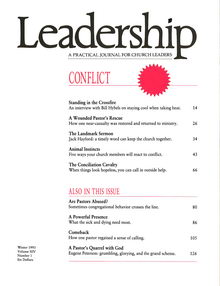
Christian leaders throughout history have found their character tested. How do I respond to a divided community or to those who oppose me? How strict should I be with those under my care? When should I correct and when should I forebear?
In the year 1256, these questions faced the newly selected governor-general of the Franciscans, a 36-year-old named Bonaventure. At the time, the movement begun by St. Francis was torn by dissension between those insisting on the austere discipline of St. Francis’s original rule and those seeking innovations. Under Bonaventure’s leadership, the order not only survived, but harmony was restored, and Bonaventure became known as “the second founder of the Franciscans.”
Bonaventure identified six virtues essential for Christian leaders: zeal for righteousness, brotherly love, patience, good example, good judgment, and devotion to God. He called these The Six Wings of the Seraph, the treatise from which this article is condensed.
While Bonaventure (1221-1274) lived in medieval times and wrote to heads of monastic communities, his insights are remarkably apt for today’s pastors.
To keep the interior of the temple clean, there had to be a roof to bear dust, rain, and gusts of wind. In the same way, leaders faithfully defend those under their headship from the storms of sin.
To do so, they must often expose themselves to the force of various adversities, as a mother hen will battle a bird of prey to protect her children.
Patience in Stress and Disappointment
The head needs a great deal of patience. There are three principal reasons.
First, many responsibilities, time-consuming activities, and fatiguing tasks demand his attention. For he is responsible for both the spiritual and physical welfare of the members of the community. We see that Paul was anxious to meet not only the spiritual, but also the temporal needs of the faithful, especially of the poor: “James and Cephas and John … would have us remember the poor, which very thing I was eager to do” (Gal. 2:9-10). The Lord himself fed those who had received the word of salvation with ordinary bread that they needed but could not obtain (Mark 6:35-44; 8:1-10).
The many time-consuming activities of headship derive from both the community’s internal concerns and its dealings with the outside. To some extent, a head must take thought for these things even if it causes him anxiety, for he is the person responsible for them.
A head also needs patience when he sees how little he gets for all his labor. Even though he wears himself out, he will not see much spiritual growth in the community. He may try many things and finally, after much labor, find the people under him beginning to improve a little. But so many obstacles stand in the way of spiritual progress that they will easily be delayed again. A head may be tempted to despair of ever seeing a return for his labors; he is like a farmer who sows much but reaps a poor harvest (Hag. 1:6).
Evil Disguised as Good
Often he will find evil conduct stealing into the community under the appearance of good. Something will appear to be good, so that he dares not denounce it as evil, but in reality it destroys some greater good and opens the door for more obvious evils.
For example, a sincere desire to save many souls may lead a monastic community to accept more members than it can properly manage. That very multiplication of its numbers then hinders the community’s observance of poverty. More of the members will want to enjoy more good things rather than live simply. From that follow more frequent business dealings to acquire the necessities of life. Soon the community is trying unusual methods for raising money and accepting gifts that the rule [policies for the Franciscan order] prohibits.
Thus, the peace of a devout life disappears, while the community’s religious standards lie neglected. The members begin aimlessly traveling around, hunting out various provisions for the flesh. They enter relationships prohibited by the rule; they look for gifts from those who seek their advice; they curry favor with the rich. They give up tasks that would strengthen other Christians in return for opportunities to beg. They expand their properties, build sumptuous residences, but do not cure scandals. Such activities crush the honor of God underfoot-that honor which a community ought to advance by its holy conduct and the inspiration it gives to its neighbors.
A similar abuse occurs when young men, and men whose virtue has not been seriously tested, are prematurely ordained or given responsibility for community leadership, preaching, and counseling.
In short, many things can be done that look good to human opinion, but actually stain our once pure interior devotion to God. Some people in the community, being dull and imperceptive about the interior life, may even suppose that all the power of a spiritual way of life lies in the external appearance of greatness. Accordingly, they defend such practices with great zeal, while neglecting true virtues and genuinely spiritual matters.
These and similar abuses will cause a spirit-filled head profound disappointment and pain. Since he is unable to correct all these problems even though he longs to do so, he has great need of patience. “My zeal consumes me. … Zeal for thy house has consumed me” (Ps. 119:139; Ps. 69:9).
Bearing the Ungrateful
A third reason why a head needs patience is the ungratefulness of those he works and cares for. His charges are scarcely ever satisfied with him; rather, they always feel put upon, because they are sure that he could do things differently, and better, if he wished. Often one is perplexed, not knowing whether to yield to their constant demands and allow everything they want, or to hold firmly to the course of action that one believes will do more good.
Many things that a head does are twisted by his people and given a bad interpretation. They murmur at his decisions, make accusations against him, reveal his faults, and derive matter for scandal from things that he did out of a sense of duty to God and to them.
- Can't finish right now?
It is almost impossible to escape the fact that whatever one determines or does, it will upset some of the brethren. Some will go so far as to resist their head to his face or argue with him in writing. They scorn him and rouse others to oppose him, or else find clever ways to keep him from fulfilling his duties.
Persistent Peacemaking
To stand up against these conflicts, and others which will confront him, a head needs a shield of patience. First, he must know how to answer everyone modestly, maturely, and kindly, so that he can stop overheated attacks without showing impatience in his speech or expression-without, in fact, even developing an impatient outlook. His patience will gain him more ground, and finally win over those who would only be further provoked by impetuous action.
Second, a head of a community should try to be a peacemaker. He should not avenge injuries done to him, nor hate those who inflict the injuries, nor hesitate to work for their cure. He should be glad to keep ungrateful persons in the community, for he will strengthen both these and other members by so doing good to them. He himself will grow in virtue through such persons, as our supreme Shepherd says: “You will be sons of the Most High; for he is kind to the ungrateful and the selfish” (Luke 6:35).
Leaders should not try to separate such people from themselves. It is, after all, the shepherd’s chief duty to teach virtuous living. What good will it do to remove from his care the very people who most need his help? If the doctor runs away from the sick, who will heal them? If a soldier shuns the attack, how will he taste victory? If a businessman neglects the deals which offer most profit, how will he get rich? This is the reason why many bishops, pastors, and religious superiors become saints: the nature of their duties gives them opportunity to do much good, to suffer many adversities, and to lead others to the heights of perfection. “If any one aspires to the office of bishop, he desires a noble task” (1 Tim. 3: 1).
Advantages of Adversity
Adversity protects one from the swelling of pride, which is more insidious for those in authority. The high position, the extent of one’s freedom and the gratification of doing good work might easily make one proud. But the yoke of adversity bows down the neck of presumption, and thus defends the head from the yawning gulf of pride.
A good head’s own salvation and spiritual progress are protected by humbling adversity; without it, success would lift him up on the wind of presumption. David, a man after God’s own heart, was humble and very fervent as long as he was hard pressed by trouble: “It is good for me that I was afflicted, that I might learn thy statutes” (Ps. 119:71). But when prosperity raised him up, he fell into sin.
A head’s holiness, therefore, increases through both the good he does and the evil he suffers. It is glorious to do good and to inspire others to do good. To suffer adversities leads to a magnificent crown, as gold that is tried in the fire becomes more beautiful and more precious.
In fact, spiritual progress is often made when one does not feel the increase, and one is strengthened while seeming to grow more infirm. “The kingdom of God is as if a man should scatter seed upon the ground, and should sleep and rise night and day, and the seed should sprout and grow, he knows not how” (Mark 4:26-27).
It is little wonder that not all the head’s efforts lead to profit for everyone; even God, who works in all men, does not succeed in bringing about the salvation of every human being. “Many are called, but few are chosen” (Matt. 22:14). Not every seed that is sown comes to fruition, and those who dig for treasure willingly tear up large tracts of land to find a little gold and silver. The true effect of a good head can be measured by the amount of harm that would befall the community without him. Headship is like light, so good to have that its mere absence is an evil.
This truth should encourage the one over a community to bear up under his work load, for he serves God just as faithfully in giving headship to those who make little or no progress as in giving it to those who do the best. “Each shall receive his wages according to his labour. … [It is] only God who gives the growth” (1 Cor. 3:8; 3:7). Just as goods that are much harder to make sell for more, so too a teacher works harder with a pupil who will not learn than with one who will, and to a just judge, his labor is more meritorious.
Copyright © 1993 by the author or Christianity Today/Leadership Journal. Click here for reprint information on Leadership Journal.