



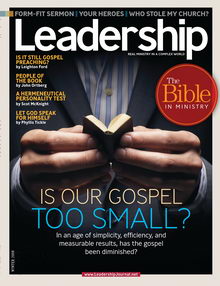
Pastors walk a fine line when they open their Bibles to help hurting or struggling people. On one side of that line is what David Powlison, editor of the Journal of Biblical Counseling, calls “verse magic,” stereotyped as “take two verses and call me in the morning.”
On the other side is “far horizon exposition,” safely but vaguely applying the Bible to the distant future, failing to make specific connections between God’s Word and life’s struggles.
Recognizing these risks, Powlison still boldly advocates using the Bible in pastoral counseling. But this means more than believing in the truthfulness and relevance of Scripture. It’s a developed skill—applying Scripture effectively to life’s problems.
Do you see the connections?
If, as Tim Keller says, “All our problems come from a failure to apply the gospel,” then biblical counseling means (1) understanding the truth of God’s Word, and (2) understanding at what point in her life a counselee is failing to apply it.
Powlison calls this task “double exegesis.”
Rather than interpreting only the text, the pastor must also interpret the problem by asking: Who is this person? What is she facing? How does she understand the world?
Todd Augustine, a pastor at College Church in Wheaton, Illinois, recalls ministering to a couple in the hospital whose premature baby had just died. “Holding that lifeless infant, I realized that my words were going to feel flat and empty, but I knew there was a substantive word that could speak to their grief and loss—God’s Word.”
Augustine didn’t open his Bible to the “obvious” account of David’s dead son in 2 Samuel 12. Rather, sensing the parents’ questions and pain, he opened his Bible to passages about God’s wisdom, purpose, and ceaseless love, beginning in Lamentations 3: “Because of the Lord’s great love, we are not consumed, for his compassions never fail.”
Is the timing and touch point right?
Mike Bullmore, pastor of Crossroads Community Church in Kenosha, Wisconsin, prays before meeting with someone, “Lord, help me to know not just what to say, but when to say it.”
Waiting on God’s timing, many who counsel advise against turning to Scripture too quickly. Instead, as they focus on the personal side of “double exegesis,” they try to locate patterns of sin, sorrow, and pain in the life of a counselee.
“I remember counseling a young man through mild depression,” recalls counselor Michael Emlet. “As we talked through his condition, two issues surfaced: ‘fear of man’ issues—the absolute control that the opinions of others held over him; and perfectionism—higher standards for himself than God had.”
As Emlet turned to Scripture, he opened not to passages about “joy in the Lord” to counter depression, but rather to passages dealing with his patient’s core issues of fear and perfectionism.
Are you ready for this?
In a Freud-friendly culture, many people are unprepared for counseling that uses Scripture as both a starting point and a method. So Bullmore begins sessions explaining how his counseling requires humility and honesty from the counselee.
“We’re the church,” Bullmore states. “We use the categories of Scripture,” not necessarily those of secular psychology. Since pastoral counseling is voluntary, most are open to seeing issues in the light of sin, grace, redemption, reconciliation, and God’s sovereignty.
Even so, complications arise. Medical problems complicate a counselee’s struggle. Emlet advises pastors to practice biblical counseling in concert with medical or psychiatric treatments. Doing so recognizes what Scripture teaches: that we are both physical and spiritual beings; sometimes we need help in both areas.
Copyright © 2008 by the author or Christianity Today/Leadership Journal.Click here for reprint information on Leadership Journal.