Article

Which Half-Brain Do You Lead With?

Comparing the latest books by Andy Stanley and Tim Keel.

There are two very different approaches to church leadership today. One is practical, focused on measurable outcomes, and concrete. Call it “left-brained.” The other is intuitive, focused on process, and organic. Call it “right-brained.” From these two mindsets have emerged two effective, respected church leaders with two new books. Andy Stanley is founding pastor of North Point, a megachurch near Atlanta. Tim Keel is founding pastor of Jacob’s Well, an emerging church in Kansas City.

Even their book titles reveal their divergent views of leadership. Stanley’s title, Making Vision Stick, communicates the pragmatic, how-to nature of his book. Keel, in contrast, declares, “This book is not a manual.” Instead, Intuitive Leadership is all about story. Keel shares large portions of his own story, moving us from his childhood, through college, seminary, and into pastoral ministry.

My husband and I were driving toward our rural home when I spotted three deer about to cross in front of us. Noticing that my husband wasn't slowing down, I reached over, gently touched his arm, and said, "Honey … deer."

He still didn't slow down, so I repeated more firmly, "Honey … deer!"

Suddenly, he hit the brakes, veered, and managed to miss all three. After I caught my breath from our near-miss, I asked him why he hadn't paid attention when I warned him.

"Warned me?" he said. "I thought you were being romantic."
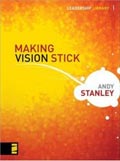
Making Vision Stick by Andy Stanley Zondervan, 2007

Keel then takes the reader through a sweeping story of world history to explain how we arrived at Postmodernity. Not until page 228 does he give any practical application regarding these cultural shifts. And even this is not in the form of concrete action steps, but rather nine changes in “posture” important for ministry in this new world.

While the right-brained Intuitive Leadership is all about story, the left-brained Making Vision Stick is all about steps. Stanley’s book is so short, so practical, it doesn’t even need a table of contents. From “State the vision simply” to “Live the vision personally,” he gives handy instructions with examples from North Point.

The differences between Keel and Stanley go beyond style, however. They have very different views of the leader’s role. For Stanley, the leader is central to a church’s vision, responsible for creating it, communicating it, and maintaining it. “When a leader blames the follower for not following, the leader has ceased to lead,” he writes.

Keel, by contrast, presents a decentralized approach in which direction is discovered from within the community. In this setting, the leader’s primary role is that of environmentalist, not program director; one of asking questions, not giving answers. “Such a move requires that you trust the people with whom you dialogue enough to listen to what they have to say.”

While Stanley clearly believes in the importance of a central visionary leader, he does not advocate North Point’s vision as normative for everyone. He shares his own church’s story but never suggests that vision is best for another church. Both Keel and Stanley understand the importance of context.

Keel emphasizes contextualized leadership. Stanley ideas of contextualization are more subtle, but both clearly understand that their churches’ unique callings should not be generalized.

Both authors also understand systems and what can sabotage their effectiveness. Stanley writes, “It’s tough to make vision stick. Time has a way of eroding the adhesive.” Keel agrees, “Organizations, as they mature, often lose sight of the original spirit that animated them.”
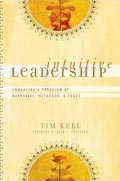
Intuitive Leadership: Embracing a Paradigm of Narrative, Metaphor, and Chaos by Tim Keel Baker, 2007

As for the criticism of the emergent movement being anti-structure, Keel plainly states, “Structure is not a bad thing. Structures support or inhibit life.” But he adds that settling for mere programs “relieves the people from stretching and doing the hard work of building relationships.”

Both books are worth reading, but they have very different objectives. Keel wants to change how leaders think. He seeks to convince readers of the need for a massive shift in how leadership looks. Stanley keeps the goal simple: to make vision stick.

Taken together, the two books with their divergent perspectives, provide a full and complementary picture of effective leadership today. That’s some real brain power.

Copyright © 2008 by the author or Christianity Today/Leadership Journal.Click here for reprint information on Leadership Journal.

Posted May 2, 2008

Also in this issue

Leading isn't just a one-person job. Here's how it's getting done today.

Difficult Sermon? Call in a Team

When the topics get tough, this preacher gets help.

Ministry in the Middle

We asked two PKs who are now raising their own PKs to tell us how they navigate ministry and family life.

Parish Without Partners?

It took a church and a social service agency teaming up to bring good news to a tough Chicago neighborhood.

Rethinking "Team" Terminology

More artistic leaders are looking for an alternative to sports metaphors in ministry.

Walking in Step

Elders and ministers can lead successfully together if they share these four priorities.

Launching a Remarriage Ministry

Saving second marriages before they start.

The Spotlight Syndrome

How do you raise a family while leading a church?

My 3x5 Salvation

When words fail, the Word I’ve memorized is there.

Apostles Today?

Rediscovering the gift that leaves churches and well-connected pastors in its wake.

Why Can't I Shake My Sins?

A surprising answer to a stubborn problem.

What Are You Focused On?

Prayer ensures the sermon reflects Christ, and not just the preacher.

Ministry's Sweet Spot

It wasn’t till we attempted the untried and untested that I discovered …

Tending or Processing?

Maybe sustainable agriculture is a better model for church life than a feed lot.

Ethnic Blends?

How do you develop a racially diverse leadership team? Are quotas the right recipe?

Keeping It Real

Can staged worship “experiences” lead to a false gospel?

The Gospel in All its Forms

Like God, the gospel is both one and more than that.

Three Overlooked Leadership Roles

We’re familiar with pastors and teachers, but today’s world needs a leadership team that includes APE, three biblical but forgotten functions.

Serving Is Believing

Rallying Christians and non-Christians around community needs may invigorate your outreach.

Sharing the Driver's Seat

When pastors team up to write the week’s sermon, can they avoid oncoming traffic?

Preaching to the Choir

Should unbelieving musicians be allowed to play with the worship team?

Next & Level

After a bad experience with personality-based, top-down leadership, a whole new approach was needed at what is truly The Next Level Church.

This Is It

What kind of groundwork leads to real community?

Ministry Team Diagnostics

How to avoid the 5 most common dysfunctions of a ministry team.

Church Attendance Record

Transformation without Changes

Too Content after Conversion

Modern-Day Israelite Complaining

High-Tech First Century Church

Using You for Sermon Illustration

Finance Committee Recommendation

Pastoral Delegation

View issue


Our Latest

Apple PodcastsDown ArrowDown ArrowDown Arrowarrow_left_altLeft ArrowLeft ArrowRight ArrowRight ArrowRight Arrowarrow_up_altUp ArrowUp ArrowAvailable at Amazoncaret-downCloseCloseEmailEmailExpandExpandExternalExternalFacebookfacebook-squareGiftGiftGooglegoogleGoogle KeephamburgerInstagraminstagram-squareLinkLinklinkedin-squareListenListenListenChristianity TodayCT Creative Studio Logologo_orgMegaphoneMenuMenupausePinterestPlayPlayPocketPodcastRSSRSSSaveSaveSaveSearchSearchsearchSpotifyStitcherTelegramTable of ContentsTable of Contentstwitter-squareWhatsAppXYouTubeYouTube
Down ArrowbookCloseExpandExternalsearch