Sorry, something went wrong. Please try again.
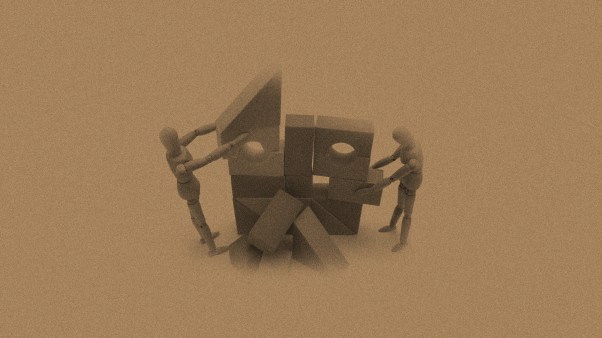
During a gathering of entrepreneurs in Las Vegas one of the speakers was a brand architect at Lego. During his presentation, he handed each attendee six Lego bricks. Then he asked them to estimate the number of unique combina¬tions that could be created with those six bricks. This sounded like a trick question, so one attendee aimed high and guessed several hundred combina¬tions. That left him several hundred million short of the actual answer!
Are you ready for this? The total number of possible permutations—six bricks with eight studs each—is 915,403,765. Nearly a billion possible permutations with six Lego bricks!
While the number of possible Lego combinations is mind-boggling, it pales in comparison to the sheer complexity and potential combinations found within DNA. Here's why:
Legos have a limited number of ways they can connect. DNA, on the other hand, uses four different "bases" (adenine, guanine, cytosine, and thymine) that can pair in specific ways. However, the sequence of these base pairs is what carries the genetic information, and this sequence can vary enormously.
A single strand of DNA can contain millions or even billions of these base pairs. A gene, which is a specific segment of DNA, might be hundreds or thousands of base pairs long. The number of possible sequences for a gene, let alone an entire DNA molecule, is astronomically huge.
To give you a sense of the scale, the human genome contains roughly 3 billion base pairs.
Even a relatively short gene of 1,000 base pairs has 4^1000 possible sequences (4 because there are 4 bases). That's a 4 followed by 1,000 zeros, a number far exceeding the number of atoms in the known universe!
Possible Preaching Angle:
The information encoded in DNA is incredibly vast and precisely organized, making the Lego analogy seem in comparison. It serves as a powerful reminder of the awe-inspiring power and intelligence behind creation and is a testimony to the purposeful Creator behind life.
Source: Adapted from Editor, “What Is a Gene?” MedlinePlus.gov (Accessed 2/12/25); Bruce Alberts et al., Molecular Biology of the Cell (Garland Science, 2014); Mark Batterson, A Million Little Miracles (Multnomah, 2024), p. 37.
In his book, A Million Little Miracles, Mark Batterson believes we’re walking through a world brimming with the miraculous—we just don’t have the eyes to see it.
“There are miracles happening all around us all the time, hidden in plain sight,” Batterson says. “If you miss them, life can become a little bit of a chore and a bore. But if you rediscover the miracle that is life, it takes on a different dimension.”
It’s not just the big, cinematic miracles—the Red Sea parting or a blind man seeing. It’s the fact that we’re currently spinning at 1,000 miles per hour on a planet hurtling through space at 67,000 miles per hour, all while our bodies conduct trillions of biochemical reactions every second.
What if the real problem isn’t that miracles are rare—it’s that we’ve trained ourselves not to notice them? Psychologists call it “inattentional blindness.” If something is constant—like the sun rising, our hearts beating, or our lungs breathing—we stop paying attention to it. Batterson explains, “We should be startled by the sun, not the eclipse.”
The same is true of our own bodies. Batterson says:
Right now, you have 37 sextillion biochemical reactions happening inside of you. Your heart will beat 100,000 times today, pumping six quarts of blood through 60,000 miles of veins, arteries, and capillaries—that’s twice the circumference of the Earth. And yet, we go about our day saying, ‘Well, I’ve never seen a miracle.’ With all due respect, you’ve never not seen one. In fact, you are one.”
So how do we start seeing the miracles around us? Learn to take nothing for granted. To wake up each day and marvel at the ordinary. To stop waiting for the grand, spectacular moment and realize that the spectacular is happening all around us, all the time. And maybe, just maybe, if we start paying attention, we’ll realize that life itself is the miracle we’ve been waiting for.
Source: Emily Brown, "Think You've Never Witnessed a Miracle? Think Again," Relevant Magazine (3-10-25)
Not all deconstruction is the same. A pastor offers three categories to help you listen better and shepherd well.
A humpback whale briefly swallowed a kayaker off Chilean Patagonia before quickly releasing him unharmed. The incident, caught on camera, quickly went viral. Adrián Simancas was kayaking with his father, Dell, near the San Isidro Lighthouse when a humpback whale surfaced, engulfing Adrián and his yellow kayak for a few seconds before letting him go.
Dell, just yards away, captured the moment on video while encouraging his son to stay calm. “Stay calm, stay calm,” he can be heard saying after his son was released from the whale’s mouth.
“I thought I was dead,” Adrián said. “I thought it had eaten me, that it had swallowed me.”
He described the “terror” of those few seconds and explained that his real fear set in only after resurfacing, fearing that the huge animal would hurt his father or that he would perish in the frigid waters.
Despite the terrifying experience, Dell remained focused, filming, and reassuring his son while grappling with his own worry. After a few seconds in the water, Adrián managed to reach his father’s kayak and was quickly assisted. Despite the scare, both returned to shore uninjured.
Reports of such incidents are rare but not unheard of: In 2021, a Massachusetts lobster diver said a humpback whale had scooped him up and spit him out. But, unlike the Old Testament's Jonah, these men didn't spend three days and nights in the belly of the whale — they didn't even reach it, nor could they have. Experts say it's just not possible for a whale to swallow something as large as a person. While their mouths are massive — as wide as 10 feet — their throats are much smaller, roughly the size of a human fist.
You can watch the short video clip here
Editor’s Note: We know that the Bible does not state that Jonah was swallowed by a “whale” but by a “great fish.” (See Addendum below). Still, the video makes a graphic illustration for the true story of Jonah, regardless of what type of “great fish” swallowed him.
Addendum:
The Bible actually does not teach that Jonah as swallowed by a “whale.” The Bible doesn’t specify what sort of marine animal it was. The Hebrew phrase used in the Old Testament, gadowl dag, literally means “great fish.” The Greek used in the New Testament is këtos, which simply means “sea creature.” There are at least two species of Mediterranean marine life that are able to swallow a man whole. These are the cachalot (also known as the sperm whale) and the white shark. Both creatures are known to prowl the Mediterranean and have been known to sailors since antiquity. Aristotle described both species in his fourth-century-BC Historia Animalium. Jesus spoke of Jonah’s ordeal as a real historical event. He used it as a typological metaphor for His own crucifixion and resurrection (Matt. 12:40-41).
Source: Editor, “A humpback whale briefly swallows kayaker in Chilean Patagonia — and it’s all captured on camera,” Associated Press (2-13-25); Rachel Treisman, “Did a whale swallow a kayaker? The truth behind the viral video,” NPR (2-14-25); Staff, “Was Jonah truly swallowed by a whale?” GotQuestions.org (Accessed 2/16/25)
In October 2022 a bird with the code name B6 set a new world record. Over the course of 11 days, B6, a young Bar-tailed Godwit, flew from its hatching ground in Alaska to its wintering ground in Tasmania, covering 8,425 miles without taking a single break. For comparison, there is only one commercial aircraft that can fly that far nonstop, a Boeing 777 with a 213-foot wingspan and one of the most powerful jet engines in the world.
During its journey, B6—an animal that could perch comfortably on your shoulder—did not land, did not eat, did not drink, and did not stop flapping, sustaining an average ground speed of 30 miles per hour 24 hours a day as it winged its way to the other end of the world.
Many factors contributed to this astonishing feat of athleticism—muscle power, a high metabolic rate, and a physiological tolerance for elevated cortisol levels, among other things. B6’s odyssey is also a triumph of the remarkable mechanical properties of feathers. Feathers kept B6 warm overnight while it flew above the Pacific Ocean. Feathers repelled rain along the way. Feathers formed the flight surfaces of the wings that kept B6 aloft and drove the bird forward for nearly 250 hours without failing.
Research shows that feather shape is largely optimized to allow the feather to twist and bend in sophisticated ways that greatly enhance flight performance. Merely being anatomically asymmetrical doesn’t mean much. What matters is that the feather is aerodynamically asymmetrical. That is, the trailing blade needs to be three times wider than the leading one. Below this ratio, the feather twists in a destabilizing rather than stabilizing way during flight.
Editor’s Note: This small bird is one example of the creative wisdom of God. This article goes on to attribute the marvel of the flight in this bird to evolution. However, the Bible says that all of creation shows the glory of intelligent design by God for those who are willing to see it (Ps. 19:1-6; Rom. 1:18-25).
Source: Michael B. Habib, “Why Feathers Are One of Evolution’s Cleverest Inventions,” Scientific American (4-16-24)
Sharing a Christian worldview with others can often create tense situations. Especially when we are talking with friends and family who do not share our views.
A "Profile" article in The New Yorker spotlighted Ross Douthat, a popular Times columnist. The title of the article is noteworthy: "The Believer: Ross Douthat's Theories of Persuasion." Douthat is a conservative leaning Catholic who is a pro-lifer and an advocate for traditional marriage.
How does he negotiate working with colleagues whose views are radically different from his own? The article offers one example that might be instructive.
In 2015, Douthat wrote a piece critical of the Supreme Court's decision to legalize gay marriage, expressing concern that it reflected a "more relaxed view of marriage's importance." Before releasing it, he thought of Michael Barbaro. Barbaro has been a close friend of Douthat's since childhood. He refers to himself as Douthat's "sidekick." And Barbaro was married to a man. Barbaro recalls:
We hadn't been in touch that much, but Ross reached out to me to say, “I'm about to publish a column in which I come out against same-sex marriage. I want you to know that it didn't come to me easily. It's something I know may be sensitive to you. And, as somebody I care about, I want you to understand it. I don't want you to read about it in my column without us talking about it.”
When Barbaro shared how much he appreciated the note, Chotiner, the New Yorker reporter conducting the interview, was surprised, Barbaro should have been furious! Why wasn't he? Barbaro explained:
I was wounded by the position he took on a personal level. How could I not be? But it was meaningfully tempered by the reality that I knew where he was coming from, and that he had gone to the trouble to reach out to me.
Barbaro and his husband later divorced. When Chotiner interviewed him, Ross was on vacation with his wife and two children. He shared, "I've been on a long journey that I know Ross generally approves of. But, although I didn't do it for him, it's very funny, as I have had children, I can just sense his glee. It's no secret that he wants people to have children and to enter into monogamous heterosexual relationships." Barbaro let out a laugh. "And that wasn't my plan, but I have sensed his joy at that outcome."
Part of the pressure of sharing our Christian worldview comes from our mistaken belief that we must convince others of our views. But our job is much simpler than all that. We are called only to speak the truth in love. And you'd be surprised at how persuasive that simple act can be.
Source: Isaac Chotiner, "The Believer; Ross Douthat's Theories of Persuasion," The New Yorker (September, 2023)
In an issue of CT magazine, author Jordan Monge shares her journey from atheism to faith in Christ. She writes:
I don’t know when I first became a skeptic. It must have been around age 4, when my mother found me arguing with another child at a birthday party: “But how do you know what the Bible says is true?” By age 11, my atheism was widely known in my middle school and my Christian friends in high school avoided talking to me about religion because they anticipated that I would tear down their poorly constructed arguments. And I did.
Jordan arrived at Harvard in 2008 where she met another student, Joseph Porter, who wrote an essay for Harvard’s Christian journal defending God’s existence. Jordan critiqued the article and began a series of arguments with him. She had never met a Christian who could respond to her most basic questions, such as, “How does one understand the Bible’s contradictions?”
Joseph didn’t take the easy way out by replying “It takes faith.” Instead, he prodded Jordan on how inconsistent she was as an atheist who nonetheless believed in right and wrong as objective, universal categories.
Finding herself defenseless, Jordan took a seminar on metaphysics. By God’s providence her atheist professor assigned a paper by C. S. Lewis that resolved the Euthyphro dilemma, declaring, “God is not merely good, but goodness; goodness is not merely divine, but God.”
A Catholic friend gave her J. Budziszewski’s book Ask Me Anything, which included the Christian teaching that “love is a commitment of the will to the true good of the other person.” The Cross no longer seemed a grotesque symbol of divine sadism, but a remarkable act of love.
At the same time, Jordan had begun to read through the Bible and was confronted by her sin. She writes:
I was painfully arrogant, prone to fits of rage, unforgiving, unwaveringly selfish, and I had passed sexual boundaries that I’d promised I wouldn’t …. Yet I could do nothing to right these wrongs. The Cross looked like the answer to an incurable need. When I read the Crucifixion scene in the Book of John for the first time, I wept.
So, she plunged headlong into devouring books from many perspectives, but nothing compared to the rich tradition of Christian intellect. As she read the works of Augustine, Aquinas, Pascal, and Lewis, she knew that the only reasonable course of action was to believe in the death and resurrection of Jesus Christ.
If I wanted to continue forward in this investigation, I couldn’t let it be just an intellectual journey. Jesus said, “If you hold to my teaching, you are really my disciples. Then you will know the truth, and the truth will set you free” (John 8:31–32). I could know the truth only if I pursued obedience first.” I then committed my life to Christ by being baptized on Easter Sunday, 2009.
God revealed himself through Scripture, prayer, friendships, and the Christian tradition whenever I pursued him faithfully. I cannot say for certain where the journey ends, but I have committed to follow the way of Christ wherever it may lead. When confronted with the overwhelming body of evidence I encountered, when facing down the living God, it was the only rational course of action.
Editor’s Note: Jordan Monge is a writer, philosopher, and tutor. She is also a regular contributor to the magazine Fare Forward and for Christianity Today.
Source: Jordan Monge, “The Atheist’s Dilemma,” CT magazine (March, 2013), pp. 87-88
Every person starts as one fertilized egg, which by adulthood has turned into roughly 37 trillion cells. But those cells have a formidable challenge. These cells must copy 3.2 billion base pairs of DNA perfectly, about once every 24 hours. To speed up the process, cells start replication in multiple spots with people having tens of thousands of them throughout their genomes.
However, this poses its own challenge: How to know where to start and how to time everything. Without precision control, some DNA might get copied twice, causing cellular pandemonium. Bad things can happen if replication doesn’t start correctly. For DNA to be copied, the DNA double helix must open up, and the resulting single strands are vulnerable to breakage or the process can get stuck.
It takes a tightly coordinated dance involving dozens of proteins for the DNA-copying machinery to start replication at the right point in the cell’s life cycle. Keeping tight reins on the kickoff of DNA replication is particularly important to avoid that pandemonium.
Today, researchers are making steps toward a full understanding of the molecular checks and balances that have evolved in order to ensure that each origin initiates DNA copying once and only once, to produce precisely one complete new genome.
3,000 years ago, King David exclaimed, “I praise you because I am fearfully and wonderfully made; your works are wonderful, I know that full well” (Ps. 139:14). Scientific knowledge has increased exponentially since that time and we should be even more in awe of God’s creative genius on display.
Source: Amber Dance, “Clever DNA tricks,” Knowable Magazine (6-26-23)
It is impossible to do justice to the wonder of the creation of the world and everything in it. You and I have to work hard to make anything. Even when you buy a piece of furniture from IKEA, with all the pieces properly designed and a booklet of instructions, you are driven to the edge of your sanity trying to follow the instructions and assemble what you bought.
All of our DIY projects require mental focus, physical dexterity, and perseverance. We struggle to make things, even though we always start with raw materials, are following instructions, and have collected the appropriate tools. But you and I have never created anything; we do not make something out of nothing. C. S. Lewis said it this way: "Creation, as it is for God, must always remain totally inconceivable to man. We only build. We always have materials to build from.”
The truth of creation should fill us with awe, humble us, and drop us to our knees. God, with nothing more than his will and his word literally spoke the universe into existence. Think of huge galaxies and little ants. Think of the body of an elephant and the translucent creatures that swim in the deepest trenches of the sea. Think of huge towering trees and microscopic organisms. Think of the technology of the human eye and the intricate design of your hand. Genesis 1 and 2 are meant to put you in your place and insert God in his proper place in your heart and life.
Source: Paul David Tripp, “Do You Believe?” (Crossway, 2021), pp. 195-196
Researchers reported recently that it is striking that water is the “least understood material on Earth.” In an article, researchers ask, “What could we not know about water? It’s wet! It’s clear. It comes from rain. It boils. It makes snow and it makes ice! Does our government actually spend taxpayer money to study water? Yes, water is common—in fact, it is the third most common molecule in the universe. But it is also deceptively complex.” From steam to ice, water continues to mystify. Here are several of the weird facts about water:
Why Does Ice Float?
Researchers tried to tease apart what makes water unique among liquids. It’s got anomalous properties, like expanding when cooled below 40 degrees Fahrenheit. (This) explains why lakes freeze downward, from top to bottom, rather than up. Normally frozen solids are denser than their liquid equivalents, which would mean that frozen chunks would fall to the bottom of a lake instead of staying on top. But when water freezes, it creates an open structure, mostly empty space and less dense than … liquid water, which is why water props ice up.
Why Can Insects Walk On It?
Water has an uncanny level of surface tension, allowing beings light enough, like insects, to walk or stand atop it. Since it’s these distinctive features among others that power our climate and ecosystems, water can appear to be “fine-tuned” for life according to the researchers.
How Does Water Evaporate?
The rate of evaporation of liquid water is one of the principal uncertainties in modern climate modeling. ... The addition of salts to water raises the surface tension … and so should reduce the evaporation rate. But experimental studies show little or no effect when salts are added. The exact mechanism for how water evaporates isn’t completely understood.
These researchers point out some of the weird anomalies of water, which covers 71% of the surface of our world. Although they do not acknowledge God in their research, they do admit that “water can appear to be ‘fine-tuned’ for life.” Christians would respond that without its God-given properties, lakes would freeze from the bottom up, killing all fish in them. And, although the salt in oceans should inhibit evaporation, the water in the oceans evaporates, producing rain over the land. These are some examples of “Intelligent Design” in which our wise creator fine-tuned the earth to sustain life and provide for our needs and enjoyment of life.
Source: Adapted from Jackie Ferrentino & Richard Saykally, “Five Things We Still Don’t Know About Water,” Nautilus (6-6-2020); Brian Gallagher, “Why Water is Weird,” Nautilus (4/23/18)
Writing for The Atlantic, David Merritt Johns says that a most confounding story appeared in his inbox by a tipster who prefaced it by saying, “I’m sorry, it cracks me up every time I think about this.”
Harvard doctoral research student Andres Korat found a curious result from a 2018 study: Among diabetics, eating half a cup of ice cream a day was associated with a lower risk of heart problems. After consulting with his department chair, Korat set out to debunk his initial finding with more research, but it ended up being stubbornly consistent.
Korat wrote in his findings, “There are few plausible biological explanations for these results.” But he also mentioned several prior studies that found similar results. Mark Pereira is an epidemiologist who authored one of those prior studies. He said, “I still to this day don’t have an answer for it.”
In his deep dive into the story, Johns claims that several medical researchers ended up spinning their data into conclusions more readily acceptable to mainstream audiences. Instead of touting the health benefits of ice cream, they pivoted to yogurt. One research paper read: “Higher intake of yogurt is associated with a reduced risk of type 2 diabetes. Whereas other dairy foods and consumption of total dairy are not.”
“The conclusions weren’t exactly accurately written,” acknowledged Dariush Mozaffarian, who co-authored the paper. “Saying no foods were associated—ice cream was associated.”
Even with advances in medical knowledge and technology, the human body is complex and full of surprises. Only God understands it fully, and our best attempts are foolish compared to God's wisdom.
Source: David Merritt Johns, “Nutrition Science’s Most Preposterous Result,” The Atlantic (4-13-23)
Each morning Alexander Chu awakened to the smell of incense burning offered in front of Buddha statues. His home was like a temple. On each wall hung a Buddha portrait, totaling more than 30 deities throughout the house.
You might think the family lived on a street in Thailand or China yet his home was in Lawrence, Kansas. His father was a science professor with a Guggenheim Award, and his mother was a so-called “tiger mom” who kept the pressure on Andrew and his two sisters for straight A’s.
My Taiwanese family lineage includes generations of Buddhists, so religion was destined to be integral to my identity formation. Yet outside our home, our neighbors pursued an entirely different faith. Somehow, I managed to go through 18 years of life without ever hearing the Good News of Jesus.
In the mid-1990s, Andrew arrived at the University of Illinois at Urbana–Champaign. His dorm was full of fervent Christians. These InterVarsity Christian Fellowship students were the first Asian American Christians he had ever met. Andrew said, “Living with them, I began to realize that the Buddhism of my upbringing was not in my heart.”
Growing curious about Christianity during his sophomore year, Andrew asked a friend if he could join him at an IVCF gathering. There for the first time he heard God’s promises declared in worship songs and saw men and women praising him. He joined GIG (Groups Investigating God) and began studying the Gospel of John. Andrew said, “The authority with which Jesus spoke amazed me; it’s as if his words jumped off the pages, addressing me directly.”
Before I could place faith in Jesus, I needed to know there was a rational basis for Christianity’s foundational truths. I attended a retreat sponsored by InterVarsity, where I took an apologetics track. I heard well-founded explanations of the inspiration of Scripture, the problem of evil, and the uniqueness of the gospel. I found that Christianity was the most intellectually stimulating worldview I had ever encountered.
During my junior year I started reading John Stott’s pamphlet “Becoming a Christian.” While reading, I grew convinced of my sin and need to be forgiven. I knelt down committed my life to Christ. I had grown up in a sea of deities, yet never had a relationship with any of them. On that day, I experienced the living God, Emmanuel: “God is with us.” A peace overtook me. That night I became the first Christian in our family’s lineage.
For months he prayed about how to tell his parents what had happened. When he was at home for winter break, he sat in the living room to read Following Jesus Without Dishonoring Your Parents. His father was stunned by his reading choice, but also pleased by the dutiful title of the book. When he asked why Andrew was reading it, he told him that he had become a Christian. His parents insisted that the family religion was Buddhism. Both parents held out hope that he would come to his senses and return to the Buddhist faith.
As the years passed, I started to discern a call to vocational ministry. My parents said that if I followed through with this plan, they would cut me off. Sensing disunity in our home, I decided to stay and care for my father, who was battling heart disease. My presence and devotion built mutual respect and helped preserve our relationship. In God’s timing, my family softened to my hopes of becoming a pastor. My parents continue to share their Buddhist experiences with me, and I continue to share my faith with them. My mom regularly prays to Jesus to bless and protect me.
Editor’s note: Andrew now serves on staff as pastor of outreach at a multisite church in the Chicago suburbs.
Source: Alexander Chu, “Beyond Buddha to Beloved,” CT magazine (June, 2014), pp. 79-80
Physicist Sabine Hossenfelder is a research fellow at the Franklin Institute for Advanced Studies in Germany. Her YouTube channel has over 550,000 subscribers. She admits she cringes when scientists like the late Stephen Hawking, and many others, make numerous unsubstantiated pronouncements like “there is no possibility of a creator.” She is uncomfortable with “overconfident proclamations” like widely held beliefs on the origin of the universe, the existence of other universes, and other unverifiable beliefs.
Hossenfelder wants scientists to be:
… mindful of the limits of their discipline. Sometimes the only scientific answer we can give is “We don't know.” It therefore seems likely to me that, in our ongoing process of knowledge discovery, religion and science will continue to co-exist for a very long time. That's because science itself is limited, and where science ends, we seek other modes of explanation.
(Some) of these limits stem from the specific math we currently use (which, for example, requires initial conditions or indeterministic jumps), and they may be overcome as physics advances further. But some limits seem insurmountable to me. Eventually, I think, we will have to accept some facts about our universe without scientific explanation, if only because the scientific method can't justify itself. We may observe that the scientific method works, conclude that it's to our advantage to continue using it, but still never know why it works.
Source: Sabine Hossenfelder, Existential Physics: A Scientist's Guide To Life's Biggest Questions, (Viking Press, 2022), p. 218
Pastor Mark Clark was raised in a staunchly atheistic household but came to Christ once he became convinced of the power and soundness of Christianity. He writes:
I heard about Christianity for the first time at a summer camp when I was nine years old. I was fascinated by the concept of God. Not enough to get me to attend church or read a Bible but enough that I found myself going back to the camp every year and talking about God. Then I came home to a very different life: Stealing from cars, stores, and the purses of my friends’ mothers—to get money for drugs, partying, and everything else you do when you don’t have God in your life.
Mark began using drugs at eight years old and they became a regular part of his life by high school. Once he nearly died from an overdose, lying glassy-eyed in the street. His parents divorced when he was eight and he developed Tourette syndrome which later grew into obsessive-compulsive disorder.
My father was a classic deadbeat dad. He died of lung cancer when I was 15 and I never got to say goodbye to him. Sitting in that very lonely funeral home, pondering where exactly my father was, I asked myself: “What do I believe? About God, myself, heaven and hell? What do I believe about eternity and morality and my father? Where is he?”
When Mark was 17, he met Chris, a former drug dealer at his school, who had become a follower of Jesus. Mark was intrigued by his life and his passion for God. Chris challenged him to examine his doubts, read the Bible, pray, and think about what he believed about life and God.
I began to wrestle with the existence of God, with questions of suffering and evil and with the reliability of the Bible. I wrestled with the doctrine of hell and how God could allow my father to go to a place of everlasting torment. But the more I explored, the more I saw the emotional power and philosophical soundness of Christianity.
The year I met Chris, I gave my life to Christ and began a journey of total transformation. The most powerful catalyst was the Bible itself. I spent two years reading the Bible. I felt like I had been set free from all the shame, guilt, and powerlessness I had known growing up, and I was confident others would want that freedom too.
People often ask me where my passion for defending Christianity comes from. As a longtime doubter myself, I delight in showing other doubters that Christianity is real—historically verifiable, philosophically compelling, consistent with science, and full of satisfying answers to our deepest questions about life’s purpose.
Source: Mark Clark, “A Skeptic Learns to Doubt His Doubts,” CT magazine (December, 2017), pp. 78-79
A team of archaeologists with the Archaeological Studies Institute believes it has found a tablet dating back to 1400 BC. Institute Director, Scott Stripling, says the tablet pre-dates the commonly held belief about when the Bible was written by as much as 800 years. If true, this would dispel the theory that the Bible was written around 600 years after the occurrence of some of the first events it describes. This means that the events were written as a firsthand account rather than after the fact.
Stripling continued, “Some scholars believe in something called the ‘documentary hypothesis,’ which states that the Bible was composed hundreds of years apart in different sections, and then later redacted. The tablet is a problem for that theory and the idea that Moses could not have written the Pentateuch. ... This type of writing is more characteristic of the very beginning of the Late Bronze Era II horizon around 1400 B.C. For those who want to push the Exodus date way off into the future, this is really problematic for them.”
Houston Baptist University Professor, Craig Evans, said; “This tablet contains the oldest text that we know of so far. It also correlates with two passages in the book of Deuteronomy where it talks about going up on Mount Ebal, building an altar and cursing the enemies of Yahweh in Israel … The skepticism that nobody could write Hebrew that far back—is just an unwarranted skepticism."
The tablet has major religious and historical implications. If the peer review of Stripling’s discovery confirms his claims, it could dispel the liberal idea that the Old Testament was written in 600 BC.
Source: Claire Goodman, “New details emerge about Katy archaeologist's ‘curse tablet’ that could shake up Biblical timeline,’” Houston Chronicle (4-5-22)
Once, when a little girl asked Albert Einstein if scientists pray, Einstein replied in part, “Everyone who is seriously involved in the pursuit of science becomes convinced that a spirit is manifested in the laws of the universe—a spirit vastly superior to that a man, and one in the face of which we with our modest powers must feel humble.”
Then in an interview before his 50th birthday, Einstein was asked if he believed in God. Einstein said,
I’m not an atheist. The problem involved is too vast for our limited minds. We are in the position of a little child entering a huge library filled with books in many languages. The child knows someone must’ve written those books. He does not know how. He does not understand the languages in which they are written. The child dimly suspects a mysterious order in the arrangement of the books but doesn’t know what it is. That, it seems to me, is the attitude of even the most intelligent human being toward God. We see the universe marvelously arranged and obeying certain laws but only dimly understand these laws.
Source: Gavin Portland, Why God Makes Sense in a World that Doesn’t (Baker Academic, 2021), pp. 52 to 53
Life on Earth requires a lot of “fine tuning.” Our planet is just the right distance from the Sun to allow freezing and melting, and the planetary axis tilted just so for seasons. There is a moon for tides to circulate and cleanse shores and oceans, an atmosphere to distribute heat (otherwise the sun-side would cook as the night-side froze), and a magnetic field that contributes to our protection from harmful solar radiation.
That all these needs were met (and many more) is all a big (coincidence) for evolutionists – we just lucked out and got just what we needed.
But we didn’t need rainbows. And yet, as astronomer Guillermo Gonzalez recently noted, we’re on the only planet in the Solar System to get them. What’s needed for a rainbow is:
Suspended water droplets in the atmosphere and the direct sunlight that results from the sun being between the horizon and 42 degrees altitude. This typically occurs just after a thunderstorm has passed and small droplets are still in the atmosphere, and the sky is clearing in front of the sun. Seems like a simple setup. This must be a common phenomenon in the cosmos, right?
But it isn’t so simple. Our moon doesn’t have the atmosphere. Mars doesn’t have the moisture. Venus has too thick an atmosphere and as we head further out, the other planets don’t have liquid water. So, the only planet to have rainbows is the only one with people on it to see them. To evolutionists that’s just one more (coincidence). To God’s people, just another example of his love and care. It’s as if someone has been trying to get our attention with a pretty shiny object writ large across the sky, saying, “Look here. ... This is important!” “I have set my rainbow in the clouds, and it will be the sign of the covenant between me and the earth” (Gen. 9:13).
Source: Jon Dykstra, “Only Earth Has Rainbows,” Reformed Perspective Tidbits (3-18-22)
Wesley So, the current US Chess Champion (in 2017, 2020, and 2021), shares how he came to Christ:
On the small planet where elite chess players dwell, very few people worship Jesus Christ. If anyone discovers that you’re one of those “superstitious,” “narrow-minded idiots,” you’re likely to see nasty comments accumulate on your Facebook fan page. They wonder how I, the world’s second-ranked chess player, can be so “weak-minded.”
Wesley grew up in the Philippines and as a child was told that if he was good, God would bless him. But this confused him, because it seemed like the bad people received more than the good people. He knew of many famous crooks who went to church and they were pretty rich. So, Wesley decided to play it safe. He would recite the right words in church, but he never connected to God in a meaningful way.
He played chess since age six or seven and as he grew up, he kept on winning. But he could never afford to hire a coach or get serious chess training. When he was 18, he got an offer to play on the chess team of a small American university. So, he left home and moved to America.
Then I met the people who would become my foster family. They were Christians, and Lotis, my foster mother, could sense my unhappiness. She asked me what I wanted to do in life, and I replied that I loved playing chess but didn’t think I was talented enough to translate that into a full-time career. Lotis told me to focus on chess alone for the next two years—the family would support me any way it could.
His foster parents were mature Christians and insisted that living as a member of the family meant that he would need to faithfully accompany them to church. They taught him that the Bible was the final authority, deeper and wiser than the internet and more truthful than any of his friends.
Before long, I was practicing my faith in a more intense way. My new family calls Christianity the “thinking man’s religion.” They encouraged me to ask questions, search for answers, and really wrestle with what I discovered. I knew I wanted the kind of simple, contented, God-fearing life they enjoyed.
People in the chess world sometimes want to know whether I think God makes me win matches. Yes. And sometimes he makes me lose them too. He is the God of chess and, more importantly, the God of everything. Win or lose, I give him the glory. Will I rise to become the world champion one day? Only God knows for sure. In the meantime, I know that he is a generous and loving Father, always showering me with more blessings than I could possibly deserve.
Source: Wesley So, “Meeting the God of Chess,” CT magazine (September, 2017), pp. 87-88
There was no archaeological evidence for the existence of the biblical King David. That is, until 1993, when surveyor Gila Cook noticed a basalt stone inscription by an Aramaic-speaking king celebrating a military victory over “the House of David.”
To date, archaeological evidence has confirmed the historical existence of about 50 Old Testament figures, most of them kings. Archaeologists have also found records of a few other names, such as Balaam, which may or may not be the biblical prophet of the same name.
Biblical people named in the archaeological record:
Foreign kings: 26
Israelite kings: 8
Judean kings: 6
Israelite priests: 3
Israelite scribes: 1
Once again, archaeology confirms that the Bible record is true and accurate and it has a historical framework. “All your words are true” (Ps. 119:160).
Source: Editor, “The Memories of Monuments,” CT magazine (September, 2021), p. 18