Sorry, something went wrong. Please try again.
The billionaire Elon Musk has recently been invoking Christianity as he discusses core beliefs. Raised Anglican in South Africa, young Musk got an early taste of differing religious views attending a Jewish preschool. “I was just singing ‘Hava Nagila’ one day and `Jesus, I Love You’ the next,” he jokes.
As he grew older, Musk has said, he turned to the great religious books—the Bible, Quran, Torah, some Hindu texts—to deal with an existential crisis of meaning. And he looked to philosophers such as Arthur Schopenhauer and Friedrich Nietzsche.
But not until the boy discovered science fiction, he says, did he begin to find what he was looking for. In particular, he says, it was the lesson he took away from the “The Hitchhiker’s Guide to the Galaxy” that the purpose of life wasn’t so much about finding the big answers but asking the right questions.
“The answer is the easy part,” Musk said during a public event. “The question is the hard part.”
Recent tweets have included: “Jesus taught love, kindness, and forgiveness. I used to think that turning the other cheek was weak & foolish, but I was the fool for not appreciating its profound wisdom.”
And: “While I’m not a particularly religious person, I do believe that the teachings of Jesus are good and wise.”
Describing himself as “cultural Christian,” Musk indicated his guiding belief goes back to that of seeking greater understanding. “That is my religion, for the lack of a better way to describe it, it’s really a religion of curiosity,” he said. “The religion of greater enlightenment.”
Source: Tim Higgins, Elon Musk's Turn to Jesus, The Wall Street Journal (8-17-24)
Stephen Steele writes about sculptor Gillian Genser who was experiencing headaches, vomiting, hearing loss, confusion, and suicidal thoughts. For years, doctors were baffled by what was afflicting her. They asked if she was working with anything toxic, and she assured them she wasn’t. She told them that she only worked with natural materials. They prescribed antipsychotics and antidepressants, but nothing seemed to help.
Finally, she saw a specialist who tested her blood for heavy metals and found high levels of arsenic and lead in her system. She was shocked, but still confused—how had she ingested those dangerous compounds? Finally, she talked to one doctor who was horrified to hear that she had been grinding up mussel shells for the past fifteen years to use in her sculpture. She had no idea that mussels can accumulate toxins over years of feeding in polluted waters.
The most fascinating thing about the story is who the sculpture was meant to be. It was Adam, the first man. Genser recognized the irony herself. She said: “It’s very interesting and ironic that Adam, as the first man, was so toxic. He poisoned me. Doesn’t that make sense?”
Steele comments,
And it makes perfect sense, because that is what Adam, the first man, did to all of us. He poisoned us. He rebelled against God – and we are contaminated by that rebellion. The message of the Bible, however, is that a second Adam – Jesus Christ – has come to cleanse us from this in-built corruption, as well as the other poisonous thoughts, words, and deeds we add to it during our lives. It doesn’t mean those who trust him will be perfect. Like Gesner, we will suffer the effects of Adam’s poison for the rest of our lives – but it will no longer define us forever.
Source: Stephen Steele, “Adam Poisoned Me,” Gentle Reformation (5-21-24)
Sportswriter Jason Gay wrote an article about a rare baseball card of the famous Babe Ruth.
At first glance, it looked like an ordinary, unexceptional, very old baseball card. It was not. It was a missing link. This was him, alright. The Babe. The most famous player baseball has ever produced … Even I knew this Ruth card was valuable, extraordinary, worth a visit. If I wanted confirmation, I needed only to look at the armed guard sitting on a stool next to its display case. This card was precious cargo, protected like a Picasso, making a brief pit stop at its former home, the Babe Ruth Birthplace and Museum, before being auctioned off and sold to the highest bidder.
[Here’s why it] is such a big deal: One, it’s the first known card depicting the towering lefty slugger. The card … is extremely scarce: There are only 10 of them known, and one hasn’t hit the market in more than a decade. But also: It’s the Babe! This is a charismatic cultural figure with a reach far beyond sports; who once justified making a salary higher than President Hoover by saying, “Why not? I had a better year.”
The auction began November 16, 2023. Within hours, bidding had hit $5.25 million. It eventually sold for $7.2 million.
1) Jesus Christ - The card was so valuable because of the name on the card—Babe Ruth. The name means everything. But the name of Jesus is worth infinitely more than any name in heaven or on earth. 2) Christian - Christians are also valuable because we bear the name of Christ on us.
Source: Jason Gay, “This Baseball Card Could Be Worth $10 Million. Or Much More.” The Wall Street Journal (11-16-23)
The Book of Leviticus is about how God is going to relate to his people.
Episode 82 | 30 min
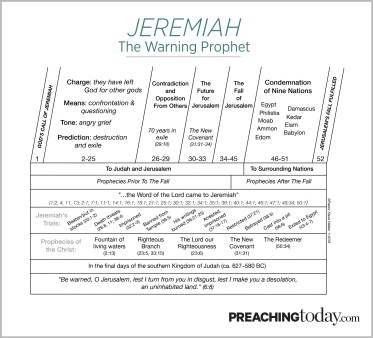
A visual guide to the big ideas, structure, theology, and historical background of Jeremiah.
All of Scripture speaks of Jesus. Once we read about him in the New Testament, we can never read the Old Testament the same way. Tremper Longman III explains in his book, How to Read Proverbs, how meeting the Messiah in the New Testament changes how we read the Old Testament.
Tremper illustrates this point using the popular 1999 movie The Sixth Sense. In this critically acclaimed work, Bruce Willis plays the lead character, a psychologist who is treating a young man being tormented by visions of the dead. Willis treats his patient with compassion, but he understands the visions to be hallucinatory. In the meantime, Willis is struggling with his own problems, including a growing distance between himself and his wife, ever since he was almost killed by an intruder.
As it unfolds, the story makes perfect sense to the audience, but it takes on a new meaning with the revelation at the end that Willis himself is dead. He wasn’t almost killed by the intruder; he was killed. His estrangement from his wife is not psychological; it is spiritual: She is alive and he is dead. This plot twist is a complete surprise, but once it comes, the audience cannot see the first part with the same understanding as they did previously.
Possible Preaching Angle: The way Christ fulfills the Old Testament changes how we understand Old Testament passages
Source: Tremper Longman III, How To Read Proverbs (Intervarsity Press, 2002), Page 103
In describing the incarnation Jill Carattini wrote:
Novelist Kurt Vonnegut once said of one of his most recurrent characters, “Kilgore was the only character I ever created who had enough imagination to suspect that he might be the creation of another human being. He said, ‘The way things are going, all I can think of is that I’m a character in a book by somebody who wants to write about somebody who suffers all the time.’”
In one scene Kilgore’s haunting suspicion is unveiled before him. Sitting content at a bar, he is suddenly overwhelmed by someone that has entered the room. Beginning to sweat, he becomes uncomfortably aware of a presence disturbingly greater than himself. The author himself, Kurt Vonnegut, has stepped beyond the role of narrator and into the book itself, and the effect is as bizarre for Kilgore as it is for the readers.
Vonnegut came to explain to Kilgore face-to-face that his life is all due to the pen and whims of an author who made it all up for his own sake. In this twisted ending, Kilgore is forced to conclude that apart from the imagination of the author he does not actually exist.
The gospels tell a story that is perhaps as fantastic as Vonnegut’s tale, though with consequences in stark contrast. The Gospel of John begins with a story that is interrupted by the presence of the author: “In the beginning was the word, and the word was with God, and the word was God. … All things came into being through him, and without him not one thing came into being. … And the word became flesh and lived among us, and we have seen his glory, the glory as of a Father’s only son, full of grace and truth.” (John 1:1-15). The Word became one of us and moved into the neighborhood. But in this story, the presence of the author is not our demise but our inherent good.
Source: Jill Carattini, “Into the Story” RZIM.org (7-17-17)
There was no question he loved her. He was absolutely bedazzled by her. Surprising, really, because she was plain, maybe even… well, (to someone else perhaps) disappointing. But then, he himself was a poor man who didn’t have even two coins to rub together. He wasn’t especially handsome, either. But he was good… a good and godly man, and he swept her off her feet, and won her heart. What makes that ordinary story extraordinary is the rest of the story.
The story—told by Soren Kierkegaard —actually begins, “Suppose there was a king who loved a humble maiden.” He was a great king and he could have whatever he wanted. Every statesman feared his wrath, every foreign state trembled before his power; they would have all sent ambassadors to the wedding.
He realized that if he asked his courtiers they would say, “Your majesty is about to confer a favor upon the maiden for which she can never be sufficiently grateful her whole life long.” That was the problem! Even if she wanted to come with him, he would never know for certain if she would have loved him for himself. So he wrestled with his troubled thoughts alone.
Finally, he decided. If she could not come up to his high station and be sure to love him freely, he must descend to hers. And he must descend stripped of his royal power and wealth, for only then would he know if his beloved loved him freely, as equals. So he laid aside all his power and privileges, and came to her as her equal, to win her love.
Source: Soren Kierkegaard, Philosophical Fragments (CreateSpace Independent Publishing Platform, 2009), Page 21
Families and children around the world have grown to love a special retelling of the biblical storyline from The Jesus Storybook Bible written by Sally Lloyd-Jones. In her introduction to the big story of the Bible, Jones writes:
There are lots of stories in the Bible, but all the stories are telling one Big Story. The Story of how God loves his children and comes to rescue them. It takes the whole Bible to tell this Story. And at the center of the Story there is a baby. Every story in the Bible whispers his name. He is like the missing piece in a puzzle—the piece that makes all the other pieces fit together, and suddenly, you can see a beautiful picture.
Source: Sally Lloyd-Jones, The Jesus Storybook Bible (Zondervankids, 2007), page 17
In his everyday life, Charles Foster is a respected veterinarian, a practicing lawyer, and a teacher at Oxford University in England. But as noted in his book Being a Beast, Foster also has an unusual practice. Every so often Foster tries to live like a badger. Yes, like one of those dark-dwelling, tunnel-making, rodent and worm-eating mammals. Usually he does this alone, though for a few days he went with his eight-year-old son, Tom. On a friend's farm, they made a human-sized badger home, a 15-feet long hole that they would sleep in. Charles says he's probably spent six weeks living underground like this over the years, sleeping during the day, awake at night like real badgers.
For Foster the main part of living like a badger involves getting low to the ground, crawling around on his hands and knees. He also blindfolds his eyes (because badgers' eyesight is terrible) and eats earthworms (since 85 percent of a badger's diet consists of worms).
Now as strange and even repugnant as this sounds, think of something even stranger and potentially more repugnant—the God of all creation who exists in perfect beauty and splendor becoming a human being and living on our fallen planet—and there was no escape for a full human lifetime. Jesus Christ came to us not just as an interesting nature experiment. Nor was he repulsed by us. He came out of love to rescue us from our sin.
Source: Ira Glass, "Being a Badger," This American Life podcast (9-9-16)
Finding encouragement in what God has already done for us.
When the Bible scholar N.T. (Tom) Wright was asked what he would tell his children on his deathbed he said, "Look at Jesus." Tom Wright explained why:
The [Person] who walks out of [the pages of the Gospels] to meet us is just central and irreplaceable. He is always a surprise. We never have Jesus in our pockets. He is always coming at us from different angles … If you want to know who God is, look at Jesus. If you want to know what it means to be human, look at Jesus. If you want to know what love is, look at Jesus. And go on looking until you're not just a spectator, but part of the drama that has him as the central character.
Source: Marlin Whatling, The Marriage of Heaven and Earth (CreateSpace, 2016), page 129
Jesus challenges the dominant myths of our culture as he call us into his version of the abundant life.
A healthy community should be characterized by joyful service to others.
A customs officer observes a truck pulling up at the border. Suspicious, he orders the driver out and searches the vehicle. He pulls off the panels, bumpers, and wheel cases but finds not a single scrap of contraband, whereupon, still suspicious but at a loss to know where else to search, he waves the driver through. The next week, the same driver arrives. Again the official searches, and again finds nothing illicit. Over the years, the official tries full-body searches, X rays, and sonar, anything he can think of, and each week the same man drives up, but no mysterious cargo ever appears, and each time, reluctantly, the customs man waves the driver on.
Finally, after many years, the officer is about to retire. The driver pulls up. "I know you're a smuggler," the customs officer says. "Don't bother denying it. But [darned] if I can figure out what you've been smuggling all these years. I'm leaving now. I swear to you I can do you no harm. Won't you please tell me what you've been smuggling?"
"Trucks," the driver says.
Possible Preaching Angles: (1) Whether it's the priority of love, the importance of marriage, the truth of the gospel, or even the person of Christ himself, at times it's easy to miss the big, obvious, important things in life. (2) Christmas; Advent; Christ, birth of: This story also illustrates how we miss the obvious--Christ himself--during the frantic pressures of the Christmas season.
Source: Todd Gitlin, Media Unlimited: How the Torrent of Images and Sounds Overwhelms our Lives (Henry Holt and Company, 2007), pp. 3-4