Sorry, something went wrong. Please try again.
At the 34-year mark of his marriage, Tim Keller shared the following insight about his marriage:
Neither my wife nor I are particularly gender-stereotyped. Yet you get into marriage, and you find you see the world differently, and you see each other differently. She sees things in me I would never see. But she sees because she’s a different gender and she’s in close, and I see things in her, and I see things in the world.
After 34 years of conflict, of arguing, of head-butting, now every single day when I get out into the world and things happen to me, I have a split second to react. What am I going to say? What am I going to do? What am I going to think? For years, even halfway through my marriage, I only thought like a man, but now, after years and years of head-butting, here’s what happens.
Something happens, and for a split second, I not only know what I would do, what I would think, how I would respond, but I know how Kathy would think, and I know what Kathy would do. For a split second, because it’s so instilled in me, I have a choice. Which of these approaches would probably work better? You see, my wisdom portfolio has been permanently diversified. I’m a different person, and yet I’m me. I haven’t become more feminine. In fact, probably in many ways I’ve become more masculine as time has gone on.
What’s going on? She came into my life, and now I know who I am. I’ve become who I’m supposed to be only through the head-butting, only through having a person who’s like me, not me, opposite to me, in close.

Source: Tim Keller, “Sermon: The First Wedding Day – Genesis 2:18-25,” Life Coach 4 God (1-12-14)
In an article in The Atlantic, Russel Shaw writes:
When my son was a toddler, I realized how much my emotional reactions influenced his. If I showed worry when he fell, he'd wail; if I remained calm, he'd recover. Learning that I could so powerfully influence his mental state was a revelation. This taught me that parenting is about more than just teaching skills; it's about shaping emotions.
Our instinct is to protect our children, but overprotecting can hinder their development. This urge has led to pop-culture mythology around pushy parenting styles, including the “Helicopter Parent,” who flies in to rescue a child in crisis, and the “Snowplow Parent,” who flattens any obstacle in their child’s way.
Lighthouse parents, on the other hand, provide support while allowing their children to learn from their experiences. Like a lighthouse that helps sailors avoid crashing into rocks, Lighthouse Parents provide firm boundaries and emotional support while allowing their children the freedom to navigate their own challenges. The key is learning when to step back and let them find their own way.
The crucial shift is from fixing problems to listening. Listening teaches resilience and communicates trust in our children's abilities. Parenting can be stressful, but by letting them face challenges, we help them build the skills they need to thrive.
Source: Adapted from Russell Shaw, “Lighthouse Parents Have More Confident Kids,” The Atlantic (9-22-24)
Every year Mount Everest gets a little taller. The peak is already the highest in the world, at roughly 29,029 feet above sea level. But over millennia, it has risen another 50 to 165 feet—and its elevation continues to grow.
New research suggests that in Everest’s region of the Himalayas, the Earth’s crust is rebounding. This is a phenomenon that occurs when a huge weight that has been pressing down on the surface is removed. The relaxing of the crust in this area started thousands of years ago. With a lightened load, the crust bobbed upward, as a boat might after unloading cargo. The rebound adds about 0.2 to 0.5 millimeter to Everest’s height above sea level each year.
Of course, that doesn’t seem like much. But as one of the co-authors of the study, a geologist, said, “[The growth] seems so insignificant, but then you pile it up over [the years] and you get amazing things happening.”
In the same way, our spiritual growth may seem slow and tiny, but over the years, as the geologist put it, “you get amazing things happening.”
Source: Nidhi Subbaraman, “Mount Everest Gets a Little Taller Every Year,” The Wall Street Journal (10-23-24)
Parents are bombarded with a dizzying list of orders when it comes to screen time and young children: No screens for babies under 18 months. Limit screens to one hour for children under 5. Only “high-quality” programming. No fast-paced apps. Don’t use screens to calm a fussy child. “Co-view” with your kid to interact while watching.
The stakes are high. Every few months it seems, a distressing study comes out linking screen time with a growing list of concerns for young children: Obesity. Behavioral problems. Sleep issues. Speech and developmental delays.
Maya Valree, the mother of a three-year-old girl in Los Angeles, understands the risks and constantly worries about them. But limiting her daughter’s screen time to one hour feels impossible as she juggles life as a working parent, she said.
Over the last few years, her child’s screen time has ranged up to two to three hours a day, more than double the limit recommended by pediatricians. Valree puts on educational programming whenever possible, but it doesn’t capture her child’s attention as well as her favorites, Meekah and The Powerpuff Girls.
“Screen time is in the top three or five things to feel guilty about as a mom,” she said. “I’ve used it to pacify my daughter while cooking or working or catching up on anything personal or professional.”
Too much screen time harms children, experts agree. So why do parents ignore them? Parents need to have some type of distraction for their kids, and “screens tend to be the easiest option, the lowest hanging fruit,” said pediatrician Whitney Casares. “I hear more people saying, ‘I know screen time is bad, I wish we had less of it in our family, but I feel helpless to change it.’”
The most recent data available comes from a national survey of nearly 1,500 families with children ages eight and younger conducted in 2020. The survey found that few families were not coming anywhere close to pediatricians’ recommended limits.
Source: Jenny Gold, “Too much screen time harms children, experts agree. So why do parents ignore them?” Los Angeles Times (6-26-24)
Many have wondered what place AI or robots will have in the future. They will make life easier, but could robots replace the world’s greatest artists?
Filippo Tincolini and Giacomo Massari formed Litix, a company that creates sculptures on commission for artists, architects, and designers. They sell their technology to clients around the world, including three sizes of Litix’s signature robot and proprietary software to program the robot for sculpting.
Massari said, “What used to take months or even years can now be done in days. Machines can run round-the-clock. They don’t get sick or sleep or go on vacation.” One of his favorite stories is about Psyche Revived by Cupid’s Kiss, Antonio Canova’s 1793 neoclassical masterpiece that sits in the Louvre. “It took Canova five years,” Massari said. To make a replica it “took our machine … less than 12 days.”
The robot does not put on the finishing touch. “… the final details will be executed by human sculptors—even Litix’s techno-evangelist owners don’t pretend that its machines can match the finest subtleties of human artisanship.”
“It took the robot four days to complete its work on Flowered Slave. Artisans then spent another 20 days finishing the work by hand—what Tincolini calls ‘“giving life to the sculpture.”’
By contrast, Enzo Pasquini has worked only with hand tools since his days as an apprentice more than 70 years ago. Around town he’s known as a master who can carve the most elaborate details into stone. “I have to do it the old way. But you have to go with the times. There are fewer and fewer young people who want to do the hard physical labor. But machines won’t change the sensitivity of the work. You will always need the sculptor for that.”’
In the same way, no matter how many intelligent computer programs we use to solve problems, or even how many skilled humans are involved, people will always need the Master Sculpture to finish what he started in our lives. “And I am sure of this, that he who began a good work in you will bring it to completion at the day of Jesus Christ” (Phil. 1:6).
Source: Elaine Sciolino, “State of the Art,” Smithsonian Magazine (December, 2023), pp. 34-41
In 2023 the ad agency Design Army created an entire campaign using only generative AI. In it, a world of impossible buildings, floating hats, and gigantic eyeballs announces the opening of a high-end eyewear retailer.
As Design Army cofounder Pum Lefebure explained, “in a typical project like this, we would hire models, makeup artists, and wardrobe specialists, scout and secure shoot locations, and ultimately it would take at least three months to execute.” But the budget was tight and time was short, so they turned to AI. Though there’s a touch of uncanny valley in the resulting imagery, the visuals are impressive.
Always aiming for faster output and grander scale, leaders across industries are excited about the potential for this new tech. But AI technology raises real concerns for the creatives whose original work could be replaced or copied by these tools.
Creativity is an essential part of who we are as human beings. In the creation narrative, when the first human is tasked with cultivating the Garden (Gen. 2:5–8, 15), we see that making is a God-given privilege and responsibility. It’s a calling generative AI threatens to undermine. We are robbing ourselves of this gift of toil—the creative process of ideating, developing, and producing—when we take too many shortcuts or automate our work.
As the opening lines of Genesis make clear, right after God completes the aspects of creation that he alone is capable of, he invites humankind to pick up where he left off. For example, God doesn’t create all of humanity in an instant; he makes only two humans and then tasks them with making more of themselves through bearing children and forming families.
To accomplish these tasks, God didn’t give humans his unique power to generate new things simply by speaking them into existence. He gave humans the purpose of joining in the ongoing work of creation. We see this again and again throughout the biblical story line. He tasks humankind with making things themselves (Ex. 31:1-11; 1 Sam. 16:16–18). It is in God’s generosity that we are handed the paintbrush and invited to join the process.
God uses the trials, tedium, mistakes, victories, and lessons of life to refine us into the image of Christ. It is not done in an instant, however much we want to rush to the final result. It is through an often-lengthy process that we become who God intended us to be and our work becomes what God ordained.
Source: Jared Boggess, “How AI Short-Circuits Art,” CT magazine (December, 2023), pp. 26-27
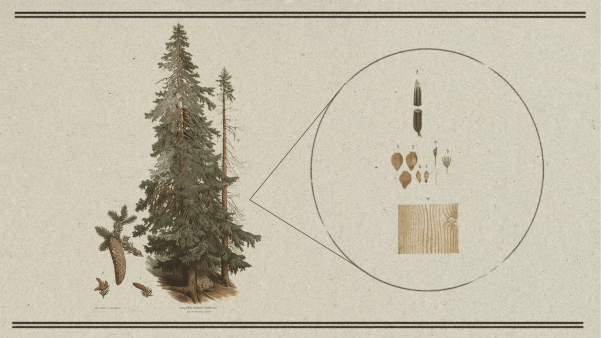
How do trees grow the strongest? Surprisingly, too much sunlight and too much easy, fast growth does not produce healthy trees. Most young tree saplings spend their early decades under the shade of their mother’s canopy. Limited sunlight means they grow slowly. Slow growth leads to dense, hard wood.
In contrast, something interesting happens if you plant a tree in an open field: Free from the shade of bigger trees, the sapling gorges on sunlight and grows too fast and too easily. Fast, easy growth leads to soft, airy wood that didn’t have time to densify. And soft, airy wood is a breeding ground for fungus, disease, and ultimately a short life.
As the acclaimed nature writer Peter Wohlleben (author of The Hidden Life of Trees) writes, “A tree that grows quickly rots quickly and therefore never has a chance to grow old.”
Source: Morgan Housel, “Investing: The Greatest Show on Earth,” The Collaborative Fund (3-9-21)
Author Lyall Watson, writing about the culture and habits of pigs, concludes that when young pigs play it is voluntary, random, and stimulated by novelty. “Jumping where there is nothing to jump over, running without going anywhere, fleeing when there is no enemy to flee from--all these are actions that lack any obvious function. They appear to be undertaken purely for pleasure.” Young wild boars chase windfall apples as readily as kittens chase balls of wool.
We call such behavior “play” and find no difficulty in recognizing it when we see it. It is easy to distinguish. An animal involved in play-fleeing or play-fighting looks very different from one seriously occupied in flight or fight. But it would be wrong to regard play just as something opposed to work. It is far more important than that.
Play is voluntary. You can’t make someone play or legislate play into being. A pig wearing a silly hat and jumping through a hoop isn’t playing. Play implies, pleasure, fun, and a definite lack of constraint. It’s something that comes more naturally to the young than it does to adults.
Play is almost certainly a complex collection of activities that are not just frivolous. The amount of time spent on it by young animals suggests that it is important; and a lack of it may impair the acquisition of vital social abilities. Play seems to be necessary for a healthy brain in pigs as well as people.
Source: Lyall Watson, The Whole Hog, (Profile Books, 2004), pp. 77-78
Success is the unrelenting prize of our culture. We will sacrifice whatever we must to avoid feeling the pain of failure. And when we do fail, our society tells us to move on as quickly as possible. But what if there's something to be gleaned from times when we do not succeed.
In the film Bob Ross: Happy Accidents, Betrayal, and Greed, Joshua Rofé describes the unseen parts of Ross' fame. The painter and television personality mesmerized audiences in half hour blocks. Mountains, bushes, and rivers emerge seamlessly before our very eyes. His ideas passed effortlessly from pallet, to brush, to canvas.
But, of course, this fluidity did not imply flawlessness. Often, Ross would extend a stroke too far or lay down a color that did not match with what he had imagined. When this happened, Ross simply labeled the mistake a "happy accident" and adjusted his plan to incorporate the mistake into a masterpiece.
Near the end of the film, Steve Ross gave some insight on this topic:
It's hard to tell people their faults. It’s even harder to admit that you have made a “happy accident.” A lot of times, I've wondered if it's not your mistakes that teach you a lot more than your successes. After success, you just move on to the next thing. But when you make a mistake, or have a “happy accident,” as Bob called it, suddenly you learn all kinds of new ways to correct it. And through that learning process you really start developing in new ways.
Source: Bob Ross; Happy Accidents, Betrayal, and Greed, Directed by Joshua Rofé, Netflix, 2021, Timestamp 1:28.40
Actor Charlie Hunnam has recently begun a transition to writing. About to turn 40, he had reached a place in life for some evaluation. Hunnam knew he would be out of work for a while due to COVID-19. And in his heart, there were stories that he had been carrying around. He shares, "They had been sort of given to me like gifts. And I wasn't honoring the gifts."
As he started the process of honoring these gifts, Hunnam found new energy. He started to get up around 4:00 am daily to go on a short hike. He would be back home, showered, and ate breakfast by 6:00 am. Then he would sit down to write until 7:00 pm. That's 13 hours! He explains the sensation this way:
I just started to get this really “now” feeling of life. Like there's nothing else in the world that would be better for me than what I'm doing right now. And the result of it was more positive than anything I've ever done in my career. ... And I've worked really, really hard to cultivate this gift and be proud of the work that I'm able to do now. But part of me feels like it's an uphill struggle.
But when I write, I feel as though I'm honoring the innate gifts that God gave me. I feel like I really can do this [stuff] at a high level. And that's a feeling that I've never had in my life before, in any regards. I feel like we all have one or two innate talents, and a task of life is to identify those and then do that as much as you possibly can. Because that's where the joy and the presence is going to come from. That's where the grace is going to come from.
Source: Frazier, Tharpe, "Charlie Hunnam On Choosing Vulnerable Roles.,” GQ (November, 2020)
Good news of great joy did not remove God’s people from the fallen world.
Episode 29 | 12 min
Episode 24 | 11 min
The birth, death, burial, resurrection, and ascension of your sermon.
The preacher needs to contemplate the person, purpose, and precedent of Christ.
Five challenges and five opportunities facing pastors in the next six years.
Three suggestions for becoming preachers who turn the world on its head.