Sorry, something went wrong. Please try again.
The late pastor and preacher Tim Keller truly lived out the teachings in his popular book, The Freedom of Self Forgetfulness: The Path to True Christian Joy. In other words, he demonstrated true humility and teachability.
For instance, in 2011, Pastor Tim Cox had accompanied Keller on a trip to South Korea. Cox reflected on the trip later and wrote:
I traveled with Tim to Seoul. Tim was speaking at a conference for pastors, and Tim kept saying ‘Look at what Jesus has done for you! If you see that, you will be changed!’ At one point I asked Tim if even that could be a legalistic thing. That I’m not looking hard enough at Jesus, so I just need to pull up my socks and try harder. When in reality, the Holy Spirit does that for me.
Tim told me, ‘Yes, of course, only the Holy Spirit can do that!’
That was the end of our conversation. The next day, Tim got to the part of his talk where he said ‘if you look at what Jesus did for you . . .’ and he looks straight at me, ‘then by the power of the Holy Spirit, you’ll change!’

Source: Michael Wear, “The Suprise of Tim Keller,” Comment, (5-22-23)
Pastor John Yates III once worked for the British scholar and Bible teacher John Stott. Yates reflected on the time when Stott’s aging and disability started to slow Stott down. Yates says:
Stott spent the last 15 years of his life going completely blind. It began with a small stroke that knocked out the peripheral vision in his left eye, forcing him to surrender his driver’s license. And over the years that followed, this man who wrote more books during his lifetime than most of us will read in an average decade became unable to see the pages in front of him. But that wasn't all. His body grew increasingly weak. He needed more sleep. He was eventually confined to his bedroom.
I spent three years working closely with John when he was in his early 70s. I was in my mid-20s. It was absolutely exhausting. I've never been around another person with a capacity for work as fast as his. He was the most disciplined and efficient man I've ever known. But there he was, years later, now in his 80s and into his early 90s, with his mind as sharp as ever. But then he was unable to do much of anything, except to sleep, eat, and listen out his bedroom window for the call of a familiar bird.
Now I found this personally incredibly difficult to understand. Why would God allow a man like John to suffer the loss of precisely those faculties that made his life so meaningful and has worked so successful, if it just seemed cruel? It would have been better, I thought, for him to die or to suffer from Alzheimer's, because at least then he wouldn't have known what he was missing.
But then I finally begin to understand why John never seemed to complain. That's because God was giving him the gift of absolute dependence. God was showing him that he delighted to offer Stott a dependence on him.
Source: John Yates III, “Season 1, Episode 1: We Have Forgotten We Are Creatures, Why Are We So Restless podcast (7-7-22)
When George Liele set sail for Jamaica in 1782, he didn’t know he was about to become America’s first overseas missionary. And when Rebecca Protten shared the gospel with slaves in the 1730s, she had no idea some scholars would someday call her the mother of modern missions.
These two people of color were too busy surviving—and avoiding jail—to worry about making history. But today they are revising it. Their stories are helping people rethink a missionary color line. As National African American Missions Council (NAAMC) president Adrian Reeves said at a Missio Nexus conference in 2021, challenging the idea that “missions is for other people and not for us.” African Americans today account for less than one percent of missionaries sent overseas from the US. But they were there at the beginning.
British missionary William Carey is often called the father of modern missions. Adoniram Judson has been titled the first American missionary to travel overseas. But both Liele and Protten predated them.
Former missionary Brent Burdick now believes African Americans are a “sleeping giant” with an important part to play in the proclamation of the gospel. “They have a lot to offer to the world.”
Source: Noel Erskine, “Writing Black Missionaries Back Into The Story,” CT magazine (Jan/Feb, 2022), p. 23
Tim Keller was a preacher full of perseverance, grace, and determination.
Preachers and professors share stories of Tim’s impact on their life.
Stuart Briscoe preached his first sermon at age 17. He didn’t know much about the topic assigned him by an elder. But he researched the church of Ephesus until he had a pile of notes and three points, as seemed proper for a sermon. Then he stood before the Brethren in a British Gospel Hall and preached.
And preached. And preached. He kept going until he used up more than his allotted time just to reach the end of the first point and still kept going, until finally he looked up from his notes and made a confession.
“I’m terribly sorry,” he said. “I don’t know how to stop.” Briscoe recalled in his memoir that a man from the back shouted out, “Just shut up and sit down.” That might have been the end of his preaching career. But he was invited to preach again the next week. And he continued preaching for seven more decades.
In the process Briscoe became a better preacher, discovered he had a gift, and was encouraged to develop it. He ultimately preached in more than 100 countries around the world and to a growing and multiplying church in America.
When Briscoe died on August 3, 2022, at the age of 91, he was known as a great preacher who spoke with clarity, loved the people he preached to, and a had deep trust in the work of the Holy Spirit.
He once wrote,
My primary concern in preaching is to glorify God through his Son. I’ve worked hard to preach effectively. But I’ve also learned to trust as well. Farmers plow their lands, plant their seed, and then go home to bed, awaiting God’s germinating laws to work. Surgeons only cut; God heals. I must give my full energy to doing my part in the pulpit, but the ultimate success of my preaching rests in God.
Source: Daniel Sillman, "Died: Stuart Briscoe, Renowned British Preacher and Wisconsin Pastor," Christianity Today (8-8-22)
Gary Chapman has been a household name since the mid-1990s after publishing his book that helped people discover their primary ways of giving and receiving love. The Five Love Languages sold 8,500 copies its first year. It more than doubled that in the second year. It was still the top-selling Christian book for much of 2021. It has sold more than 20 million copies worldwide.
But an article in Christianity Today is titled, “Gary Chapman Doesn’t Know That He Is Famous.” The article says Chapman continues to live a humble and faithful walk with Jesus and his church:
Gary Chapman is constant. He’s lived in the same red-brick house for more than 20 years. He still counsels couples in the same Baptist congregation he has pastored for five decades in Winston-Salem, North Carolina. He blocks Sundays from his busy speaking schedule so he can attend worship there, even if it means taking a redeye flight to make it on time. Many weeks, he stands at the door after services to greet parishioners.
He doesn’t drink. He seems to have worn khakis for most of his life. His guiltiest pleasure is that he can’t finish lunch or dinner without a dessert. … He waters his backyard flowers in the mornings and pulls kudzu. He prays through his first round of daily calisthenics: “I come to you in the name of Jesus,” he recites, swinging his arms up and down, then intercedes for people by name. During heel raises, he covers some refugee camps and rescue missions. He does it all over again at night, “but at night I’m just talking to God and praising God.”
Even when he retired in October, 2021, not much changed about Gary. He kept his church office and continues counseling.
Source: Kara Bettis, “Gary Chapman Doesn’t Know He’s Famous,” Christianity Today (September, 2021)
Out of curiosity Ben Kirby started watching worship songs on YouTube and identified many of the leaders and preachers as wearing sneakers worth from $800 to $1200. Others wore designer outfits worth thousands. He started an Instagram account posting the preachers and the price tags. In the first month he had 100,000 followers.
In an interview for The Washington Post he questioned the blatant extravagance of someone preaching about Jesus: “I began asking, how much is too much? Is it okay to get rich off of preaching about Jesus? Is it okay to be making twice as much as the median income of your congregation?”
One report noted:
Practice what you preach. We expect our leaders—no matter who they are—to maintain certain standards of decency and to uphold the same values they profess to support. ... Kirby continues to show the dissonance between what preachers, pastors, and priests say and what the details of their clothing reveal about their actual lifestyles.
Just a few examples of what religious leaders have been photographed wearing:
Source: Hendy Agus Wijaya, “This Instagram Account Exposes Greedy Preachers Who Flaunt Designer Items That Cost Thousands Of Dollars,” Success Life Lounge (3-25-21); Ben Kirby, “The Lord Works In Mysterious Colorways,” Preachers Sneakers (Accessed 7/2/21)
Tim Challies writes:
Every now and again Aileen gets into cooking shows. Every time she does, it works out well for me. And for the kids. It could be Top Chef or Master Chef. It doesn’t really matter. She starts watching and before long she gets cooking.
Whether in narrow pursuits like cooking or wider pursuits like living, we are people who thrive on imitation and inspiration. Whether deliberately or inadvertently we are always on the lookout for people who are worthy of imitation. Aspiring chefs seek out, carefully watch, and closely imitate experienced chefs.
Cooking shows are meant to be entertaining, but they are also meant to be inspiring. They are meant to attract viewers, but also to inspire imitators. And in that way they are a little glimpse of the way we should all live our lives. For in some ways every life should be a show, a public demonstration--of virtue, a display of character, a demonstration of practical godliness. Every life should be lived in such a way that it inspires others to imitate it.
Even as we follow our Savior, we must be willing and eager to have people follow us. Like Paul we should say, “Be imitators of me, as I am of Christ” (1 Cor. 11:1). Just as we have all longed for an example to follow, we must provide an example for others to follow. Just as we have longed to be imitators, we must be eager and willing to be imitated.
Source: Tim Challies blog, “Good Things Happen When My Wife Watches Cooking Shows,” Challies.com (9-25-20)
In his book, Faith That Endures, Ronald Boyd-MacMillan tells the story of a number of conversations he has had with Wang Mingdao, one of China's most famous church pastors of the last century. The first time he met this famous—and persecuted—Chinese pastor, they had the following interchange:
"Young man, how do you walk with God?” I listed off a set of disciplines such as Bible study and prayer, to which he mischievously retorted, “Wrong answer. To walk with God, you must go at walking pace."
The words of Wang Mingdao touched me to the core. How can I talk about the Christian life as walking with God when I so often live it at a sprint? Of course, we "run with perseverance the race marked out for us," but we may fail to run with "our eyes [fixed] on Jesus, the pioneer and perfecter of faith" (Heb 12:1-2). Jesus is inviting me to walk with him. Too often, I find myself running for him. There's a difference!
On another visit, Boyd-MacMillan asked Wang Mingdao about his twenty-year imprisonment for proclaiming Jesus in China. That cell became a place of unchosen unhurried time for Mingdao. There was nothing to do but to be in God's presence, which he discovered was actually everything. Boyd-MacMillan summarizes what he learned from Wang Mingdao:
One of the keys to the faith of the suffering church: God does things slowly. He works with the heart. We are too quick. We have so much to do—so much in fact we never really commune with God as he intended when he created Eden, the perfect fellowship garden. For Wang Mingdao, persecution, or the cell in which he found himself, was the place where he returned to "walking pace," slowing down, stilling himself enough to commune properly with God.
Source: Ronald Boyd-MacMillan, Faith That Endures (Revell, 2006), p. 307; Allan Fadling, An Unhurried Life (IVP, 2013), pp. 13-14
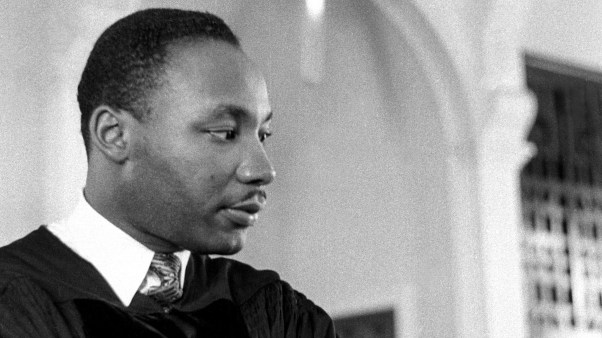
King knew his context, developed a mantra, offered winsome challenge, and employed metaphors.
In his book The Grace Awakening, Charles Swindoll recounts an experience he once had while ministering at a Bible conference. On the first night he had briefly met a couple who seemed to be friendly and quite glad to be at the meetings. However, as the week went by, Swindoll noticed that roughly ten minutes after he would start speaking at every meeting, the husband would be fast asleep!
This experience began to irritate Charles so much that by the time of the final meeting, he was convinced that the man was there only to please his wife, and was "probably a carnal Christian." At the conclusion of the final meeting however, the wife requested to speak to Charles for a few minutes. He figured she wanted to talk to him about her husband's lack of interest in spiritual matters.
Imagine how greatly embarrassed he was when the wife mentioned that her husband had terminal cancer and that they had attended the conference mainly at his request. It was his “final wish” to be at the conference even though the pain medication he was taking made him drowsy. She then said, "He loves the Lord, and you are his favorite Bible teacher. He wanted to be here to meet you and to hear you, no matter what." Charles Swindoll wrote, "I stood there, all alone, as deeply rebuked as I have ever been."
What a dangerous thing it is to judge others. Jesus said, "For in the same way you judge others, you will be judged, and with the measure you use, it will be measured to you" (Matthew 7:2).
Source: Charles R Swindoll, The Grace Awakening (Word Publishing, 1990), pgs. 165-166
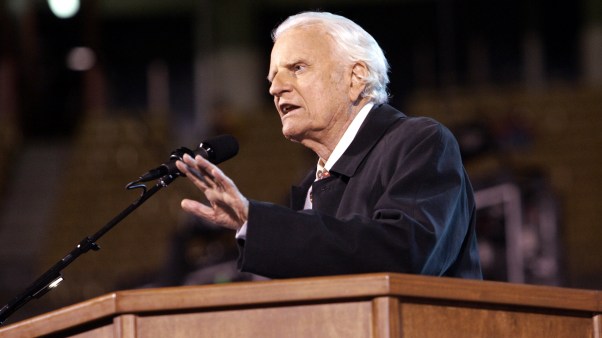
Billy’s nervousness before preaching, how he recovered after preaching, and his utter reliance on prayer to overcome spiritual opposition.