Sorry, something went wrong. Please try again.
Christmas might be a time for vacations, but it sure does require plenty of work. It turns out families are dedicating a staggering amount of time to Christmas preparations over their lifetimes. A survey of festivity enthusiasts reveals that holiday preparations consume almost five years of their lives.
The most substantial chunk of time goes to planning Christmas dinner, consuming nearly two-and-a-half years of preparation over a lifetime. In addition to meal planning, hosts spend a remarkable 164 weeks cleaning and tidying before welcoming holiday guests.
The decorating process itself presents its own time demands. People spend more than two days adorning their Christmas trees, and 34 hours untangling lights. For those with real trees, an additional 36 hours are spent picking up or vacuuming pine needles over a 63-year period.
The research also highlights the stress associated with holiday preparations, with 60% of respondents finding the season stressful and 45% wishing for ways to make it less so. The cost-of-living crisis has amplified these concerns, with 41% expecting this Christmas to be more stressful than last year.
Despite these challenges, people maintain their enthusiasm for the season. The survey revealed that spending time with family and friends (44%), enjoying festive food and drink (41%), and giving presents (34%) rank as the nation’s favorite aspects of Christmas.
Possible Preaching Angle:
Christmas; Contentment; Fellowship; Hospitality - As we prepare for Christmas, it's important to reflect on how we're spending our time. Are we dedicating our efforts to what truly matters, like family, fellowship, community, and the essence of Christmas? Or are we getting caught up in distractions that create stress and detract from the fundamental values of togetherness and the true meaning of the season?
Source: Staff, “Christmas by the numbers: 34 hours untangling lights, 36 hours cleaning up pine needles over a lifetime,” Study Finds (12-24-24)
A peculiar hospitality can awaken faith in our secular contexts.
America is in a party deficit. Only 4.1 percent of Americans attended or hosted a social event on an average weekend or holiday in 2023, a 35 percent decrease since 2004. Last month, Party City, the country’s largest retailer of mylar balloons, goofy disposable plates, and other complements to raging, announced that it would close after years of flagging sales and looming debt.
Six months ago on Reddit, someone asked one of the saddest questions I’ve ever seen on the social platform, which is really saying something: “Did anybody else think there would be more parties?”
“When I was a kid my parents and extended family used to have serious parties on a regular basis,” the post continues. “I remember houses and yards full of people, music all the way up, lots of food and of course free flowing alcohol. Neighbors, family, coworkers, their friends, they all showed up. And likewise, my parents went to their parties. I thought that is what my adult years would be like, but they aren’t.”
A lot of other people seem to feel the same way. Polling from 2023 showed that although 84 percent of Americans enjoy birthday parties, only 59 percent had attended one in the previous year. In a different YouGov poll from 2022, only 28 percent of respondents said they would “probably” or “definitely” throw a party for their next birthday. Everyone wants to attend parties, but no one wants to throw them. We just expect them to appear when we need them, like fire trucks.
Source: Ellen Cushing, Americans Need to Party More, The Atlantic (1-4-25)
In the U.S., solo dining reservations have risen 29% over the last two years, according to OpenTable, the restaurant reservation site. They’re also up 18% this year in Germany and 14% in the United Kingdom.
Japan even has a special term for solo dining: “ohitorisama,” which means “alone.” In a recent survey, Japan’s Hot Pepper Gourmet Eating Out Research Institute found that 23% of Japanese people eat out alone, up from 18% in 2018. As a result, many restaurants in Japan and elsewhere are redoing their seating, changing their menus, and adding other special touches to appeal to solo diners. Even so-called family restaurants are increasing counter seats for solitary diners, and restaurants are offering courses with smaller servings so a person eating alone gets a variety of dishes.
OpenTable CEO Debby Soo thinks remote work is one reason for the increase, with diners seeking respites from their home offices. The pandemic also made social interactions less feasible and therefore less important while eating out.
The growth in solo dining also is the result of more people who are living alone. In 2019, the Pew Research Center found that 38% of U.S. adults ages 25 to 54 were living without a partner, up from 29% in 1990. In Japan, single households now make up one-third of the total; that’s expected to climb to 40% by 2040, according to government data.
Increasing interest in solo travel – particularly among travelers ages 55 and over – is also leading to more meals alone.
A time of solitude can be a refreshing break from a busy schedule. But for many people solitude is not a choice. Without putting singles in an embarrassing spotlight, it would be encouraging if church members would diplomatically invite singles to share a homecooked meal, especially during the holidays.
Source: Dee-Ann Durbin and Anne D'Innocenzio, “How Restaurants Are Catering to a Growing Number of Solo Diners,” Time (9-3-24)
The UN Refugee Agency says the country of Columbia has hosted 3 million refugees and migrants from neighboring Venezuela. Columbia has also had the second highest number of Internally Displaced Persons, IDPs, in the world. Since 1985, violence and threats from armed groups have caused 6.7 million Columbians to flee their homes and go elsewhere in the country. Almost 20% of Columbia's population have been traumatized by the refugee, migrant or IDP experience. Here's one pastor’s story:
In 1984, Pastor Jose Higinio Licona and his family experienced violent displacement themselves in their hometown. His family owned a 6-acre farm, milked cows, and grew yucca and corn. One evening, when Licona returned from church, he found dozens of uniformed men with guns in his house, nonchalantly sipping his wife's lemonade. They demanded that he join their force. Pastor Jose decided it was time to flee with his family and a few animals. During their flight, they had to sell their animals and food became scarce. They never got their land back. Pastor Licona's current church is small, only about two dozen people. But most of them could report similar stories of loss as IDPs.
Since they were IDPs themselves, Licona's church started helping Venezuelan migrants when they started coming about 4 years ago. They butchered cows and harvested a half ton of yucca. They helped migrants pay rent and apply for temporary protection status. They hosted dinners offering Venezuelan dishes, offered counseling, and shoulders to cry on. They're helping 2,000 Venezuelan migrants who settled in the area. Pastor Jose says helping migrants is instinctive, "How could they not? We are all IDPs!"
This church has given from what little it had. What sacrifice!
Source: Sophia Lee, “The Crossing,” Christianity Today magazine (November, 2023) pp. 34-45
Fine dining typically means splurging a little for high-quality meat or fresh seafood. But what if money were truly no object?
Restaurant owners and chefs around the world create original dining experiences for those who want unique experiences. You know, like spending nearly $10,000 on a pizza or $1,000 on an ice cream sundae.
Here are a few of the world’s most expensive meals:
(1) Salvation and The Lord's Supper—They're both offered free of charge (although Jesus paid the price that we could never have paid), and the Lord's Supper is better than anything on this list. (2) Social Justice—While millions of people are malnourished, a few people can afford outrageously expensive, luxurious meals. (3) Simplicity; Provision—God promised to provide daily bread, not daily slice of "Louis XIII" pizza. (4) Hospitality—Hospitality is more about love and openness than about trying to offer a "world's best meal." Encourage people to keep it simple.
Source: Staff, “20 Most Expensive Foods in the World 2024,” PassionBuzz.com (12-19-23); Lia Sestric, “10 Most Expensive Meals in the World,” Go Bank Rates (5-3-23)
In February 2020, BBC journalist Vicky Baker jumped on the Eurostar to Paris, motivated by a sudden urge to have dinner with a friend. American Jim Haynes had entered his late 80s and his health was declining, yet she knew he would welcome a visit. Jim always welcomed visitors to his home in Paris.
She was far from the only guest wandering into the warm glow of his artist's workroom on a wet winter's night. Inside, people were squeezing, shoulder to shoulder, through the narrow kitchen. Strangers struck up conversations, bunched together in groups, and balancing their dinners on paper plates.
Jim had operated open-house policy at his home every Sunday evening for more than 40 years. Absolutely anyone was welcome to come for an informal dinner, all you had to do was phone or email and he would add your name to the list. No questions asked. Just put a donation in an envelope when you arrive.
There would be a buzz in the air, as people of various nationalities - locals, immigrants, travelers - milled around the small, open-plan space. A pot of hearty food bubbled on the stove and servings would be dished out onto a trestle table, so you could help yourself and continue to mingle. It was for good reason that Jim was nicknamed the "godfather of social networking." He led the way in connecting strangers, long before we outsourced it all to Silicon Valley.
At the dinners' peak, Jim would welcome up to 120 guests, filling his home, and spilling out into the cobbled back garden. An estimated 150,000 people have come over the years.
"The door was always open," says Amanda Morrow, an Australian journalist. "It was a revolving door of guests - some who wanted to stay over, and others who just wanted to say hello. Jim never said no to anyone."
Amid the outpouring of online tributes since his death in his sleep on 6 January 2021, these words from his son Jesper stand out:
The only thing that really got Jim down was people leaving. He struggled with that. He didn't like being on his own... His goal from early on was to introduce the whole world to each other. He almost succeeded.
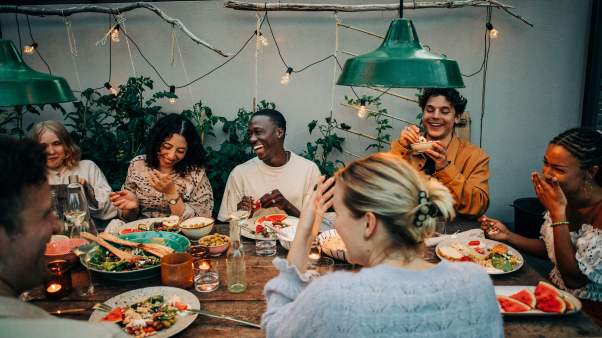
Fellowship; Home; Outreach – Imagine the results if church members would invite others to share in an informal meal at their home. Neighbors, friends, church members, visitors to church all welcomed to mingle and fellowship in the warm, cozy atmosphere of a home.
Source: Vicky Baker, “Jim Haynes: A Man Who Invited the World Over for Dinner,” BBC News (1-23-21)
The dining room is the closest thing the American home has to an appendix—a dispensable feature that served some more important function at an earlier stage of architectural evolution. Many of them sit gathering dust, patiently awaiting the next “dinner holiday” on Easter or Thanksgiving.
That’s why the classic, walled-off dining room is getting harder to find in new single-family houses. It won’t be missed by many. Americans now tend to eat in spaces that double as kitchens or living rooms—a small price to pay for making the most of their square footage.
But in many new apartments, even a space to put a table and chairs is absent. Eating is relegated to couches and bedrooms, and hosting a meal has become virtually impossible. The housing crisis is killing off places to eat whether we like it or not, designing loneliness into American floor plans.
According to surveys in 2015 and 2016 by the National Association of Home Builders, 86 percent of households want a combined kitchen and dining room—a preference accommodated by only 75 percent of new homes. If anything, the classic dining room isn’t dying fast enough for most people’s taste.
If dining space is merging with other rooms in single-family homes, it’s vanishing altogether from newly constructed apartments. Americans might not mind what’s happening to their houses, but the evolution of apartments is a more complicated story.
Floor-plan expert Bobby Fijan said “For the most part, apartments are built for Netflix and chill.” Even though we’re dining at home more and more—going to restaurants peaked in 2000—many new apartments offer only a kitchen island as an obvious place to eat.
This is partly a response to shrinking household size. According to the U.S. Census Bureau, the share of one-person households more than tripled from 1940 to 2020. A dedicated dining space might feel wasted on someone who lives alone.
As households and dining spaces have contracted, the number of people eating alone has grown. According to a 2015 report by the Food Marketing Institute, nearly half the time we spend eating is spent in isolation, a central factor in America’s loneliness epidemic and a correlate to a range of physical- and mental-health problems.
In an age when Americans are spending less and less time with one another, a table and some chairs could be just what we need for fellowship and human interaction. Make an effort to invite people over, especially during the holiday season, and especially those who live alone.
Source: M. Nolan Gray, “Why Dining Rooms Are Disappearing From American Homes,” The Atlantic (6-10-24)
Keisha House is a nurse practitioner and assistant director of the Substance Use Disorder Center of Excellence at Rush University Medical Center. House spent an afternoon training a bunch of aspiring professionals in the skills of preventing death from opioid overdose. These included recognizing signs of substance abuse and administering doses of Naloxone, the generic name for Narcan, an agent that can reverse the effects of an overdose.
These would be absolutely essential skills for any healthcare professional to learn, but House’s clients that day were not nurses or doctors. Rather, they were a group of barbers.
“You all are our eyes and ears, in the barbershop,” House told her audience at Larry’s Barber College in the Washington Park neighborhood of Chicago. House stressed to them that their relationship with local clientele made them invaluable partners in the ongoing quest to reduce and eventually eliminate drug overdoses within the black community.
House stressed the importance of learning the visual signs of overdose, because they’re not always consistent with the ways that such overdoses are portrayed in media. Symptoms can include unresponsiveness, constricted pupils, a limp body, and breathing that slows or stops. In 2018, studies showed that opioid overdoses happened all over the city, but the most deaths were clustered in the mostly black and brown neighborhoods.
Health improvement advocates say that Rush’s outreach to barbershops and beauty shops was influenced by a 2017 Illinois law requiring hair stylists, barbers, and cosmetologists to receive domestic violence and sexual assault awareness training. “In the beauty shop, barber shop, it’s a safe haven,” House said. “If we increase the knowledge, the training, the awareness … we’re able to promote positive health behaviors among their customers, where they feel safe.”
Laniah Davis was one of the barber students given free Narcan kits after the day’s presentation, and she’s feeling confident.
David said, “Now that we know this information, we’re able to save a life or two. If it was somebody in my family, I would want someone to help them. So, whether I know them or not … I would see myself jumping into action to do whatever it takes.”
Just as these barbers were given authority to administer life-saving medicine, so are we authorized to act swiftly and boldly to rescue our neighbors from danger and to show God’s love in real-life situations.
Source: Angie Leventis Lourgos, “Student barbers add reversing opioid overdoses to their list of skills,” Chicago Tribune (7-9-24)
The pandemic has brought many changes to businesses, schools, and churches. Another way the pandemic altered America: It has created what might be called the “Introvert Economy.” Data from studies appears to show that most people’s social lives continue to dwindle.
During the pandemic, a lot of Americans had to stay home—and many discovered that they preferred staying in to going out. And odds are it will stick: It is the youngest adults who are going out less, and when they do go out, it is earlier.
Technology has also speeded changes in social habits. There is evidence that TV schedules once had a big impact on people’s schedules. Now that more content is streamed on demand, people may be thinking about their time differently. More choices of at-home-entertainment also may decrease the desire to go out or stay out. This is another trend accelerated by the pandemic—perhaps because when more people work from home, they save time on commuting and can go out to dinner earlier.
There was a bit of a bump in socializing in 2022, probably in response to years of pandemic isolation. Yet the long-term trend is clear: More time watching TV or playing video games at home.
One small upside to the data. Chances are everyone else is having just as uneventful of a weekend as you are. Your friends aren’t all that busy and would love to hang out with you.
Source: Adapted from Todd Brewer, “Living Alone (and Lonely),” Mockingbird Week in Review (1-26-24); Allison Schrager, “The Introverts Have Taken Over the US Economy,” Bloomberg (1-22-24)
I’ve noticed along the way of life that some people are much better at seeing people than others are. In any collection of humans, there are diminishers and there are illuminators.
Diminishers … make others feel insignificant. They stereotype and label. If they learn one thing about you, they proceed to make a series of assumptions about who you must be.
Illuminators, on the other hand, have a persistent curiosity about other people. They have been trained or have trained themselves in the craft of understanding others. They know how to ask the right questions at the right times—so that they can see things, at least a bit, from another’s point of view. They shine the brightness of their care on people and make them feel bigger, respected, lit up.
Illuminators are a joy to be around. A biographer of the novelist E.M. Forster wrote, “To speak with him [gave you] a sense of being listened to with such intensity that you had to be your most honest, sharpest, and best self.” Imagine how good it would be to offer people that kind of hospitality.
Source: David Brooks, "The Essential Skills for Being Human," The New York Times (10-19-23)
Hosting friends and family from out of town always sounds good in theory, but it doesn’t come without its challenges. Two-thirds of Americans have told a guest to “make themselves at home” and regretted it later. That’s according to a new survey of 2,000 Americans, which found 72 percent have told a guest to make the space their own—and 91% of those have regretted it afterward.
Some of the reasons respondents have regretted allowing people to make themselves at home include guests expecting more meals than planned (54%), overstaying their welcome (45%), and making a mess (39%).
Results also looked to see who makes the worst guests, with friends (42%), siblings (39%), and in-laws (37%) topping the list. For a third of respondents (35%), the situation has become unpleasant enough that they’ve told someone they’re a “bad guest.”
On the flip side, 75% of Americans surveyed believe they’re a good host—with 31% of those saying they’re a “very good” host.
The survey also looked at the lengths that hosts go to, and the steps people can take to ensure their home is inviting. In order to be a good host, over four in 10 have purchased a new bed or new mattress for people to sleep on when they stay the night (49%) or purchased new furniture to ensure guests are comfortable (45%).
Source: Sophia Naughton, “Instant regret! Two-thirds of Americans say don’t tell guests ‘make yourself at home’,” Study Finds (8/22/23)
It’s a beautiful day in the neighborhood, haven’t you heard? Mister Rogers said so—and now his simple advice on how to be a good person has been backed by sophisticated polling data. A recent Gallup poll on health and well-being showed that saying hello to more than one neighbor correlated with greater self-perception of well-being.
Averaged across five dimensions that included career, communal, physical, financial, and social well-being, the increase which greeting a neighbor had led to around a two-point increase on a scale of 0-100 up until the sixth neighbor, at which point further greetings had no measured impact.
Men were more likely to greet neighbors than women, as were people with children under the age of 18 in the household, and people with a household income of more than $120k a year. Individuals aged 40 to 65+ were the most common greeters of neighbors, and 27% of the participants greeted five neighbors or more in a day.
The report continued, “Notably, greeting neighbors is also linked to career wellbeing (liking what you do each day), physical wellbeing (having energy to get things done), and financial wellbeing (managing your money well).”
Source: Andy Corbley, “Mister Rogers Had a Point: Regularly Greeting Six Neighbors Maximizes Your Wellbeing,” Good News Network (8-18-23)
In her book Atheists Finding God: Unlikely Stories of Conversions to Christianity in the Contemporary West, Jana Harmon explored why atheists came to faith in Christ. One big factor included the kindness of Christians. Harmon writes:
Nearly two-thirds of the former atheists I spoke with thought they would never leave their atheistic identity and perspective. They were not looking for God or interested in spiritual conversations. So, what breached their walls of resistance? ... Something [disrupted their] status quo.
She shares one story about how some Christians became the catalyst that disrupted the atheistic worldview by Christlike kindness:
Jeffrey became an atheist following a childhood tragedy where he lost two brothers in a house fire. His deep pain fueled a vitriolic hatred against God and instability in his own life. During the next 20 years, he developed strong arguments to support his emotional resistance to belief. When his wife unexpectedly became a Christian, his anger against God only grew.
One evening his wife called and asked him to pick her up at the home of the Christians who had led her to Christ. Jeffrey was expecting a heated exchange, but instead received warm hospitality. Feeling valued, he was drawn back again and again toward meaningful conversation. Over time, his walls of resistance began to melt, friendship and trust developed, and intellectual questions were answered. Eventually, he lost his resistance to God and found the peace and joy that had long eluded him.
Source: Christopher Reese, “50 Atheists Found Christ. This Researcher Found Out Why,” Christianity Today (6-12-23)
In CT magazine, author and podcaster Jen Wilkins writes:
It was a typical Friday night at the Wilkin house. A spontaneous dinner had collected a growing number of neighbors and friends. As the kitchen swelled with people and chatter, I leaned over to each of my kids and whispered the code they were probably expecting: “FHB.”
Family hold back. Maybe you know this strategy, too. Surveying the food relative to the guests, it became apparent that we needed a non-miraculous solution for our five loaves and two fishes. My husband prayed over the meal and then, quietly, the Wilkins slipped to the back of the line, serving themselves minimal portions to stretch the food. They knew they wouldn’t go without; it was not a matter of if they would eat but when. Worst case, we’d order a pizza once the guests had gone home.
Nobody wants to be at the end of the line. Given the choice, we want to go first, to get the full portion, to sit in the most comfortable chair. But Christ-followers understand that life is about more than doing what we want. It’s about doing what we wish. Let me explain.
We can all imagine times when we wanted to be treated better, when we longed for more care, recognition, and grace than we received from others. We are not wrong to hold these wishes. They illustrate the basic human need to be known, loved, and accepted. And what we do with how we feel about our wishes, met and unmet, will shape the course of our lives. To that end, Jesus invites us to live lives directed by wishful thinking, though not in the way we might anticipate: “So whatever you wish that others would do to you, do also to them, for this is the Law and the Prophets” (Matt. 7:12, ESV).
Put simply, Jesus tells us to do what we wish. Thinking about our own wish list, we then act accordingly toward others. We give the encouragement we wish we had received…and serve as we wish to be served. We step to the end of the line. We move to the least comfortable chair. We defer what we wish for ourselves and instead secure it for others.
Every day we look for ways to do what we wish others would do for us. It’s easier to take the smaller portion when you know the lack is only temporary. This world is flat-out starving for kindness and decency. It is ravenous for meaning and purpose, and we are just the family to invite them to the table. Do it as Christ did for you.
Source: Jen Wilkin, “Jesus Transforms Our Wishful Thinking,” CT magazine (July/August, 2023), p. 33
Traveling from Niagara Falls to Washington D.C., a tour group of 10 South Koreans got stuck driving in a blizzard near Buffalo. Two of the group went to a local house to ask for a shovel to dislodge their vehicle.
It was Christmas Eve when Alex Campagna heard their frantic knocking on his door. Outside was “the worst blizzard I’ve experienced - it was the Darth Vader of storms.” Knowing the folly of trying to carry on, he invited them all inside, putting them up on couches, air mattresses, and sleeping bags.
Eager to repay his kindness, the guests cooked several South Korean meals like stir-fried pork, and dakdori tang, a spicy chicken stew. As it turns out Campagna and his wife really like Korean food and actually happened to have some of the more extravagant ingredients on hand.
The Times reports they waited out the blizzard and stayed Friday and Saturday. They swapped stories, and even enjoyed some American football matches on Christmas Eve. On Christmas day drivers came to pick up the tour group and took them to New York for some impromptu flights.
“We have enjoyed this so much,” said Choi Yoseob, a member of the group who described the experience as unforgettable and a “unique blessing.”
Source: Andy Corbley, “Christmas Spirit Enfolds Korean Tourists During Blizzard –After They Knocked on This Guy’s Door,” Good News Network (12-27-22)
A fistful of black letters flicker atop the pale-yellow background. The sign is broken, but few care. Because they are broken too. There is a place, like God and grandmother’s house, where the door is always open. You may find better food elsewhere, but you won’t find better food for the money. They have a menu, though I have never needed it.
When you sit down at the table or the bar you will likely be greeted by someone who calls you “honey,” or “sugar,” or “baby,” or sometimes “boss.” But you will be greeted, and usually with a smile. And by someone who knows what it means to work long and hard for very little.
Some of them are working their way through college. Some of them are single parents trying to pay the rent and keep the lights on at home. Some are ex-cons trying to hold down a job by wiping tables and desperately trying to believe the rumors of second chances.
On any given day there might be a family of five seated near you with three small children scarfing down jellied toast and scrambled eggs. They’re here because the food is cheap and sometimes dad doesn’t want mom to have to cook after working twelve hours at the shirt factory. On one side of you will be three bikers and a war veteran swapping stories. On the other side will be an elderly couple who come every Thursday night. They come just to hear the voices. Their own kids have long since stopped visiting, and they’ve already buried all of their other friends.
It doesn’t matter what you’ve done or where you’ve come from, you are welcome here. Strait-laced or strung out, drunk or sober or in that fuzzy place in between. In blue jeans, a business suit, or pajamas. No one is turned away.
Waffle House may not be a church, but many of our churches could stand to learn a few things about open arms and second chances from this wild, wayside diner.
Source: Adapted from Brandon Meeks, “The Gospel According to Waffle House,” Poiema (7-31-22)
U.S. cities were shedding people steadily even before the pandemic. According to Postal Service data, 15.9 million Americans filed a change-of-address request between February and July of 2020. Roughly one in five Americans either changed residences or know someone who did in just the first few months of the pandemic, according to Pew Research. Many of them were spurred—or enabled—by COVID-19 lockdowns, seeking more breathing room as homes morphed into places where work, school, meals, and rest all unfolded under one roof.
Though median U.S. home prices rose relatively steadily over the past decade, they soared during the pandemic, climbing 30 percent from early-2020 to early-2022. It seems we have collectively awakened to the fact that our homes really do matter. Except, it is harder than it has been in generations to actually find a home.
But for Christians, the broken housing market is more than just an opportunity to practice the virtue of contentment. With a dream home out of reach for so many, it may well be time for us, followers of the man who had no place to lay his head (Matt. 8:20) and to reimagine what the home is truly for.
The best homes—the ones that feel most like a home—are almost never the biggest, prettiest, cleanest, or most well organized. They are those that seem to envelop you upon crossing the threshold with signs of real, actual life: dishes in the sink and toys strewn on the floor, a stack of yet-to-be read books on a side table, furniture arranged to foster conversation, tea on the stove, and a “let me dig around and see what we have in the fridge” attitude that is neither fussy nor sterile. They are infused with an earnest Galatians 6:10, do-good-to-all-people mindset, and it shows. Homes are a place of growth and connection with ourselves, our spouses, our friends, and our communities.
And as we watch the world quiver under the weight of war and political discord and injustice, let’s be reminded that home isn’t found in the perfect house, but in the people that enter, the reflection of eternity it offers, the shelter it provides, and the growth and connection it creates. No matter the location, no matter the size, these things remain.
Source: Adapted from Julie Kilcur, “The Dream Home Is Dead,” CT magazine (September, 2020), pp. 33-40
When Julie and Jimmy Johnson experienced a home invasion in early May, they weren’t frightened like most couples would be. Even after the invader walked into their bedroom and got into their bed, they didn’t even notice, at least not at first.
That’s because the invader was a dog named Nala, who had wandered in from her own home two miles away. Julie says the couple is accustomed to dogs sleeping in their bed, because they live with three dogs of their own. These dogs normally bark incessantly at any incoming animal or person, according to Julie, but for some reason Nala’s presence didn’t spark a response.
Confused by the snuggling newcomer, Julie resorted to posting a photo on Facebook. She wrote, “This is the weirdest post I have ever had to make. Is this your dog?” Eventually Julie was contacted by Nala’s owner, who came to retrieve her super chill, snuggly intruder. In a subsequent post, Julie updated her followers on the situation: “Her name is Nala and her mom is on the way to get her. Good luck getting her out of my bed.”
Believers should always be ready to model God’s unconditional love to others, including those from outside our household or community. God's unconditional love transcends normal boundaries of household.
Source: Deb Kiner, “Tennessee couple wakes up to dog snuggling in bed but it wasn’t their dog,” Oregon Live (5-9-22)