Sorry, something went wrong. Please try again.
Melissa Kearney, author of The Two-Parent Privilege offered the following observation on X:
I gave another talk about the Two Parent Privilege to college students today. And again, during the Q&A, a college student asked me why I don’t talk about porn/TikTok/OnlyFans, and how addiction to those sites is affecting young people’s ability to form healthy relationships.
I answered honestly that it wasn’t part of the lens I brought to the topic of family structure when I wrote the book. But it keeps coming up, over and over, in all the conversations I am having outside my usual policy/academic circles about marriage & family formation.
I have been quite struck by how often young people have brought this issue up to me over the past 7 months, and I don’t quite know what to make of it.

Source: Melissa K. Kearney, [@kearney_melissa] (4-19-24), X.com
As Christmas approaches, too many parents will be competing to track down and purchase the latest and greatest toy that their child has set their heart on. Take a break from your frenzied competition with other parents to look back at the “5 Best Toys of All Time.” It’s guaranteed that you won’t guess them, even though you should.
So, here are five items that no kid should be without. All five should fit easily within any budget, and are appropriate for a wide age range so you get the most play out of each one. These are time-tested and kid-approved!
1. Stick
This versatile toy is a real classic—chances are your great-great-grandparents played with one. Stick works really well as a poker, digger, and reach-extender. Stick comes in an almost bewildering variety of sizes and shapes, but at least the classic wooden version is biodegradable.
2. Box
Box also comes in a variety of shapes and sizes. You can turn your kids into cardboard robots or create elaborate Star Wars costumes. A large box can be used as a fort or house and the smaller box can be used to hide away a special treasure. Got a Stick? Use it as an oar and the box becomes a boat. One particularly famous kid has used the box as a key component of a time machine, a duplicator and a transmogrifier, among other things.
3. String
Kids absolutely love string. The most obvious use of string is tying things together. You can use it to hang things from doorknobs or tie little siblings to chairs or make leashes for your stuffed animals. Use string with two cans for a telephone, or with a stick to make a fishing pole.
4. Cardboard Tube
The cardboard tube comes free with a roll of paper towels and other products. Some kids have nicknamed the cardboard tube the "Spyer" for its most common use as a telescope. Or tape two of them together for use as binoculars. But if you happen to be lucky enough to get a large size from Christmas wrapping paper, the best use is probably whacking things.
5. Dirt
One of kids’ favorite things to play with is dirt. As we grow up, we pick up an interest in cleanliness and aren’t such a fan of dirt anymore. Many parents aren't so fond of it either. But dirt has been around longer than any of the other toys on this list, and shows no signs of going away. In fact, there are some studies have shown that kids who play with dirt have stronger immune systems than those who don't.
So, what can you do with dirt? Well, it's great for digging and piling and making piles. Dirt makes a great play surface for toy trucks and cars. Just add water and—presto!—you've got mud! Dirt is definitely an outdoor toy, despite your kids' frequent attempts to bring it indoors. If they insist, you'll probably want to get the optional accessories broom and dustpan. But as long as it's kept in its proper place, dirt can be loads of fun.
Source: Jonathan Liu, “The 5 Best Toys of All Time,” Wired (1-31-11)
High fives, fist bumps, and words of encouragement are given freely by the Flash Dads. The Flash Dads program was launched seven years ago by Jefferson County Public Schools in Kentucky, and there are now several dozen members. The men go to elementary schools across Louisville and line up to greet students, cheering them on and getting the day started on a positive note.
Participant Roger Collins said, The Flash Dads are "community members showing up for students who sometimes don't have anybody showing up for them." Another member of the Flash Dads, James Bogan, heard about it through his grandson, and signed up so he could surprise him one day at school. "It's contagious and I've been doing it ever since," he said.
The Flash Dads take their duties as role models and mentors to heart, and Bogan said the students know "we're not just there that day. We're there whenever you need us. It's not a one-day thing, it's a lifetime thing."
Source: Catherine Garcia, “'Flash Dads' cheer on Louisville elementary school students,” The Week (11-30-23); Staff, “Dozens of ‘Flash Dads’ cheer on students at Kentucky elementary schools,” NBC (11-12-23)
The power and importance of eloquence in the beautiful sermon.
Are we missing the life that is right in front of us, often found in interruptions?
Do you ever find yourself reminiscing over your favorite childhood toys or memories? A new survey reveals that four in five Americans may be “kidults”—still looking up their childhood favorites for nostalgia.
The poll of 2,000 American Gen Zers and Millennials found that, if given the opportunity, 67 percent would try to buy a replica of something from their childhood and 76 percent feel a sense of nostalgia in the process. This comes as two in three (65%) adults realize they can now buy things for themselves that their parents would never let them have or couldn’t buy for them as a kid.
Commissioned by MGA’s Miniverse, the study found 59 percent of people consider themselves kidults—adults who hold onto their childhood spirit through consumer products like video games, toys, books, movies, fashion, and so on.
Isaac Larian at MGA Entertainment said,
Embracing nostalgia is a big part of being a ‘kidult.’ That feeling gives us the ability to hold onto the imagination and creativity we often associate with childhood. In many ways, holding onto toys and collectibles from our past is both liberating and entertaining, and miniature versions of them makes this experience more accessible. ... (Having) mini toys on display is a constant reminder of being a kid at heart.
It can be enjoyable to relive childish memories and even collect childhood toys. But it can also become a snare for some who never grow to maturity, especially spiritually. Some are content to remain a spiritual babe and never grow to adulthood in their faith (1 Cor. 3:1-3; Heb. 5:12-14).
Source: Sophia Naughton, “Are you a kidult? Half of young adults buy nostalgic toys to relive their childhoods,” Study Finds (8/9/23)
For decades television, and recently the internet and social media, have taken a strong foothold on people's minds, shaping perceptions, opinions, and effectively distracting people from reality. In 1961, Newton Minow, head of the Federal Communications Commission, gave a speech before TV-industry leaders. Television had become “a procession of game shows, formula comedies about totally unbelievable families, mayhem, violence, sadism, murder, Western bad men, Western good men, private eyes, gangsters, more violence, and cartoons.” He stated that they were turning TV into “a vast wasteland.”
Major tech companies, from Microsoft to Google and Facebook's Meta, have invested vast amounts in recent years in augmented and virtual reality. "Their approaches vary, but their goal is the same: to transform entertainment from something we choose, channel by channel or stream by stream, into something we inhabit. In the metaverse, the promise goes, we will finally be able to do what science fiction foretold: live within our illusions." Why just surf the net when we can live there?
Various science fiction writers such as George Orwell (1984), Ray Bradbury (Fahrenheit 451), and Aldous Huxley (Brave New World) have predicted people will simply give in to the deluge of compelling entertainment. "We will become so distracted and dazed by our fictions that we’ll lose our sense of what is real. We will make our escapes so comprehensive that we cannot free ourselves from them. The result will be a populace that forgets how to think, how to empathize with one another, even how to govern and be governed."
As one columnist recently observed, “It’s a place where people form communities and alliances, nurture friendships and sexual relationships, yell and flirt, cheer and pray.” It’s “a place people don’t just visit but inhabit.”
Source: Megan Garber, “We've Lost The Plot,” The Atlantic (1-30-23)
Newton Howard is a brain scientist who teaches at Georgetown University. He says, “We are transformers. We change things as humans.” This idea of humans using their ingenuity to create new possibilities is one that Newton says holds extraordinary value, especially for children.
For this reason, Howard commissioned the creation of two life-sized statues of Bumblebee and Optimus Prime, stationed outside the door of his home in historic Georgetown. They are characters from the long-running animated series Transformers, which has merchandised children’s toys, and in recent years has spawned cinematic adaptations from action filmmakers.
In a conversation with a local columnist, Howard quoted Albert Einstein: “Imagination is more important than knowledge.” He says statues have been popular with neighbors and passersby, with people often coming to take photos in front of them. However, the statues do have their detractors, which include people in the Old Georgetown Board, a panel who review projects in the historic neighborhood. That board recently voted to reject Howard’s request for the statues to remain permanently.
Newton learned of the decision from local media coverage, and from messages of support from friends and neighbors. Newton said, “I have received so many beautiful messages. The people that want this to be removed are people that are showing no grace, no openness, no inclusion, no invitation to others. It’s an awful message. It’s contrary to what I believe.”
After addressing potential safety concerns by securing the statues to his property, Newton applied for another exemption, which is to be voted on later in the year. He’s prepared to pursue legal action to defend the statues.
Just as people have found inspiration from these transforming statues, people around us can find inspiration when they see us transformed by the gospel.
Source: Theresa Vargas, “More than meets the eye: Georgetown vs. giant Transformers statues,” Washington Post (4-8-23)
2022 saw some truly bizarre Guinness World Records, including:
This is a lighthearted look at human “accomplishments.” But it does raise the question, “What new and innovative activity can you accomplish for the Lord and his Kingdom this year? How can you use your spiritual gift to unlock new avenues of service or outreach for the Lord?”
Source: Ben Hooper, “Odd 2022: The 10 oddest Guinness World Records of the year,” UPI.com 12-13-22)
One hundred years ago (1922), a Minnesota man named Ralph Samuelson went to a local lumberyard. Most people would have said that Samuelson found two ordinary eight-foot-long pine boards. But Samuelson had a more creative idea. He saw two water skis. Here’s the backstory on his invention of waterskiing.
Samuelson lived in Minnesota and wondered if you could ski on water the way you could on snow. At 18, he made his own skis and had his brother pull him behind his boat. He unsuccessfully tried snow skis and barrel staves before realizing that he needed something that covered more surface area on the water. That’s when Samuelson spotted two eight-foot-long, nine-inch-wide pine boards.
Using his mother’s wash boiler, he softened one end of each board, then clamped the tips with vises so they would curve upwards. He affixed leather straps to hold his feet in place and acquired 100 feet of window sash cord to use as a tow rope. Finally, he hired a blacksmith to make a small iron ring to serve as the rope’s handle.
Samuelson tried several different approaches. In most of his attempts, he started with his skis level with or below the water line; but by the time his brother got the boat going, Samuelson was sinking.
Finally, he tried raising the tips of the skis out of the water while he leaned back—and it worked. As his brother steered the boat, Samuelson cruised along behind him. To this day, this is still the position that water skiers assume. Samuelson began performing tricks on his skis and crowds as large as 1,000 came out to watch him.
1) Creativity; Persistence; Vision – Those who are truly successful often start with a dream and persist despite setbacks. Just because it has never been tried before, doesn’t mean it can’t work. 2) Skill; Spiritual Gifts; Talent – God gives different gifts to his people to use for the common good. Don’t neglect your gift, but use it to glorify God and to serve his people.
Source: Sara Kuta, “The Man Who Invented Waterskiing,” Smithsonian (7-1-22)
The hottest new book in the Lake Hazel branch of the Ada Community Library had a waiting list more than 50 people strong. But it wasn’t just word-of-mouth advertising that propelled the book into must-read territory. It was also its exclusivity. Unlike most mass-produced works on library shelves, The Adventures of Dillon Helbig’s Crismis is one-of-a-kind. And its author Dillon Helbig is eight-years-old.
Dillon made his authorial intent clear when, after writing and illustrating his 81-page creation by hand at home, he snuck it onto a library shelf during a recent visit with his grandmother. After returning home, he admitted the scheme to his mother, who immediately called the library to ask if anyone had seen it.
“It was a sneaky act,” said branch manager Alex Hartman. Dillon himself admitted this, calling his clandestine act “naughty-ish.” Nevertheless, Hartman was impressed, calling the book “far too obviously a special item for us to consider getting rid of it.” Hartman eventually read it to her six-year-old son, who loved it. She said:
Dillon is a confident guy and a generous guy. He wanted to share the story. I don’t think it’s a self-promotion thing. He just genuinely wanted other people to be able to enjoy his story. ... He’s been a lifelong library user, so he knows how books are shared.
The other librarians agreed that it met the criteria for inclusion onto its stacks. So, Hartman got Dillon’s permission to add a barcode to the back of The Adventures of Dillon Helbig’s Crismis, and officially added it to the collection. They also gave Dillon a Best Young Novelist award, which they created specifically for him.
Dillon’s mom said, “His imagination is just constantly going, and he is a very creative little boy. He just comes up with these amazing stories and adventures, and we just kind of follow along.”
Just like these librarians encouraged Dillon, we should also encourage the young people we encounter. We can promote their gifts and talents and prepare them to keep on serving others.
Source: Christina Zdanowicz, “An 8-year-old boy snuck a book he wrote onto a library shelf,” CNN (2-7-22)
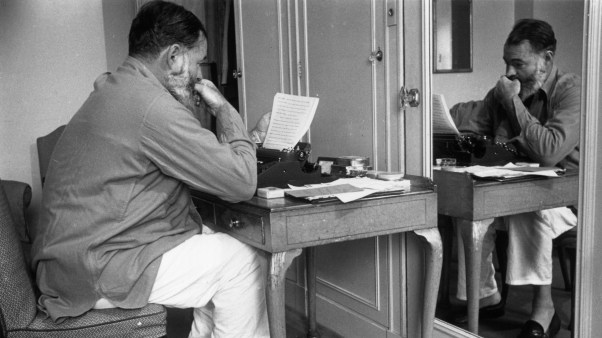
3 ways Hemingway challenges us to open our eyes to ourselves, Scripture, and the world around us.
Learning the dos and don’ts of narrative preaching.
Episode 66 | 26 min
Drawing elements from the arts, poetry, and screenwriting.
Joshua Haldeman grew up on the prairies of Saskatchewan. When the domino effect of the Great Depression hit Canada, Haldeman lost his five-thousand-acre farm and had to start from scratch. He tried his hand at chiropractic medicine and politics. Then Haldeman discovered his passion—flying airplanes.
In 1950, Haldeman uprooted his family and moved halfway around the world to South Africa, a place he had never even been to before! With the help of his wife, Winnifred, and their children, he disassembled his 1948 single-engine airplane. The airplane was packed into crates, shipped to South Africa, and reassembled by the family once it got there.
A few years later, Joshua and Winnifred Haldeman embarked on a thirty-thousand-mile round-trip flight from Africa to Australia and back. They are believed to be the only private pilots to have ever made that flight in a single-engine airplane. As a comparison point, Charles Lindbergh's legendary transatlantic flight in 1927 was only 3,600 miles. Twenty-seven years later, the Haldemans flew more than eight times as far!
Few people have heard of Joshua and Winnifred Haldeman, but I bet you've heard of their grandson Elon Musk. Musk's entrepreneurial exploits are well documented. He has turned the automotive and aerospace industries upside down. At SpaceX headquarters, there are two giant posters of Mars. One shows a cold, barren planet. The other looks a lot like Earth. The second poster represents Musk's life purpose—colonizing Mars.
How does someone even conceptualize colonizing a planet, in the non-science-fiction sense? Dreams are not conceived in a vacuum. One of Musk's biographers noted, "Throughout his childhood. Elon heard many stories about his grandfather's exploits and sat through countless slide shows that documented his travels.” Those stories were the seedbed of Musk's imagination. Those stories were the shoulders he stood on.
Source: Excerpted from Win the Day: 7 Daily Habits to Help You Stress Less & Accomplish More Copyright © 2020 by Mark Batterson, pages 24-25. Used by permission of Multnomah, an imprint of Penguin Random House LLC.
Over the course of several months, Peter Skillman conducted a study pitting the skill of elite university students against that of the average kindergartner. Groups of four built structures using 20 pieces of spaghetti, 1 yard of tape, 1 yard of string, and 1 marshmallow. The only rule, the marshmallow had to end up on top.
Business students began by diagnosing the task, formulating a solution, and assigning roles. The kindergarteners, by contrast, got right to work, trying, failing, and trying again. Author Daniel Coyle explains the outcome, “We presume skilled individuals will combine to produce skilled performance.” But this assumption is wrong. In dozens of trials, the kindergartners built structures that averaged 26 inches tall, while the business school students built structures that averaged less than 10 inches.
We see smart, experienced business school students, and we find it difficult to imagine that they would combine to produce a poor performance. We see unsophisticated, inexperienced kindergartners, and we find it difficult to imagine that they would combine to produce a successful performance . . . individual skills are not what matters. What matters is the interaction.
The kindergartners succeed not because they are smarter but because they work together in a smarter way. They are tapping into a simple and powerful method in which a group of ordinary people can create a performance far beyond the sum of their parts.
Source: Daniel Coyle, The Culture Code (Bantam, 2018), pp. xv-xvii.
Episode 49 | 28 min
Three ways to do it, using the imagination.
Preaching with heart: A case for emotion in expository preaching.
At the 2016 Isaac Asimov Memorial Debate at the American Museum of Natural History, the question of whether or not the universe is a simulation was addressed.
Astrophysicist Neil deGrasse Tyson, who was hosting the debate, said that he thinks the likelihood of the universe being a simulation “may be very high.” But says he wouldn’t be surprised if we were to find out somehow that someone else is responsible for our universe.
Tyson uses a thought experiment to imagine a life form that’s as much smarter than us as we are than dogs, chimps, or other terrestrial mammals. “What would we look like to them? We would be drooling, blithering idiots in their presence,” he says. Whatever that being is, it very well might be able to create a simulation of a universe.
Tyson goes on to say, “And if that’s the case, it is easy for me to imagine that everything in our lives is just the creation of some other entity for their entertainment,” Tyson says. “I’m saying, the day we learn that it is true, I will be the only one in the room saying, I’m not surprised.”
Albert Mohler, commenting on this article states, “So a man who denies the very possibility of the divine creation of the cosmos is here willing to entertain in public the idea that some higher species has merely created the entire cosmos as a simulation for that being’s own entertainment.”
Source: Kevin Loria; "Neil deGrasse Tyson thinks there’s a ‘very high’ chance the universe is just a simulation," Business Insider (4-22-16); Albert Mohler, “Agnostic scientist Neil deGrasse Tyson says its very probable the universe is a simulation,” The Briefing (5-6-16)