Sorry, something went wrong. Please try again.
When Shafiqullah walked into his wedding celebration in Kabul, Afghanistan, he was surprised to find 600 extra people in the room, none of whom he recognized. His original guest list had numbered about 700 people. Besides the guests on his bride’s side, he invited “my cousins; my neighbors, people from my village, and 100 to 150 colleagues.”
But among the 1,300 gathered, he strained to pick them out from the strangers. He said, “It was amazing, but also disturbing as these were people I had never seen before in my entire life.” Still, he knew his obligations. He said, “If I didn’t serve them, it would have caused me dishonor and taken away all happiness from my wedding day.”
So, he told the caterers at the wedding hall to double the food order, bringing the cost of his wedding to nearly $30,000—a small fortune in this impoverished country. It is a familiar tale in Afghanistan, where weddings are vital demonstrations of two tightly held values: commitment to hospitality and devotion to family and community.
But the strain of having to host a party the size of a small village is proving ruinous for many young Afghan men, who find themselves taking out loans to get married that will take years to pay back.
The crowds that stream into Kabul’s wedding halls each night have given rise to a subculture of “toi paal”—wedding crashers who show up in droves. They are uninvited men who hang around the stretch of the airport road that has been nicknamed “Las Vegas,” for the bright neon lights and mirrored glass of the wedding halls.
Because weddings are generally segregated by gender, usually by huge partitions, the draw is not the opportunity to meet women so much as it is the banquet fare of lamb, chicken, lamb pilaf, yogurt, fruit, and pudding. Most young men in Kabul seem to know the expression, “With a wedding every night, there is no need to go hungry.”
Uninvited wedding guests were also mentioned in a parable of Jesus. Only invited guests are welcome at the Wedding Supper of the Lamb. All who come into the wedding banquet must come according to God’s rules. No “wedding-crashers” are allowed.
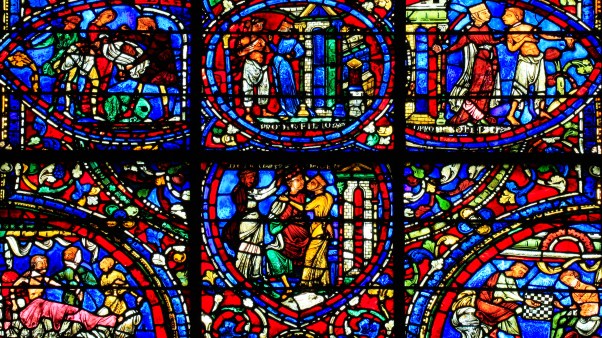
Source: Joseph Goldstein, “At Afghan Weddings, His Side, Her Side and 600 Strangers,” NY Times (4-18-15)
Rich Gilson and his wife, Suzanne, purchased a house in Wildwood, New Jersey, about four years ago, and they have been working on additions and renovations to the home during that time. Gilson, who works in home inspections and renovations, was able to start working on the driveway of the house in the area in front of the home’s garage.
Gilson said, “So I start digging. I’m hitting concrete. I'm hitting rock. I'm hitting glass. Then I found these two things, and they look like root balls. I throw them in the soil pile, both of them, thinking they’re just roots.”
As he continued his work outside on Sunday, he came across one of the cylindrical objects again. “I pick it up, and I'm thinking what is this? Why are these things following me, right? I look at the edge, and I think ‘I can see something there.' It looked like paper. So, I started tugging at the edge, and I knew immediately what it was. I thought ‘this is money.’”
The money was wrapped in brown paper. Gilson and his wife began pulling the cylinder apart, and it amounted to rolls of $10 and $20 bills, totaling $1,000. That money would have been worth a lot more at the time: $1,000 in 1934 is the equivalent of more than $22,000 today when accounting for inflation, per the U.S. Bureau of Labor Statistics.
Gilson said, “So I start to think, OK, either somebody robbed a bank because all these bills came from the same lot,” or he believes that someone may have taken their money out of a bank during the Great Depression in the U.S.
Gilson added that he’s still curious about the money’s story, where it came from and whether someone simply forgot about it. He also hopes that people who see his discovery don’t come looking for more of the money. Gilson said, “Please don’t come to my house with a shovel. I’m trying to finish the house, not make more work for myself.”
This story brings to life Christ's parable of the treasure buried in a field. Like the kingdom of heaven, sometimes the most precious things in the world are hidden from view for a while. God has surprising hidden treasure which only the diligent can find. The kingdom of heaven (Matt. 13:44), godly wisdom (Prov. 2:3-5), and the Word of God (Jer. 15:16) are waiting to be discovered by the earnest seeker.
Source: Marina Pitofsky, “A New Jersey man was working on his driveway. He discovered a trove of money from the 1930s.” USA Today (7-15-22)
As followers of Jesus we can confidently persist in prayer, knowing that we pray to a father who is caring and just—guaranteeing that life will have the final word.
Business consultant Morgan Housel claims that the best arguments seldom win the day; it’s the best story that changes minds and hearts. Housel writes:
A truth that applies to many fields, which can frustrate some as much as it energizes others, is that the person who tells the most compelling story wins. Not who has the best idea, or the right answer ...
[For example], the Civil War is probably the most well-documented period in American history. There are thousands of books analyzing every conceivable angle, chronicling every possible detail. But in 1990 Ken Burns’ Civil War documentary became an instant phenomenon, with 39 million viewers and winning 40 major film awards. As many Americans watched Ken Burns’ Civil War in 1990 as watched the Super Bowl that year. And all he did – not to minimize it, because it’s such a feat – is take 130-year-old existing information and wove it into a (very) good story.
It's the same for writer Bill Bryson. His books fly off the shelves, which I understand drives the little-known academics who uncovered the things he writes about crazy. His latest work is basically an anatomy textbook. It has no new information, no discoveries. But it’s so well written – he tells such a good story – that it became an instant bestseller.
This drives you crazy if you assume the world is swayed by facts and objectivity – if you assume the best idea wins … The novelist Richard Powers summarized it this way: “The best arguments in the world won’t change a single person’s mind. The only thing that can do that is a good story.”
Source: Morgan Housel, “Best Story Wins,” Collaborative Fund (2-11-21)
Courtney Wilson and Shenita Jones had lavish plans for their pending nuptials. The venue they selected had it all: a swimming pool with a waterfall, a hot tub, sauna, tennis courts, gazebos, even a bowling alley. They were scheduled to have the ceremony on Saturday, and a catered brunch on Sunday. The one thing they didn’t have? Permission.
Property owner Nathan Finkel had met with the couple months prior when they posed as potential buyers of the property, which was listed for sale with a $5 million price tag. When they later asked Finkel if they could stage their wedding there, he declined.
But that didn’t stop Wilson and Jones from sending out invitations to guests to gather at the property. According to attorney Keith Poliakoff, who represented the upscale suburban locale, the couple made a critical miscalculation.
“The guy figured it was a vacant house and didn’t realize Nathan lived on the property in a different home. This guy had no idea he lived there. You know the shock that must have been on his face when he showed up at the gate and the owner was home?”
Indeed, once Nathan saw that Wilson had arrived to begin setting up for the wedding, he called police to compel them to vacate the property. Nathan told the 911 dispatcher, “I have people trespassing on my property. And they keep harassing me, calling me. They say they’re having a wedding here. I don’t know what’s going on. All I want is it to stop.” When police arrived, Wilson left without incident. No charges were filed.
1) Law; Rules; Obedience – We can’t ignore laws just because they are inconvenient to our plans. If we attempt to ignore them, God will use the consequences of our actions to inform our behavior. 2) Kingdom of God; Parable; Salvation – This reminds us of the uninvited wedding guest in Jesus’ parable. All who come into the wedding banquet of the kingdom must come according to God’s rules. No “party-crashers” are allowed.
Source: Staff, “South Florida Couple Attempts to Hold Wedding at Mansion They Didn't Own,” NBC News (4-21-21)
Author Alan Fadling asks us to consider this parable:
There was once a king who had two servants. One of the servants, for fear of not pleasing his master, rose early each day to hurry along to do all the things that he believed the king wanted done. He didn't want to bother the king with questions about what that work was. Instead, he hurried from project to project from early morning until late at night.
The other servant was also eager to please his master and would rise early as well. But he took a few moments to go to the king, ask him about his wishes for the day and find out just what it was he desired to be done. Only after such a consultation did this servant step into the work of his day, work comprised of tasks and projects the king himself had expressed a desire for.
The busy servant may have gotten a lot done by the time the inquiring servant even started his work. But which of them was doing the will of the master and pleasing him?
Genuine productivity is not about getting as much done for God as we can manage. It is doing the good work God actually has for us in a given day. Genuine productivity is learning that we are more than servants, that we are beloved sons and daughters invited into the good kingdom work of our heavenly Father. That being the case, how might God be inviting you to wait for his specific direction? Or is God inviting you to take a specific step now?
Source: Alan Fadling, An Unhurried Life (IVP, 2013), p. 51-52
It is better to finally believe what at first I could not say than to say at first what I do not believe.
When we face the storms of life, we must have a solid foundation we know we can trust.
God provides all that we need, so we should center our lives on his kingdom and give generously.
How to read and communicate Jesus’ stories for spiritual impact and life transformation.
As a new year approaches, what will we do with the opportunities God gives us?
Treasure hunters in Britain were thrilled with the find of 5,000 coins (some dating from the 11th century) found buried in a lead bucket in a field in Buckinghamshire. It's one of the largest coin hoards found in Britain.
This find brings to life Christ's parable of the treasure buried in a field. Like the kingdom of heaven, sometimes the most precious things in the world are hidden from view for a while.
Source: Robert Hall, “Thousands of ancient coins discovered in Buckinghamshire field,” BBC (1-2-15)
Life is uneven, but God cares about what we do with what we have.
Seven skills for finding daily life examples for preaching
The parables show us the values and mission of Jesus. Here’s how to do justice to their unique form.
Parables are tiny lumps of coal squeezed into diamonds, condensed metaphors that catch the rays of something ultimate and glint it at our lives. Parables are not illustrations; they do not support, elaborate or simplify a more basic idea. They are not ideas at all, nor can they ever be reduced to theological statements. They are the jeweled portals of another world; we cannot see through them like windows, but through their surfaces are refracted lights that would otherwise blind us--or pass unseen.
Source: Walter Wink, The Christian Century (Nov. 5, 1980). Christianity Today, Vol. 30, no. 6.