

Sorry, something went wrong. Please try again.
Everybody is surprised and the story goes viral (over 2 million views) as a father of a teen goes the extra mile to show how much he cares for his son. Two news hosts of Fox4 at Dallas-Fort Worth:
"A suburban father is an internet hero for dropping in on his son's high school physics class to teach the kid a lesson. Poor kid. Brad Howard told his son, also known as Brad, if he heard from his teacher at Rockwall Heath High School about him talking too much in class, he would sit through class with him. Sure dad. Oh, last week dad got an email, he kept his promise. Daughter Molly posted a picture online."
Report begins with teen Brad speaking to the camera: "I walked in. I had no idea he was going to come, but I was saying hi to everybody and talking to all of my friends and I was like, 'hey Grant', and I heard 'hey Bradley'. And my dad was sitting in my chair."
Father, sitting next to Brad on a sofa: "As the teacher began to teach, all of the sudden I began to think to myself, what if she calls on me to answer a question?"
Hosts voiceover as father and son toss a football: "Turns out dad Brad was actually more uncomfortable about the whole situation than his son, but the teen said he learned a thing or two. He better take his dad's threats much more seriously from now on. When dad says he's going to do something, he's going to do it. I love that they're both laughing about it."
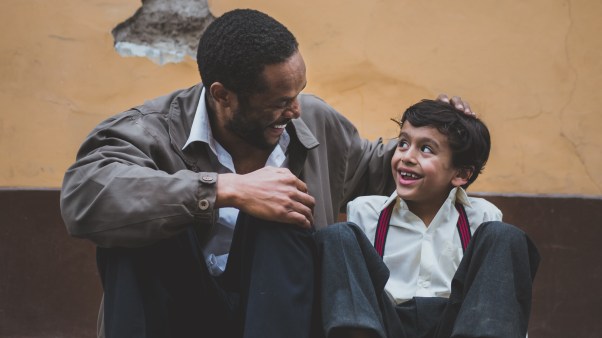
Source: Fox 4 Dallas-Fort Worth, “Dad sits in son's class to teach him a lesson,” YouTube (5-11-17)
The vast majority of American Christians were raised in the faith—and most can point to the influence of their moms. In a 2023 study, the American Bible Society found that a majority of believers remain in the same religious tradition as their mothers.
This agrees with a large body of mainstream social science research dating back to the 1970s that says the active faith of mothers is a strong predictor of religious transmission. Some of this may be attributed to the natural bond children have with their mothers. But there is also research that shows that moms take a more active role in faith formation in America.
For every 100 Americans raised by Protestant mothers:
99% of Christian teenagers talk about God with their mothers
71% of Christian teenagers read the Bible with their mothers
70% of Christian teenagers pray with their mothers
63% of Christian teenagers say their mothers encourage them to go to church
62% share the same faith tradition as adults
19% have no religion
11% joined another Christian tradition
4% are now Catholic
4% are other
Source: Editor, “Mothers Of the Faith,” CT magazine (May/June, 2024), p. 17
While on my way to dispose of a breakfast of which I only took three bites, I noticed something that has broken my heart: The sixteenth craft I made at preschool this week, stuffed into the garbage beneath a layer of yesterday’s trash as if I wouldn’t find it.
No, not the one with the blue crayon circles. Also, no, not the paint handprints that mysteriously had some other kid’s name spelled backward on it. I’m talking about the one with the eight star stickers, a singular macaroni noodle glued to the top, wrinkled from when I shoved it in my backpack. Yes, there’s a hole in the middle from where I pressed the marker down too hard, but that doesn’t give you an excuse to dispose of it without my permission.
I am aware the refrigerator already displays five similar drawings, and, yeah, you have four noodle necklaces hanging on the lamp by your desk. But when I came home excitedly holding this latest presentation of my blossoming creativity, I thought the look of pride you had on your face was sincere. Now, I’m not sure what to believe.
Do you not appreciate the six minutes of uninterrupted focus required for me to produce such masterpieces? Is there no true love for the wilting dandelions I harvest from our yard three times a week that I demand you find a new vase for every time? Does this prove you’re not planning on treasuring the rocks I collected for you in my pocket that I forgot to take out until it was too late, which were rattling around in the dryer during the third load of laundry you were doing today?
My future therapy bills are already increasing over the denial of genius presented through this unforgivable act of parental neglect.
But trauma creates great art, and with that, I’m prepared to unveil my greatest work yet: a rainbow mural of permanent markers all over the bathroom on every surface I could reach. The sink. The baseboards. The shower curtain. The mirror. The light switch. The door. The fancy tile you had installed during a remodel before I was born.
I’m hopeful the tears I see forming in your eyes represent how moved you are by my magnum opus. It feels great to finally have my work be respected the way it should.
Source: Stenton Toledo, “I Cannot Believe You Heartlessly Threw Away the Sixteenth Craft I Brought Home from Preschool This Week,” McSweeneys.Net (10/13/23)
American Protestants are keeping their children in the faith at a higher rate than Catholics or the unaffiliated. The biggest influence: mothers.
Children Of Two Protestant Parents:
80% are still Protestant
13% are now unaffiliated
2% are now Catholic
Children Of Two Catholic Parents:
62% are still Catholic
19% are now unaffiliated
16% are now Protestant
Children Of Two Unaffiliated Parents:
63% are still unaffiliated
29% are now Protestant
7% are now Catholic
Children Of A Protestant Mother And Catholic Father:
49% are now Protestant
25% are now unaffiliated
14% are now Catholic
Children Of A Protestant Mother And Unaffiliated Father:
61% are now Protestant
29% are now unaffiliated
2% are now Catholic
Source: Editor, “Cradle Christians,” CT magazine (Jan/Feb, 2017), p. 19
According to an article in Scientific American magazine more than 40 percent of people with opioid addiction reported some type of childhood abuse or neglect, much higher than the rate for the general population. Another study showed that among those with any type of addiction, at least 85 percent have had at least one adverse childhood experience, with each additional experience raising the risk. The link is most pronounced among those diagnosed with post-traumatic stress disorder (PTSD), characterized by flashbacks and other psychological disturbances that can develop in response to a shocking or terrifying event.
Just a few of these major adverse causes are: being a victim of extreme bullying, relentless daily stress in the home, "witnessing violence; losing a parent; or experiencing a life-threatening illness, accident, conflict, or disaster."
The shocking reality is that the vulnerable childhood brain is physically rewired. Growing up in a threatening and stressful environment can undermine this circuitry. Stress in early life also alters the nucleus accumbens, a part of the striatum that is key to addiction: it makes us want more of what feels good.
The victim is often in a frame of mind that is the antithesis of delayed gratification. Immediate relief by taking drugs or illicit sex is perceived as a better option than making wise, long-term choices. A positive future is too uncertain and unattainable. Overall, severe early stress can create a general sense of dread and pleasurelessness. So, if traumatized kids are exposed to drugs that amplify dopamine or activate the brain’s own opioid systems, they are highly susceptible to becoming addicted because the drugs offer the excitement and comfort they otherwise lack.
Some Christians are too quick to judge and condemn the millions of Americans who are in bondage to a number of destructive addictions. While repentance must clearly be emphasized, an understanding of how and why many get addicted will lead to greater compassion and possibly more effective ministry.
Source: Maia Szalavitz, “New Treatments Address Addiction alongside Trauma,” Scientific American (9-17-24)
In a new study published in Computers in Human Behavior, a team evaluated 118 children aged three to six and found that overall, kids were more inclined to trust machines over humans.
The study divided children into different groups and showed them videos of humans and robots labeling objects, some recognizable to the kids and other items that would be new to them.
Researchers demonstrated the reliability and trustworthiness of humans and robots by having them incorrectly identify familiar items, calling a brush a plate, for instance. This intentional mislabeling allowed researchers to manipulate the children’s concept of who could and could not be trusted. Interestingly, the children showed a stark preference for robots.
When both bots and humans were shown to be equally reliable, children were more inclined to ask robots questions and accept their answers as true. Even when the robots proved unreliable, children preferred them to reliable adults. Children also appeared to be more forgiving of their machine-friends versus their human ones. When the robots made a mistake, children perceived it as accidental. But when the adults fumbled? Children thought those missteps were intentional.
When asked who they would want to learn from and share secrets with, the majority of children chose the robots over the humans. But that preference might only last for so long: Older children were likelier to trust humans when a robot was shown to be unreliable.
Parents have a God-given responsibility of nurturing trust and educating their children. This profound duty should remain in their hands, not delegated to AI, government, or technology. Embracing this role empowers parents to shape the values and character of the next generation.
Source: Reda Wigle, “Study reveals whom children really trust — and it’s not humans,” New York Post (5-31-24)
A growing number of high-profile tragedies are leading to prosecutions of parents not for their actions, but for their failures to act. One such case involves Elizabeth Puleo-Tague, whose teenager’s fondness for fast, erratic driving led to a crash that killed a passenger in his car. The mother of the boy who was killed wants her prosecuted for parental neglect.
Kiernan Tague, 17, was charged with second-degree murder in the death of his friend Flynn MacKrell after his vehicle, a BMW X3, lost control at 105 miles per hour and collided with a tree. Flynn's mother, Anne Vanker, believes that Puleo-Tague should be held responsible for her son's actions due to her negligence.
“To say this is a living hell is an understatement," said Flynn's mom, Anne Vanker, in an interview. “My life has been ruined. No one should ever, ever have to lose a child like this ... I still can’t believe my son — my big calm son — is gone.”
Vanker says that Kiernan’s mother, Elizabeth Puleo-Tague, should be held legally liable for Flynn’s death. An investigation by the local prosecuting attorney revealed a history of Puleo-Tague pleading with Kiernan to slow down. Despite her repeated warnings and the use of a safety app, Kiernan continued to engage in dangerous driving.
Months before the crash, Puleo-Tague had been receiving notifications from a safety app called Life360, informing her of Kiernan’s aggressive driving. Kiernan had even taken a photo of his Audi’s speedometer exceeding 140 miles per hour.
Texts show that Puleo-Tague repeatedly begged her son to change his ways, but he refused. But not only did she fail to stop her son from continuing in his reckless ways, she bought an even faster car—the BMW—and left the keys at home during a trip to Canada.
In her request for charges, Vanker compared Puleo-Tague to James and Jennifer Crumbley, who are serving 10-year sentences in prison because they failed to take a rifle away from their son Ethan Crumbley, who eventually took the lives of several people at his school.
"She was sitting on a ticking time bomb. She knows he's out of control, yet she basically gets him a weapon," Vanker said. "It's like she handed him an AR-15."
Regardless of the outcome of the case, the tragedy serves as a stark reminder of the importance of addressing reckless behavior in young people, and of the potential consequences of parental neglect.
Source: Tresa Baldas, “'Slow the f--- down': Grosse Pointe mom's texts to son may come back to haunt her,” Detroit Free Press (8-22-24)
After being in rock music for a season, Bob Carlisle's mood began to change in the mid 90's. He said, "I like anything that's done honestly and genuinely. Right now I'm more introspective and trying to write my own music." This led to Bob writing more about his family on his third solo album, Shades of Grace. Carlisle said, "I wanted to reveal more of myself as a father and as a husband. If I'm not nurturing my family, I have no business traveling."
The most inspirational song Carlisle recorded on the album Shades of Grace was a sentimental ballad about his daughter titled “Butterfly Kisses,” written for her 16th birthday. The song itself takes the listener through different stages of his daughter's life--of first being a child, then a teenager, and finally becoming a wife. The lyrics are extremely poignant and meaningful for all fathers.
The Bible teaches the importance of nurturing and guiding our children through the different stages of their growth, including the more challenging seasons (Prov. 22:6; Eph. 6:4). Let's ask God for wisdom and strength to nurture our children through all their stages of growth and development. Let's ensure we give quality time to understand them, walk with them, and to pray for them.
Editor’s Note: "Butterfly Kisses" by Bob Carlisle is still a popular song today, even though it was released over 25 years ago. As of 2023, the song has over 100 million streams on Spotify, 200 million views on YouTube, is the 14th most played song on Christian radio, and is the 22nd most played song at weddings.
Source: “Butterfly Kisses (song),” Wikipedia (Accessed 11/4/23); Editor, “Butterfly Kisses,” SongFacts (Accessed 11/4/23)
In a New York Times editorial, David French notes the frequent conversations he has with parents of teenagers about the teen mental health crisis in America. French writes, “As a parent of a teenager, I see this world every day.” But then he raises the following questions about this crisis: “What if the call [to anxiety and depression and rage] is also coming from inside the house? What if parents are inadvertently contributing to their own kids’ pain?”
French writes:
When we think about children and screens, let’s also consider the relationship between adults and their TVs and smartphones. Watch [the news] and you’ll see a discourse dominated by fear and anger. If you spend any time at all on political Twitter [or Facebook], you’ll quickly see a level of vicious, personal attacks that differ little from the most extreme personal bullying a person can experience in middle school or high school.
What should we do about it? French concludes:
It might be worth asking a simple question: How much fear and anxiety should we import into our lives and homes? Forget teens, for the moment. Are we proving any more capable of handling the information age? It’s a question I honestly ask myself … I know that my anxiety can radiate outward to affect my kids …. If we want to heal our children [we] may well start by seeking the help we need to heal ourselves.
Source: David French, “What if Kids Are Sad and Stressed Because Their Parents Are?” The New York Times (3-19-23)
In the dead of night at the heart of the Colombian jungle, army radios crackled to life with the message the nation had been praying for: "Miracle, miracle, miracle, miracle." The military code revealed that four children missing in the jungle for 40 days had all been found--alive.
The youngsters, all members of the indigenous Huitoto people, had been missing since the light plane they were travelling in crashed into the Amazon on May 1, 2023. The tragedy killed their mother and the two pilots and left the children--aged 13, nine, four, and one--stranded alone in an area teeming with snakes, jaguars, and mosquitos.
Rescuers initially feared the worst, but footprints, partially eaten wild fruit and other clues soon gave them hope that the children might be alive after they left the crash site looking for help. Over the next six weeks, the children battled the elements in what Colombia's President Gustavo Petro called "an example of total survival which will remain in history."
If there were ever children well-prepared to tackle such an ordeal, the Mucutuy family were the ones. Huitoto people learn hunting, fishing, and gathering from an early age, and their grandfather told reporters that the eldest children were well acquainted with the jungle.
Speaking to Colombian media, the children's aunt said the family would regularly play a “survival game” together growing up. She recalled, “When we played, we set up little camps. Thirteen-year-old Lesly knew what fruits she can't eat, because there are many poisonous fruits in the forest. And she knew how to take care of a baby.”
After the crash, Lesly built makeshift shelters from branches held together with her hair ties. She also recovered fariña, a type of cassava flour, from the wreckage of the Cessna plane they had been travelling in. The children survived on the flour until it ran out and then they ate seeds. The fruit from the avichure tree, also known as milk tree, is rich in sugar and its seeds can be chewed like chewing gum.
But they still faced significant challenges surviving in the inhospitable environment. Indigenous expert Alex Rufino said the children were in “a very dark, very dense jungle, where the largest trees in the region are.” In addition to avoiding predators, the children also endured intense rainstorms.
John Moreno, leader of the Guanano group in the south-eastern part of Colombia where the children were brought up, said they had been "raised by their grandmother," a widely respected indigenous elder. He said, “They used what they learned in the community, relied on their ancestral knowledge in order to survive.”
It is the duty of parents and the church community to train up children to survive and thrive in the hostile environment of the world. It is literally “a jungle out there” for our children and they must be prepared when they are young.
Source: Matt Murphy & Daniel Pardo, “How children survived 40 days in Colombian jungle,” BBC (6/12/23)
It’s no secret that many college students spend much of their four years at school drinking way more than they probably should. Now, a new study is actually putting a number on the plethora of unfortunate consequences that comes from a wild night of college drinking.
Over four years, researchers say the average college student deals with 102 alcohol-related consequences the morning after. These range from blacking out, suffering a hangover, being pressured to have sex with someone, or having to miss work or class because they drank too much the night before.
However, the team found one major factor keeps many students from overdoing it at a college party—strict, disapproving parents. Researchers say college students who thought their parents would disapprove of their alcohol-related dilemmas ended up reporting fewer negative incidents after drinking than their peers who partied harder.
Research professor Kimberly Mallet said, “Kids really look to their parents for guidance in a lot of ways even if they don’t outwardly say it. It’s empowering for parents to know that they can make a difference. We often think of peers as having an influence on drinking behaviors, but we found that parents can make a difference, even after their child has left home.”
Source: Chris Melore, “From hangovers to blacking out: Students suffer 102 alcohol-related consequences at college,” Study Finds (10/28/22)
Pastor Bryan Chapell writes in his recent book Grace at Work:
My musician wife, Kathy, talks about a time that she was changing a particularly yucky diaper of one of our children. She said to a friend standing beside her, "These hands have played Mozart." The friend replied, "Maybe these hands are diapering the next Mozart!"
Undeniably, what those hands were doing was nurturing an eternal soul. When we are working to fulfill responsibilities God gives us, no matter how difficult or onerous the task, the Bible helps us to avoid thinking, “I'm just not doing something very important.”
Source: Bryan Chapell, Grace at Work, (Crossway, 2022), pp. 32
Did you drop the ball this Mother’s Day and forget to pick up a gift for your mom? You’re not alone. A new survey has found that one in six Americans hasn’t sent their mother a single present in over a year. A survey found that 67 percent know their mom’s favorite flower. However, 37 percent admit they haven’t bought their mother flowers of any kind over the last year.
Another 57 percent know exactly what movie their mom would love to watch. But one in three people haven’t sat down to watch a movie with her in more than a year. Another 81 percent know their mom’s favorite hobby, but only half the poll say they’ve joined their mother to do that activity within the last six months. Even though 81% know their mom’s favorite way to pamper herself, 51% haven’t treated their mom in the last month.
A study found that mothers spend a staggering 97 hours a week doing something related to parenting—the same amount of time most people with a six-figure salary spend on their job.
Celebrating Mother’s Day is an easy way to show appreciation to the hard work, dedication, and care moms provide. They may not be sending flowers or taking mom out to dinner, but at least Americans are picking up the phone. More than 80 percent of the poll say they speak to their mother at least once a month.
So, if there’s a lesson coming out of this survey, maybe it’s that Americans need to spend a little quality time with their mom. With Mother’s Day being a day to do whatever our mother’s love to do, this day in May allows many kids a chance to play “catch-up.” After all, everyday can be Mother’s Day if you try.
Source: Chris Melore, “Forgot Mother’s Day? 1 in 6 Americans haven’t sent their mom a gift in over a year!” Study Finds (5-9-22)
When children have questions about their heavenly Father, their first instinct is to ask their mothers. Christian women tend to be more devout than men, and they’re often tasked with the bulk of parenting duties. But findings from Barna Research detail the gap between moms and dads when it comes to many aspects of faith formation:
Practicing Christians were asked, “Whose faith influenced you?”
Mother – 68%
Father – 46%
Practicing Christian teens were asked, “Which parent offers spiritual guidance?”
Prayer together: Mother 63%, Father 53%
Discussing God: Mother 70%, Father 56%
Discussing the Bible: Mother 71%, Father 50%
Responding to faith questions: Mother 72%, Father 56%
Encouraging church attendance: Mother 79%, Father 64%
Source: Staff, “Faith of Our Mothers,” CT magazine (May, 2019), p. 17
Tim Keller said he would never forget the story about one of his mentors, a college professor named Dr. Addison Leach.
Two young women at the college were both bright and their respective parents wanted them to get Master’s Degrees and go on to careers. But, instead, they both became Christians. Both decided that they were going to become missionaries. Their parents had a fit. One of the mothers called Dr. Leach, thinking that Dr. Leach was one of the reasons that the girls had become (in the mother’s words) “religious fanatics, rather than pursuing the course they had hoped, getting a career and having security. Instead, they were going to go wildly off into the blue.”
This mother said, “We wanted our daughter to get a master’s degree, start a career, and get something in the bank, so she could have some security. Dr. Leach responded:
Please just let me remind you of something. We’re all on a little ball of rock called earth, and we’re spinning along through space at zillions of miles per hour. Even if we don’t run in to anything, eventually we’re all going to die. Which means that under every single one of us there’s a trap door that’s going to open one day and we’re all going to fall off this ball of rock. And underneath will either be the everlasting arms of God or absolutely nothing. So maybe we can get a master’s degree to get some security.
But the biggest savings account in the world cannot stop cancer. It can’t stop traffic accidents. It cannot stop broken hearts. It can’t give you anything … any of the things that only God can give you. He’s the only significance you can have. He’s the only love that you can get and can’t lose.
Source: Excerpt From: Timothy J. Keller. “A Vision for a Gospel-Centered Life.” Apple Books.
First-year UNC coach Hubert Davis was asked about his faith during a press conference introducing him as the new coach of the University of North Carolina Tar Heels in April 2021.
He said, “[Faith is] the most important thing to me. My faith and foundation [are] firmly in my relationship with Jesus. It just is. And my mother was a Christian and she begged me to go to church growing up. And I didn’t want to go. I wasn’t interested in it. My mom used to always say that Jesus had a plan for me. And at the time growing up, I didn’t understand it and I didn’t listen to it.”
Davis said he grew a tremendous hatred toward God after his mother passed away in high school. His animosity continued into his first two years at UNC. He couldn’t reconcile what his mom had told him with the pain of her loss.
Davis continued, “One of the things that [legendary Tar Heels coach Dean] Smith used to do was make all the freshmen go to church. And as I went to church, only because Coach Smith and (assistant) Coach Guthridge encouraged me to go to church, I started to understand what my mom was talking about. I started to understand the sacrifice that Jesus made for me and how much He loves me, and two days before my junior year of college, I became a Christian.
Instead of being upset that Jesus has taken away the most beautiful person in my life in my mom, I’m thankful every day that He gave me the best that I could ever have for 16 years. … My faith in Christ is the foundation of who I am.”
Source: Kevin Mercer, “First-year UNC coach Hubert Davis reaches 20 wins with Christ as 'foundation of who I am,’ Sports Spectrum (2-23-22)
When Jessica Rocha set out to celebrate her graduation from the University of California San Diego, she took a photo. And like many Instagram influencers often do, Rocha was in a field. But instead of being in a cute outfit with stylish accessories, Rocha was in her graduation gown. And her parents were on hand for the occasion.
Central to the importance of the shot was its location, and the way that it demonstrated her family heritage. In the photo, Rocha and her parents stood in the same fields where all three of them had toiled as migrant workers, planting and harvesting, for years and years. According to Rocha, after her parents emigrated to the US from Mexico they required her to work in the fields as way to remind her about the value of getting an education. During her high school years, she often worked the overnight shift with her father. They would plant strawberries late through the evening and into the morning. Rocha barely got enough sleep to take the bus to school in the morning.
Rocha took the photo to honor her parents for the way they sacrificed so that she could pursue her education. She said, “Nobody thinks about nor sees what happens behind a vegetable you grab at the grocery store. But behind it is someone who breaks their backs every day working in the fields."
Even after she made it into college, Rocha still worked the fields on weekends and during school breaks. She credited her parents for the motivation. “Many times I wanted to give up, but my parents and their pieces of advice and support were the reason I kept going. If it wasn't for how my parents raised me I don't know who I would be today."
1) Honor your parents for the sacrifices they made in raising you and their lasting influence in your life; 2) It's a blessing to look back and see the places from which God has brought us; it's also necessary for us to remember God's power and continue to trust in God's provision.
Source: Christopher Brito, “College graduate honors her parents with photos in fields where they worked,” CBC News (6-16-21)
On August 18, 1920 state lawmakers in Tennessee filed into the statehouse to cast their ballots on the ratification of the 19th Amendment. Carrie Chapman Catt had lobbied hard for the rights of women to vote. The 19th Amendment had already been ratified by 35 of the required 36 states. With other states refusing to call special ratification sessions, Tennessee remained the suffragists’ last chance to vote in 1920.
The debate in Nashville raged for days, in the chamber, in committee rooms, and spilling out into restaurants and hotels. By midday on August 18, the outcome was still too close to call. Then, young legislator Harry Burn switched his vote to “yes’” The Amendment passed by his single vote.
Most of his constituents opposed women voting, but the constituent who mattered most to him was his mother. That morning she had sent a note urging him to “be a good boy and help Mrs. Catt.”
Source: Kimberly Hamlin, "The 19th Amendment, When American Women Won the Vote,” History Magazine, (Summer 2020), p. 17
For over a decade, Greyhound Lines has partnered with the National Runaway Safeline--an organization that seeks to keep runaway and homeless youth safe--to reunite young people with their families and guardians. Since 1995, the Home Free program has helped over 16,000 families by providing free bus tickets, according to the National Runaway Safeline.
To get a free ticket home, a person between the ages of 12 and 21 must call the NRS helpline (1-800-RUNAWAY). They also must be named on a runaway report and be willing to return to their family. The family or guardian also needs to agree to receive them at home. If the individual hoping to return home is under the age of 15, Home Free also provides a free ticket for the child's parent or guardian.
Before a young person begins their journey home, National Runaway Safeline works with them and their guardians to create a plan for their return. It also locates resources in the community that will be able to provide support once they are settled. After the family is reunited, the group says it follows up to make sure the family member arrived home safely and provides additional resources.
Source: Elizabeth Wolfe and Saeed Ahmed, “Greyhound Is Giving Free Tickets to Runaways Who Want to Return Home” CNN (12-31-19)
These 5 Father’s Day sermons will ignite your creativity as you work on your sermon for Father’s Day.