

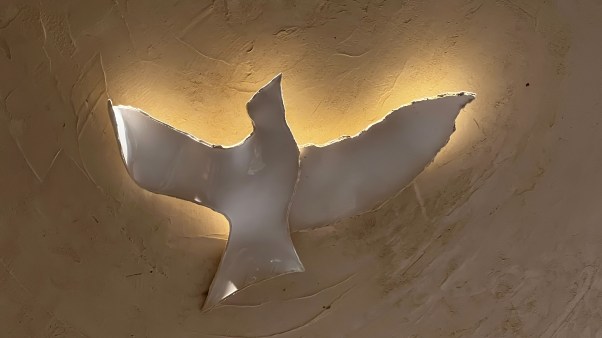
May 24
Sorry, something went wrong. Please try again.
Henry Drummond wrote:
Ascension … what if it didn't happen? Suppose Jesus had not gone away. Suppose he were here on earth NOW. Suppose he were still in the Holy Land--Jerusalem.
Every ship that started for the East would be crowded with Christian pilgrims. Every train flying through Europe would be thronged with people going to see Jesus.
Supposing YOU are in one of those ships. The port when you arrive after the long voyage is blocked with vessels of every flag. With much difficulty you land and join one of the long trains starting for Jerusalem. As far as the eye can reach the caravans move over the desert in an endless stream. As you approach the Holy City you see a dark mass stretching for (miles and miles) between you and its glittering spires. You've come to see Jesus, but you will NEVER see him.
Source: F.W. Boreham, A Bunch of Everlasting (Reprint Wentworth Press, 2019) p. 66
Pastor David Hansen writes of our need to rely on the Holy Spirit:
I live near a river. Fish live in it, and the willowy river bottom is home to mice and mountain lions. From my kitchen window I watch bald eagles, ospreys, golden eagles, and hawks. These birds of prey ride the wind. It doesn't take much energy on their part. However, when geese fly, they must (expend energy by) flapping their wings, but birds of prey soar by catching currents.
Birds of prey seek thermals; columns of warm air that rise from the earth filled with energy. The birds glide on the heated currents of air. A good thermal can lift them high into the sky without so much as a single flap of their wings. From their higher place they can see more ground and can fly longer and farther, and when the time comes to dive on their prey, they can plummet with great speed.
As I watch these birds, I think of pastoral ministry. I too seek thermals. The Spirit lifts, gives vision, direction, and power. Ministry is riding on the free winds of the Spirit that lift us to heights we cannot climb on our own. We can't stay in the air very long on our own strength, but we can seek thermals. Our soul-wings are made large that we might catch the Spirit.
Although this passage is written to pastors, the illustration itself can easily be directed toward our church members encouraging them to seek the filling of the Holy Spirit through prayer.
Source: David J. Hansen, The Art of Pastoring: Ministry Without All the Answers, (IVP books, 2012), p. 51
Andrew Wilson writes in an article for Christianity Today:
When you’re sailing, is “being filled with the wind” an experience or a habit? Both. Catching the wind on a sailboat is clearly an experience. I vividly remember that first feeling of being seized and carried forward by a mighty power from elsewhere. But it is also a habit. If you don’t put the sails up, pull the mainsheet fast, or adjust the jib, you won’t go anywhere, even if the wind is blowing powerfully.
Sailing, in that sense, is the art of attentive responsiveness to an external power. You rely entirely on the external power to get you anywhere. Sailors never imagine themselves to be powering the boat by their own strength. But you also have to respond attentively to whatever the wind is doing, which comes through cultivating awareness, skill, and good habits.
Being filled with the Spirit involves the same both-and. We pursue the experience of the Holy Spirit - Paul uses the language of filling and drenching, drinking and pouring. We rely entirely on the Spirit’s immeasurable power, rather than our own strength, to get us anywhere. But we also develop habits. We respond attentively to what he is doing in and through us, a capacity that comes through awareness, skill, and practice. Paul mentions four such habits in subsequent verses: teaching one another, singing, giving thanks, and submitting to one another (Eph. 5:18–21).
Source: Andrew Wilson, “Paul Says to ‘Be Filled with the Spirit.’ How Do We Obey a Passive Verb?” ChristianityToday.com (7-21-19)
In his book, Life in the Presence of God, Kenneth Boa compares a soaring eagle to Christians learning to soar through the power of the Holy Spirit:
God seems to like eagles. Thirty-three Bible verses mention them! Eagles are true flying birds, meaning they get off the ground by flapping, but they soar by thermals. Eagles begin flight training around four months old. But even before that, at about two months, they stand up in the nest and spread their wings when they feel gusts of wind. They're training to know the thermals! Thermals are the columns of air formed as heat rises from the ground. Because heat rises, these air columns push up and up, displacing the cold air around them. By staying in the warmth of the thermal, the birds continue to soar. Eagles become experts in this.
In this magnificent aerodynamic action, gravity isn't deactivated—it's still at work—but the higher principle overcomes gravity. Eagles drop down when they step off a branch. Then, they start flapping like crazy. Once they're in the air, though, their wings don't have to work very hard, and while soaring, they use a small fraction of the effort required to rise. They're almost at rest and can just enjoy the pleasure of flight.
When we first begin following Christ (or practicing a spiritual discipline) we're like eagles spreading our wings. Once we start flapping, though, we lift up. Maybe after a few tries we're back down on the ground. But through repeated practice, we finally soar. Also, in Greek, the Holy Spirit is called pnuema, which means "current of air." Think about what this means for us! We flap and flap, but eventually we catch the current of air, and we soar. This is how the Holy Spirit works with our training. He's not only our coach; he's the power behind everything we do.
Source: Kenneth Boa, Life in the Presence of God (InterVarsity Press 2017), pages 129-130
Imagine that you've decided to go sailing. The problem is that you know next to nothing about sailing. So you to the store and you purchase several books to find out what's involved. You carefully read them and then you talk to a veteran sailor who answers questions for you. The next day, you rent a sailboat. You examine it closely to make certain that everything needed for a successful sailing experience is present and in good working order. Then, you take your boat out onto the lake. Your excitement is at a fever pitch, though you're also afraid. But you follow the instructions you've read and the counsel received from the experience sailor, and you launch your boat into the water. You carefully monitor each step and hoist the sail.
At that precise moment you learn a crucial lesson. You can study sailing. You might even be able to build a sailboat. You can seek from the wisest and most veteran of sailors. You can cast your boat onto the most beautiful of lakes under a bright and inviting sun. You can successfully hoist the sail. But—and this is a big "but"—only God can make the wind blow!
Possible Preaching Angles: Sam Storms adds, "You and I can study the Bible…. We can orchestrate a worship service according to biblical guidelines. We can do everything that lies in the power of a Christian man or woman. But only the Spirit can make the wind blow.
Source: Sam Storms, Practicing the Power (Zondervan, 2017), page 34 (Note: A version of this story originally appeared in When I Don't Desire God by John Piper)
In a New York Times article titled "The Stories We Tell Ourselves," philosopher Todd May notes that we're often telling stories about ourselves—mainly to make ourselves look good. May writes: "We tell stories that make us seem adventurous, or funny, or strong. We tell stories that make our lives seem interesting. And we tell these stories not only to others, but also to ourselves."
May says that most of us "live in echo chambers that reflect the righteousness of our lives back to us." And in our "echo chambers" we justify why we and our group are superior to others. In short, we tell ourselves a very narrow, shallow story.
Followers of Jesus aren't always better people, but we always have a better and bigger story because our story isn't first and foremost about us. It begins with Jesus. A children's Bible called The Jesus Storybook Bible has a wonderful way of summarizing this story as Jesus tells his followers:
This is how God will rescue the whole world [Jesus says]. My life will break and God's broken world will mend. My heart will tear apart—and your hearts will heal … I won't be with you long. You are going to be very sad. But God's Helper will come. And then you'll be filled up with a Forever Happiness that won't ever leave. So don't be afraid. You are my friends and I love you.
Source: CJ Green, "The Only Thing You've Got Is What You Can Sell: Making Peace with the Stories of Our Lives," Mockingbird blog (1-18-17)
Someone (J.D. Grear) has said that many of us think that the Holy Spirit is like our pituitary gland. You know it's there, you're glad you've got it, and you don't want to lose it, but you're not exactly sure what it does. Well, the Holy Spirit does a lot. For our purposes here, the Holy Spirit is our teacher, reminder, and enabler.
A number of years ago I suffered from a hip problem. For over a year I walked with a cane. Every time I leaned on one side, I felt an excruciating pain. As long as I was leaning on the other side, sitting, or in bed, there was no problem and no pain. But turn the wrong way and "Ouch!!" That pain was a teacher. I learned to be very careful about the way I walked, how I turned, and the steps I climbed. The pain was also a reminder: "Hey, be careful. Don't lean on that side." But when I did, there was always a kind soul who became my enabler, and would grab my arm and make sure I didn't fall.
The Holy Spirit is like that.
Source: Adapted from Steve Brown, Hidden Agendas (New Growth Press, 2016), page 81
For the 1889 World's Fair in Paris, more than a hundred artists submitted plans to design the centerpiece, the masterpiece of the Exposition Universelle. The winner was an engineer named Alexandre Gustave Eiffel, who proposed a 984-foot tower, the tallest building in the world at that time. Skeptics scoffed at his design, calling it useless and artless. Eiffel called her La Dame De Fer—the Iron Lady. Gustave Eiffel's name was on his tower, but Eiffel himself thanked seventy-two scientists, engineers, and mathematicians on whose shoulders he stood. Their names are inscribed on the tower.
The Tower also relied on 300 riveters, hammermen, and carpenters who put together the 18,038-piece jigsaw puzzle of wrought iron in two years, two months, and five days. Oh, and don't forget the acrobatic team Eiffel hired to help his workers maintain balance on very thin beams during strong gusts of wind. We have each of them to thank—as well as the Paris city council that voted in 1909 not to tear down the tower despite the fact that its twenty-year permit had expired. The tower's longevity also depends on each councilmember and to each of the voters who put them in office.
Source: Mark Batterson, If: Trading Your If Only Regrets for God's What If Possibilities, (Baker Books, 2016), pages 7-9
In the classic French film Jean de Florette, townspeople in a small village in Provence, France conspire against a local landowner named Jean who has just inherited a plot of land. They want to force Jeans's little farm to fail so they can possess the land. The land receives only scant rainfall so they sneak on to his property and plug a healthy stream, cementing it shut and covering it with dirt.
Jean does not know about the nearby spring, but he knows of another, more distant water supply over a mile away. He initially makes progress, but eventually getting the water and dragging it from the distant spring becomes a backbreaking experience. Sadly, he never discovers that he already has an inexhaustible supply of water underground but nearby.
Possible Preaching Angles: Holy Spirit; God, power of—In the same way, Christians have an inexhaustible supply of power—the Holy Spirit—living within us. Sadly, some of us are like Jean in this film—you spend our lives in backbreaking effort trying to haul another supply.
Source: Wikepedia, "Jean de Florette," last accessed on October 13, 2016
While every analogy of the Trinity has its limitations, this picture illustrates one aspect of our Triune God—that they are all on the same team.
Say a family is trapped in a forest fire, so a helicopter team undertakes a rescue. One fireman flies the helicopter over the smoky blaze to coordinate the operation and see the big picture. A second fireman descends on a rope into the billowing smoke below to track down the family and stand with them. Once he locates the family, he wraps the rope around them, attaching them to himself, and they are lifted up together from the blaze into safety. In this rescue operation the first fireman looks like the Father, who can see the whole field unclouded from above to sovereignly orchestrate the plan.
The second fireman looks like the Son, who descends into our world ablaze to find us, the human family, and identify with us most deeply in the darkness of the grave. The Spirit is like the rope, who mediates the presence of the Father to Jesus, even in his distance, and raises Jesus—and the human family with him—from sin, death, and the grave, into the presence of the Father. Of course, like all analogies, this one falls short. The Spirit is a person, not a thing (like the rope). And the Father, Son, and Spirit are not separate individuals but the one God, sharing a divine nature and essence as one being.
Possible Preaching Angles: The point of the analogy is this: the rescue mission requires the interdependent action of all three persons. Each has a distinct and necessary role. And yet, zooming out, they are undertaking one united, joint action: the rescue of the human family. We miss what is happening if we pit Jesus against God, or God against Jesus. The Father, Son, and Spirit are working together at the Cross, of one will and nature, in a united, joint action for the redemption of the world. The Cross is a triune act.
Source: Adapted from Joshua Ryan Butler, The Pursuing God (Thomas Nelson, 2016), page 122
You might not know the name Angelo Dundee, but you've undoubtedly heard of Muhammad Ali, probably the most famous professional boxer of all time. For more than two decades, Angelo Dundee was in Muhammad Ali's corner, literally. He was Ali's cornerman! He's the one who made Ali float like a butterfly and sting like a bee. He also trained fifteen other world boxing champions. Angelo Dundee described his job as a cornerman this way: "When you're working with a fighter, you're a surgeon, an engineer, and a psychologist."
As followers of Jesus Christ, we have something even better than a surgeon-engineer-psychologist in our corner—the Holy Spirit.
Source: Mark Batterson, If (Baker Books, 2015), page 249
The 137-mile long Atchafalaya River is a distributary of the Mississippi River that meanders through south central Louisiana and empties into the Gulf of Mexico, serving as a significant source of income for the region because of the many industrial and commercial opportunities it offers. Yet as scenic, productive, and enriching as this river is, it owes all its strength—all of it—to the mighty Mississippi. That's because a distributary doesn't have its own direct water source; it is an overflow of something else. So when the Mississippi is high, the Atchafalaya is high; and when the Mississippi is low, the Atchafalaya is low. What the Atchafalaya accomplishes depends wholly on something other than itself.
The church is a lot like the Atchafalaya River. Anything of value she accomplishes is always tied to her source. So if she somehow loses connection with it—with her first love, the Living Word—she loses all power. She dries up and empties.
Source: Matt Chandler, Eric Geiger, Josh Patterson, Creature of the Word (B&H Books, 2012), page 6
Even though our churches are only able to be the object of revival rather than its producer, I don't think our waiting is as passive as it seems. Let me illustrate with an image from James K. A. Smith's book Imagining the Kingdom:
I cannot choose to fall asleep. The best I can do is choose to put myself in a posture and rhythm that welcomes sleep. I lie down in bed, on my left side, with my knees drawn up; I close my eyes and breath slowly, putting my plans out of my mind. But the power of my will or consciousness stops there. I want to go to sleep, and I've chosen to climb into bed—but in another sense sleep is not something under my control or at my beckoned call. I call up the visitation of sleep by imitating the breathing and posture of a sleeper … . There is a moment when sleep "comes" settling on this imitation of itself which I have been offering to it, and I succeed in becoming what I was trying to be. Sleep is a gift to be received, not a decision to be made. And yet it is a gift that requires a posture of reception—a kind of active welcome.
Source: Adapted from John Starke, "Catching Sleep and Catching Revival"; John Starke, The Gospel Coalition (7-8-15)
John Piper provides the following helpful illustration of the Holy Spirit before and after Pentecost:
Picture a huge dam for hydroelectric power under construction, like the Aswan High Dam on the Nile, 375 feet high and 11,000 feet across. Egypt's President Nasser announced the plan for construction in 1953. The dam was completed in 1970 and in 1971 there was a grand dedication ceremony and the 12 turbines with their ten billion kilowatt-hour capacity were unleashed with enough power to light every city in Egypt. During the long period of construction the Nile River wasn't completely stopped. Even as the reservoir was filling, part of the river was allowed to flow past. The country folk downstream depended on it. They drank it, they washed in it, it watered their crops and turned their mill-wheels. They sailed on it in the moonlight and wrote songs about it. It was their life. But on the day when the reservoir poured through the turbines a power was unleashed that spread far beyond the few folk down river and brought possibilities they had only dreamed of.
Well, Pentecost is like the dedicatory opening of the Aswan High Dam. Before Pentecost the river of God's Spirit blessed the people of Israel and was their very life. But after Pentecost the power of the Spirit spread out to light the whole world. None of the benefits enjoyed in the pre-Pentecostal days were taken away. But ten billion kilowatts were added to enable the church to take the light of the gospel of the glory of Christ to every tongue and tribe and nation.
Source: John Piper, "Was the Holy Spirit not on Earth before Pentecost," Gospel Coalition Blogs (5-24-15)
On January 28, 1945, as World War II was groaning to a close, 121 elite Army Rangers liberated over 500 POWs, mostly Americans, from a Japanese prisoner of war camp near Cabanatuan in the Philippines.
The prisoners, many of whom were survivors of the infamous Bataan death march, were in awful condition, physically and emotionally. Before the Rangers arrived, the primary Japanese guard unit had left the camp because of Japan's massive retreat from the Philippines. The new situation was precarious. Japanese troops were still around and in the camp, but they kept their distance from the prisoners. The men of Cabanatuan didn't quite know what to make of their new freedom—if freedom was in fact what it was. And then, without warning, the American Rangers swept upon the camp in furious force.
But one of one of the most interesting facets of the story was the reaction of many of the prisoners. They were so defeated, diseased, and familiar with deceit that many needed to be convinced they were actually free. Was it a trick? A trap? Was this real? One prisoner, Captain Bert Bank, struggling with blindness caused by a vitamin deficiency, couldn't clearly make out his would-be rescuers. He refused to budge. Finally, a soldier walked up to him, tugged his arm, and said, "What's wrong with you? Don't you want to be free?" Bank, from Alabama, recognized the familiar southern accent of his questioner. A smile formed on his lips, and he willingly and thankfully began his journey to freedom.
Finally, well away from what had been, for years, the site of an ongoing, horrific assault on their humanity, the newly freed prisoners began their march home. In the description of one prisoner, contrasting it with the Bataan nightmare years earlier, "It was a long, slow, steady march …but this was a life march, a march of freedom."
Source: Adapted from Matt Heard, Life with a Capital L (Multnomah, 2014), pp. 80-81
A person is lying on a surgical table. It's the moment of crisis. Doctors and nurses are working frantically to save a life. But it's clear they are losing their patient. Next to the operating table, the EKG shows the patient's heartbeat. It's erratic. It's fading. It is gone.
A loud, high-decibel drone sounds, and a flat line appears on the monitor. The heart has stopped. Instead of giving up, the medical team increases its activity. The head doctor calls for a crash cart. Paddles are amped up with electrical current and pressed against the patient's chest. The doctor calls, "Clear!" and shocks the patient's heart. All eyes again turn toward the monitor with anticipation, fear, and hope.
Nothing. Still, the doctor is not ready to give up. "Clear!" Again, current is sent through the heart. All eyes are turn toward the monitor. Then another, and another. The heart is beating once again. Blood is flowing. A life has been saved.
Possible Preaching Angles: (1) Evangelism; Church, mission of; Mission—When God looks at the church, he longs for us to have a healthy heartbeat. He wants our hearts to beat with his love for the lost, and he longs for evangelistic passion to flow through our veins. (2) Christ; Holy Spirit—In this story, Jesus or the Holy Spirit are like the doctor, bringing his church back to life.
Source: Kevin G. Harney, Organic Outreach for Churches (Zondervan, 2011), pp. 19-20
In a classic episode from the classic TV series from the 1960's, The Andy Griffith Show, Andy Taylor, the sheriff of Mayberry, is out of town. His deputy, Barney Fife, is in charge, and he has deputized the local mechanic who is named Gomer. The two deputies are walking down the street one evening when they notice that someone is robbing the town's bank. They hide behind a car. They are afraid and don't know what to do. Finally, Gomer looks at Barney and says excitedly, "Shazam! We need to call the police."
In utter exasperation, Barney shoots back: "We are the police!"
Possible Preaching Angles: (1) Men; Fatherhood—Stephen Mansfield adds, "This is very much like the predicament of many men today. They know something is wrong. They aren't whole … and are confused about what it means to be men. They have no idea what to do … They're waiting for rescue … Then they look around and realize … they are the 'police." (2) Body of Christ; Church, mission of; Priesthood of Believers—We could say the same thing about the church, both men and women—"We look around and realize … we are the police."
Source: Stephen Mansfield, Mansfield's Book of Manly Men (Nelson, 2013), page 12