

Sorry, something went wrong. Please try again.
I was ten years old when I watched porn for the first time. I found myself on Pornhub, which I stumbled across by accident and returned to out of curiosity. The website has no age verification, no ID requirement, not even a prompt asking me if I was over 18. The site is easy to find, impossible to avoid, and has become a frequent rite of passage for kids my age.
Where was my mother? In the next room, making sure I was eating nine differently colored fruits and vegetables on the daily. She was attentive, nearly a helicopter parent, but I found online porn anyway. So did my friends.
Today I’m 16, and my peers are suffering from an addiction to what many call “the new drug.” Porn is the disastrous replacement for intimacy among my sexless, anxiety-ridden generation.
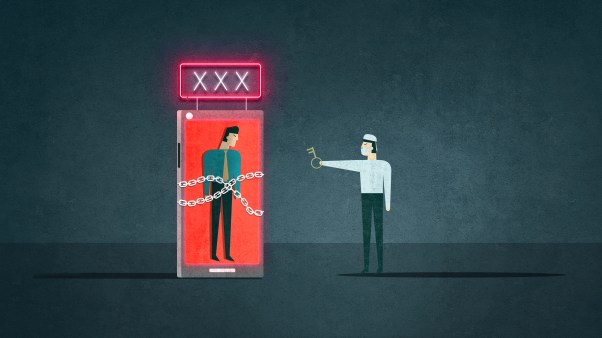
Porn is not about sexual health. Nor is it “content.” It’s a substance. If a child ordered three shots of vodka at a bar, the bartender would object. If a child asked for cigarettes at a gas station, the attendant would laugh. But with a quick Google search, a child has access to millions of hours of a dangerous substance.
Source: Isabel Hogben, “I Had a Helicopter Mom. I Found Pornhub Anyway,” The Free Press (8-29-23)
Pornography consumption has skyrocketed in recent years, especially among young people. Despite this, many Americans, including Christians, remain unconcerned about its societal effects.
A new report by Barna and Pure Desire reveals that 61% of Americans now view porn at least occasionally, up from 55% in 2015. Even within the church, pastors are more likely to report personal histories of porn use, with nearly 1 in 5 currently struggling.
The report underscores pornography's widespread accessibility, noting that it "touches all segments of society" regardless of age, gender, or religious beliefs. The increased availability of online porn, coupled with factors like social isolation during the COVID-19 pandemic, has contributed to this surge. One recent study suggested 2.5 million people view online pornography every minute, and online porn consumption has increased by 91 percent since 2000.
While some faith-based efforts advocate for legal restrictions on the porn industry, others focus on helping individuals overcome pornography habits. However, the report highlights a significant hurdle: many people, including Christians, simply don't see a problem with it.
Research suggests that frequent porn use can lead to negative mental, emotional, and relational health outcomes. Despite this, many Christians remain comfortable with their own porn consumption. The reports states, “Over three in five Christians (62%) tell Barna they agree a person can regularly view pornography and live a sexually healthy life.” That’s only four percentage points behind the share of all US adults (66%) who don’t consider viewing pornography harmful.
The report also explores the impact of pornography on relationships, particularly between men and women. Women are more likely to report negative effects, including feeling less attractive to their partners. Additionally, the study reveals that young people are increasingly exposed to pornography at younger ages, with the average age of first exposure now 12.
While there are efforts to address the issue, the report emphasizes the need for churches to offer support and resources for those struggling with pornography. By fostering a community where people can find help and healing, churches can play a crucial role in combating the pervasive influence of pornography.
Source: Maria Baer, “More Christians Are Watching Porn, But Fewer Think It’s a Problem,” Christianity Today online (9-26-24)
Melissa Kearney, author of The Two-Parent Privilege offered the following observation on X:
I gave another talk about the Two Parent Privilege to college students today. And again, during the Q&A, a college student asked me why I don’t talk about porn/TikTok/OnlyFans, and how addiction to those sites is affecting young people’s ability to form healthy relationships.
I answered honestly that it wasn’t part of the lens I brought to the topic of family structure when I wrote the book. But it keeps coming up, over and over, in all the conversations I am having outside my usual policy/academic circles about marriage & family formation.
I have been quite struck by how often young people have brought this issue up to me over the past 7 months, and I don’t quite know what to make of it.
Source: Melissa K. Kearney, [@kearney_melissa] (4-19-24), X.com
As the village speeches dragged on, eyes drifted to screens. Teenagers scrolled Instagram. One man texted his girlfriend. And men crowded around a phone streaming a soccer match. Just about anywhere, a scene like this would be mundane. But this was happening in a remote Indigenous village in one of the most isolated places of the planet.
The Marubo people have long lived in communal huts scattered hundreds of miles along the Ituí River deep in the Amazon rainforest. They speak their own language, hunt, fish, and trap spider monkeys to make soup or keep as pets.
They have preserved this way of life for hundreds of years through isolation—some villages can take a week to reach. But since September (of 2023), the Marubo have had high-speed internet thanks to Elon Musk.
The 2,000-member tribe is one of hundreds across Brazil that are suddenly logging on with Starlink, the satellite-internet service from Space X. Since its entry into Brazil in 2022, Starlink has swept across the world’s largest rainforest, bringing the web to one of the last offline places on Earth. The results have been less than utopian:
“When it arrived, everyone was happy,” said 73-year-old Tsainama Marubo sitting on the dirt floor of her village’s maloca, a 50-foot-tall hut where they sleep, cook, and eat together. The internet brought clear benefits, like video chats with faraway loved ones and calls for help in emergencies. “But now, things have gotten worse,” she said. […] “Young people have gotten lazy because of the internet.”
After only nine months with Starlink, the Marubo are already grappling with the same challenges that have racked American households for years: teenagers glued to phones; group chats full of gossip; addictive social networks; online strangers; violent video games; scams; misinformation; and minors watching pornography.
Leaders realized they needed limits. The internet would be switched on for only two hours in the morning, five hours in the evening, and all day Sunday.
Decades ago, the most respected Marubo shaman had visions of a hand-held device that could connect with the entire world. “It would be for the good of the people,” he said. “But in the end, it wouldn’t be.” “In the end,” he added, “there would be war.”
His son sat on the log across from him, listening. “I think the internet will bring us much more benefit than harm,” he said, “at least for now.” Regardless, he added, going back was no longer an option. “The leaders have been clear,” he said. “We can’t live without the internet.”
Two things here stand out: The first, that exposing a remote tribe to this modern tool created many of the same problems experienced within modernity: Use of the internet changes the user. Secondly, the categorization of the internet as simultaneously harmful and essential is perhaps unsurprising, but it’s fascinating that putting limitations on use of the internet seems to be the best way to deal with this ambiguity.
Source: Adapted from Todd Brewer, “The Internet’s Final Frontier: Remote Amazon Tribes,” Another Week Ends Mockingbird (6-7-24); Jack Nicas, “The Internet’s Final Frontier: Remote Amazon Tribes,” New York Times (6-2-24)
Columnist Peggy Noonan wrote a sobering article based on the work of researcher Jonathan Haidt’s new book The Anxious Generation: How the Great Rewiring of Childhood Is Causing An Epidemic of Mental Illness. Noonan mentions a dark irony raised by Haidt: (Noonan’s words here) “Parents are often physically overprotective of their children out of fear of sexual predators. But those predators have moved online, where it’s easy to find and contact children.”
Then she quotes a section in the book where Haidt includes an essay from a 14-year-old girl:
I was ten years old when I watched porn for the first time. I found myself on Pornhub, which I stumbled across by accident and returned to out of curiosity. The website has no age verification, no ID requirement, not even a prompt asking me if I was over 18. The site is easy to find, impossible to avoid, and has become a frequent rite of passage for kids my age. Where was my mother? In the next room, making sure I was eating nine differently colored fruits and vegetables on the daily.
Source: Peggy Noonan, “Can We Save Our Children from Smartphones?” The Wall Street Journal (4-4-24)
Kaylee and Mike Low have four children. When their oldest son, now aged 14, started asking for a cell phone back in the fourth grade, they both said no.
Mrs. Low said, “He was really noticing his peers getting smartphones. But we weren't naïve to the fact that a cell phone would increase the risk of exposure to pornography, and other risks (such as the effects on mental health and the developing brain). So, we just kind of had this gut feeling that it wasn't the right timing."
It became a hot topic of family conversation. Sixth grade was probably the hardest year for him in this process. There were 34 kids, and he was the only one without a smartphone.
At the times when their son grew frustrated, Mr. and Mrs. Low "got better at teaching him" why they wanted to wait and made space for the teen to express his feelings. Mrs. Low said, "I think we just really tried to listen to him, tried to validate his feelings.” They told him, “We're doing it because we love you, and we want what's best for you,” instead of it coming across as being bossy or being told what to do.
However, in 7th grade, the teen quit asking for a cell phone altogether. He'd noticed that some of his classmates, who were often up gaming all night, were more anxious than they used to be, couldn't regulate their emotions, or seemed disengaged from the world around them. Some of them had lost interest in extracurricular activities and "really seemed unhappy."
When his parents asked him where he felt the benefits were, he said that he “doesn't have to carry the world around in his pocket.” He said that kids at school are stressed out about how many likes they get, or what's going on in some random part of the world. So, he feels a sense of freedom. He finds joy in outdoor activities or extracurriculars. He's driven to succeed in life.
Mindful of his future needs, the Lows now plan to introduce their eldest to a cell phone gradually. They are preparing him for adulthood when he doesn’t live with his family.
Now in 9th grade he is thanking his parents, after five years of freedom from screens and the dangers of untethered access to the internet.
Source: Louise Chambers, “He Was the Only Kid in Class Without a Cell Phone, Years Later He Thanks His Parents,” Epoch Times (12/19/23)
Since the 2007 launch of the iPhone, smartphones have granted billions of people customized, password-protected, hand-held access to a near-limitless array of digital stimuli. And this portable, pervasive parallel universe is highly addictive, often by design.
The leading online pornography site, Pornhub, was founded in 2007, a few months before the first iPhone dropped. By 2009, the site was already receiving millions of monthly unique visitors. In November 2022, Pornhub was visited 10.2 billion times, making it the fourth most popular destination on the web, and 97% of that traffic came from mobile devices.
Source: Mary Harrington, “Smartphones Have Turbocharged the Dangers of Porn,” The Wall Street Journal (10-13-23)
Potbellied pigs are running wild in Delaware, alarming agricultural officials and raising the risk of damage and disease. The problem started when people bought the pigs as pets, but then quickly discovered they couldn’t control them. The Delaware Department of Agriculture said, “Owners who can no longer manage these animals are likely to relinquish ownership and allow them to roam.”
Sellers often mislead buyers by calling the pigs micro pigs, teacup pigs, and mini pig. But potbellied pigs can weigh up to 200 pounds and can live up to 20 years. The pigs can reproduce at a young age. Female potbellied pigs can become pregnant at three months old, and males can breed at eight weeks of age. The wild pigs dig up and destroy crops. Feral swine can also leave fecal material in waterways and wetlands, contaminating water sources and increasing disease risks for humans, wildlife, and livestock.
In a similar way, we think that we can allow small sins into our lives because they are manageable or controllable, only to find out that they are not. They will run wild.
Source: Joshua De Avila, “Potbellied Pigs Are Running Amok in Delaware” The Wall Street Journal (11-18-22)
New Pew Research Center data has found that nowadays, 63% of men under 30 are electively single, up from 51% in 2019—and experts blame erotic alone-time online as a major culprit. Psychologist Fred Rabinowitz “[Young men] are watching a lot of social media, they’re watching a lot of porn, and I think they’re getting a lot of their needs met without having to go out. I think that’s starting to be a habit.”
The new, post-COVID numbers would surely back up previous research that the pandemic has made men prefer an evening alone instead of actually meeting a partner. 50% of single men responded that they are “looking for a committed relationship and/or casual dates,” a decrease compared to 61% four years ago.
But these statistics tell a sadder truth about this generation of men, NYU psych professor Niobe Way said. “We’re in a crisis of connection. Disconnection from ourselves and disconnection from each other. And it’s getting worse.”
Another factor at play might be the interests of women are changing—especially as suitors of the same age are becoming apparently less desirable. [Women would] rather go to brunch with friends than have a horrible date.
But perhaps the largest issue now with young men is that they are more lonely than women, a recent study showed. In the early 1990s, 55% of men were reported to have six or more close friends. That percentage dwindled down to 27% in 2021. Now, 15% of men say they have no close personal friendships.
University of Akron professor Ronald Levant said, “Women form friendships with each other that are emotionally intimate, whereas men do not. Even while not dating, [women] have girlfriends they spend time with and gain emotional support from.”
Source: Alex Mitchell, “Six out of 10 young men are single — the disturbing reasons why,” New York Post (2/23/23)
Modern society has made sex easy and emptied it of its God given meaning. Sex has been redefined as a self-determined commodity that results in frustration and despair.
Author Jonathan Grant argues that this has occurred in five phases:
1. The separation of sex from procreation (through contraception)
2. Then the separation of sex from marriage (with the rise of cohabitation)
3. Then the separation of sex from partnership (as sex becomes temporary and recreational)
4. Next the separation of sex from another person (through the explosion of online pornography)
5. Finally, the separation of sex from our own bodies (through questioning the very categories of “male” and “female.”)
In making sex so easy and individualistic, we have cheapened it and thereby emptied it of its power. We tried to make it simpler, and we ended up making it smaller.
Source: Andrew Wilson, “We All Need Sexual Healing,” a review of Jonathan Grant’s book, “Divine Sex” (Brazos Press, 2015), CT magazine (September, 2015), pp. 71-73
In a kind of “sting operation” on the social media site TikTok, The Wall Street Journal created dozens of automated accounts, also called bots. They set up these bots to understand what TikTok shows young users. These bots, registered as users aged 13 to 15, were turned loose to browse TikTok’s videos. The videos revealed that TikTok can quickly drive minors (and of course adults, too) into “rabbit holes” of content focused on drugs, violence, or sex.
For example, one bot was programmed to dwell on videos with hashtags related to drugs. On its first day on the platform, the account lingered on a video of a young woman walking through the woods, with a caption suggesting she was in search of marijuana.
The next day, the account also watched a video of a marijuana-themed cake. Soon after, the teenager’s feed took an abrupt turn … with the majority of the next thousand videos touting drugs and drug use, including marijuana, psychedelics, and prescription medication. One showed an image of a person exhaling smoke and linked to a website that was “420 friendly” (code for marijuana use) and offered “yummy goodies for all.”
The article concluded that TikTok only needs one important piece of information to figure out what a user wants: The amount of time you linger over a piece of content. Every second you hesitate or re-watch, the app tracks you. Through that one powerful signal, TikTok can learn your most hidden interests and emotions, and drive users of any age deep into rabbit holes of content—in which feeds are heavily dominated by videos about a specific topic or theme. It’s an experience that other social-media companies like YouTube have struggled to stop.
Source: Bob Barry, "How TikTok Serves Up Sex and Drug Videos to Minors," The Wall Street Journal (9-8-21)
The skies were stormy as Father James Quinn, chaplain for the FBI’s Miami office, began to offer his public remarks. “Even the heavens are crying,” said Quinn, as he addressed the crowd of loved ones and coworkers gathered to remember FBI Special Agent Laura Schwartzenberger. “She led a life of sheer determination, dedication and courage,” according to FBI Director Christopher Wray.
Laura Schwartzenberger was killed alongside Special Agent Daniel Alfin during a child pornography investigation. The agents were killed and four others were wounded after the man at the center of the investigation opened fire while they attempted to serve a search warrant at his residence.
Laura was known as a tireless advocate for children. As she spent seven years working crimes against children. According to Wray, she experienced “the very worst parts of humanity. It’s a job with high stress, high emotional toll, and high burnout. But Laura never stopped.”
She was also known as a tireless athlete who used her fitness for good. She had the distinction as being the only female member of the Albuquerque SWAT team in its history. Michelle Brown, the gym owner where Schwartzenberger was known for her 5am Cross-Fit workouts, called her “a true hero.”
Director Wray said that Laura’s presence was so deeply felt in her community that several parents of victims from previous investigations reached out to ask how they could help care for her family. He said, “They asked how they can help Laura’s two boys. And that speaks volumes about what Laura meant to this community.”
A life given in service is never wasted; on the contrary, we live up to the highest ideals of the gospel of Jesus when we work to right the scales of justice and protect society’s most vulnerable. In so doing, we are affirming the value of every human life as worth protecting.
Source: Tribune News Service, “‘The heavens are crying’: FBI agent is laid to rest days after she and colleague were killed,” Oregon Live (2-6-21)
Of the hundreds of men I’ve counseled about their sexual addictions, not one has told me that after masturbating he felt stronger, more confident, and more vitally connected to the deep part of his soul. Debates over whether or not masturbation is a sin totally miss the point. The crucial question is not whether masturbation is right or wrong. The question is, as it is with any thought or behavior, does it hinder our spiritual, emotional, and social maturity? Does it stand in the way of love?
Source: Michael John Cusick, Surfing for God: Discovering the Divine Desire Beneath Sexual Struggle (Thomas Nelson, 2012), p. 160
In a series of online messages, Brooklyn Nine-Nine actor Terry Crews opened up about his addiction to pornography, which he says "really, really messed up my life."
Some people say, “Hey, man ... you can't really be addicted to pornography.” But I'm gonna tell you something: If day turns into night and you are still watching, you probably have got a problem. It changes the way you think about people. People become objects. People become body parts; they become things to be used rather than people to be loved. ... Every time I watched it, I was walled off. It was like another brick that came between me and my wife. And the truth is, everything you need for intimacy is in your (partner).
Source: Brandon Griggs; “Terry Crews: ‘Porn Addiction Messed up my Life,’” CNN.com (2-24-16)
We spend four billion hours a year watching porn. Sorry. I've just understated the problem. We dedicated well over four and a half billion hours to watching porn on one porn site in 2016. Humanity spent twice as much time viewing porn in a year as it has spent existing on planet Earth. It all adds up to over 500 thousand years worth of porn consumed in the span of 12 months. Since 2015, human beings have spent one million years watching porn.
One million years.
I'm telling you this not only because it's an interesting bit of trivia … but because these figures are serious. More than serious: staggering, incomprehensible, unthinkable, apocalyptic. All the more so for Americans, because we watch more porn than anybody else on Earth.
Porn is obviously America's favorite pastime. According to surveys, almost 80% of American men between the ages of 18 and 30 admit to watching porn regularly. Nearly 70% of men between 31 and 49 admit to it. Half of men from 50 to senior citizen age also confess to regular porn viewing. 30% of younger men say they watch porn every day. Porn viewership is not quite as common among women, but it's far more common today than it was 10 years ago. Remember, too, this is just what people will admit to doing.
Today, porn grosses more in a year than Hollywood. It also brings in more money than the NFL, NBA, and MLB combined.
Possible Preaching Angles: This illustration functions like the Law—it exposes the sin in our hearts. But it should also point to the availability of Christ’s grace and the support of Christian community.
Source: Matt Walsh, “We're A Nation Of Porn Addicts. Why Are We Surprised By The Perverts In Our Midst?” Daily Wire (11-30-17)
With the right approach, churches can give struggling ministers a fighting chance.
In his book The Porn Problem, author Vaughan Roberts recalled the following:
Bobby Moore was the England soccer captain who received the World Cup from Queen Elizabeth when England won the trophy in 1966. An interviewer later asked him to describe how he felt. He talked about how terrified he was as he approached Her Majesty, because he noticed she was wearing white gloves, while his hand, which would soon shake the Queen’s, was covered in mud from the pitch … As the triumphant captain walks along the balcony, he keeps wiping his hand on his shorts, and then on the velvet cloth in front of the Royal box in a desperate to get himself clean.
Roberts continued, “If Bobby Moore was worried about approaching the Queen with his muddy hands, how much more horrified should we be at the prospect of approaching God? Because of our sin, we are not just dirty on the outside; our hearts are unclean. And God doesn’t just wear white gloves; he is absolutely pure, through and through.”
Source: Vaughn Roberts; The Porn Problem, (The Good Book Company, 2018), Page 51
Pastor and author Paul David Tripp uses the following scenario to describe what's really going on every time a man chooses to lust (or anytime anyone chooses to sin):
A man is walking home from work and lusting after the woman approaching him on the sidewalk. He slows down his walk to get a longer look, and he turns around and watches as she passes. Think with me again about the godlike posture of this man. First, he is treating this moment as if it belongs to him. It's as if he is sovereign and she is on the sidewalk according to his will and for his pleasure. He's the self-appointed deity of the moment … The world has shrunk to the size of his desire, and he rules it for his pleasure. … He will have what he will have, even if it is the only the right to stare at body parts and imagine having them for his pleasure.
But there is more. For that moment he is stealing God's creation and taking it as his own. He has no right to this woman. She does not actually belong to him in any way, but he takes her with his mind and his eyes. … He's ripped this woman out of the hands of God and claimed her as his own for whatever momentary pleasure he can achieve … He has denied God's existence. He has set himself up as God.
What's the solution to this godlike delusion of lust? Tripp continues:
Recognition of and living for the community with God for which I was created keeps my sexual life pure. There is no other way. Heart-controlling love for God protects my heart from wandering to all the places it could wander in this sexually insane world.
Source: Paul David Tripp, Sex in a Broken World (Crossway, 2018), pages 124-125
In 1987, The New York Times reported on a radioactive contamination accident in Brazil caused four deaths and left 112,000 people with radioactive contamination. Several houses had to be destroyed and the International Atomic Energy Agency labeled it as "one of the world's worst radiological incidents."
The incident began when a private radiotherapy institute moved to a new site and unknowingly left behind a container of radioactive material inside an obsolete unit used for cancer treatments. Two men illegally entered the partially demolished building and disassembled the unit. The container with radioactive material was deemed to have scrap value so they wheeled it home. There one of the thieves punctured a small hole in the container's thick window "allowing him to see a deep blue light coming from the tiny opening he had created."
The thieves sold the container to Devair Alves Ferreira, the owner of a local scrapyard. He "noticed the blue glow from the punctured capsule. Thinking the capsule's contents were valuable or even supernatural, he immediately brought it into his house. Over the next three days, he invited friends and family to view the strange glowing substance."
As Mr. Ferreira and several other workers took the machine apart. … Inside, they found the shiny bluish dust which, they later told doctors, glowed in the dark. Attracted by the pretty powder, several people handled it, examined it, and even rubbed it on their skin. Soon many people became very sick. A medical physicist used a device to confirm the presence of radioactive materials and alerted the authorities.
Source: Marlise Simons, "Brazil Gets Help on Radiation Accident" New York Times (10-11-87)
Seth Stephens-Davidowitz, a former data scientist at Google, used his data-analysis skills to learn what was really on Americans' minds. The result, a book called Everybody Lies, shows how the terms and questions people type into search engines don't at all match what they claim on surveys.
"So for example," he recently told an interviewer, "there have historically been more searches for porn than for weather." But just 25 percent of men and 8 percent of women will admit to survey researchers that they watch porn. When asked if he had any big insights about Americans' personal lives, Stephens-Davidowitz said:
I think there's two. The book is called Everybody Lies, and I start the book with racism and how people were saying to surveys that they didn't care that Barack Obama was black. But at the same time they were making horrible racist searches, and very clearly the data shows that many Americans were not voting for Obama precisely because he was black.
I started the book with that, because that is the ultimate lie. … People can say one thing and do something totally different. You see the darkness that is often hidden from polite society. That made me feel kind of worse about the world a little bit.
But, I think the second thing that you see is a widespread insecurity. … I think people put on a front, whether it's to friends or on social media, of having things together and being sure of themselves and confident and polished. But we're all anxious. We're all neurotic. … I now assume that people are going through some sort of struggle, even if you wouldn't know that from their Facebook posts.
Source: Olga Khazan, "Our Searches, Ourselves," The Atlantic (6-9-17)