
Sorry, something went wrong. Please try again.
Richard Foster discusses healthy pastoral leadership, his daily routine, and how to practice solitude in an age of distraction.
With pastoral warmth, Paul E. Miller’s A Praying Life helps leaders bring their messy lives to a Father who listens, understands, and stays.
A benediction for the pastor who feels too fragile for the task—but stays anyway.
The New York Time’s ethicist received the following from an anonymous reader:
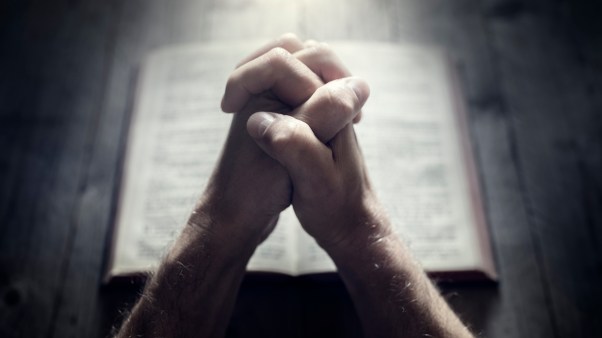
I have an 85-year-old neighbor who is a sweet friend and caring person. My issue is that she is very religious and I’m not at all. She prays for me and says it in person, texts, and emails for even the most minor of situations. I’ve told her my view of religion and that she doesn’t need to pray for me. She said she has to, otherwise she’s not following the Bible. I’m trying to ignore this but it’s really bothering me that she can’t respect my wishes.
“The Ethicist” responded:
I’m glad that you’ve been honest with each other about your very different views concerning prayer. But… if you don’t think these prayers will do you any good, you presumably also don’t think they’ll do you any harm. By contrast, she thinks that you’ll be worse off without them, and that praying for you is her duty.
The only reason you give for objecting to her prayers is that she has failed to comply with your wishes. Yet I don’t find that she has thereby treated you with disrespect… So, you’re not entitled to insist that she stop including you in her prayers. What you can fairly ask is simply that she refrain from informing you about them. Still, instead of requiring that your octogenarian neighbor change her ways, I wonder whether you might change yours — and learn to accept this woman for who she is, hearing her prayers as a sincere expression of her loving feelings toward you.
Source: Kwame Anthony Appiah, “My Neighbor Won’t Stop Praying for Me. What Should I Do?” The New York Times Magazine (12-18-24)
Billy Collins, the former poet Laurette of the United States, was recently asked by The New York Times Book Review, "How has the internet changed your writing?" Collins responded:
The internet asks us to speed up. Poetry invites us to slow down. I write with a pencil and paper, then use the computer only as a fancy typewriter. So, no change really, except in [the internet’s] role as the most persistent distraction in human history.
(1) Distractions; Prayer—Of course there are many other distractions that can keep us from slowing down and being with God. (2) Bible reading and meditation—The Bible also invites us to slow down and listen to God speaking to us.
Source: By the Book, “Poems About Dead Relatives Irk Billy Collins,” The New York Times Book Review (11-28-24)
In a culture that feels increasingly disconnected, here’s something surprisingly encouraging: Nearly half of Americans still pray every single day.
According to new data from Pew Research, 44% of U.S. adults say they pray at least once a day, and another 23% say they pray weekly or a few times a month. That means two-thirds of the country still turns to prayer with some regularity—a practice that remains deeply embedded in American life.
Prayer habits also vary by race, gender, and age. Black Americans are the most likely to pray daily (64%), while women are more likely than men (50% vs. 37%). Older adults continue to lead the way in daily prayer, while younger generations are less consistent—but still showing up.
For many Americans, prayer isn’t just a habit—it’s a lifeline.
As pastor and theologian Tim Keller once wrote, “Prayer is the way to experience a powerful confidence that God is handling our lives well, that our bad things will turn out for good, our good things cannot be taken from us, and the best things are yet to come.”
In a time when faith trends often point to decline, this data is a reminder that spiritual rhythms haven’t disappeared—they’re just shifting.
Source: Emily Brown, “Forty-Four Percent of Americans Pray Every Day, Study Finds,” Relevant Magazine (5-1-25)
In an issue of CT magazine, E.F. Gregory shares the following story of how a persecuted pastor in China prayed for her during the devastating fires in Southern California:
On January 7, 2025, a series of devastating wildfires erupted in the Los Angeles area. As I drove home to Alhambra, strong winds and sirens filled the air, and flames were visible in the mountains. As I drove, strong winds threatened to push my car to the curb. Broken tree branches littered the streets. The Eaton Fire was igniting near Altadena, a suburb north of my location. The community of Altadena would soon be severely affected by the fire.
The Los Angeles wildfires were catastrophic, killing at least 29 people, destroying nearly 17,000 structures, and displacing over 100,000 individuals. The sheer scale of the disaster is overwhelming, making it difficult to know how to respond.
A phone call with Pastor Zhang from eastern China offered a different perspective. While facing persecution and challenges in his ministry, Zhang relies heavily on prayer and a network of believers. When he learned about the fires near my home, he prayed for my family and our community.
Zhang’s thoughtful, empathetic questions surprised me. After all, we were meeting to talk about how he felt to know that Christians outside of China are interceding for his community. Instead, Zhang was remembering and praying for me.
Zhang's empathy was striking, especially given the isolation Chinese Christians often feel from the global Christian community. He emphasized that prayer unites believers across distances and cultures. "We pray for all parts of the world," he said, including the California fires, asking for God's mercy and grace. For Zhang, the fires were an opportunity to connect the struggles of his church with those of mine.
Recent years have been particularly challenging for Chinese Christians due to increased persecution. Zhang said, “In the latter half of the last century, the Chinese church was like an orphan, separated from the family of the universal church.”
Despite these challenges, Zhang believes prayer is a mutual act that strengthens relationships between believers worldwide. Zhang prayed that the disaster in Los Angeles would bring American Christians together to demonstrate God's care for the affected communities.
As we grieve our losses, I’m comforted and humbled to know that the persecuted church is interceding on our behalf. This is why I believe that praying for the church in China is more important than ever. When they suffer, I also suffer. But prayer does not move in only one direction. If I focus only on caring for my Chinese brothers and sisters without allowing them to care for me, we are not in real relationship. We need to pray for one another.
Source: E. F. Gregory, “Los Angeles, My Chinese Christian Friends Are Praying for Us,” CT magazine online (2-5-25)
An article on the website First Things advocates one simple way to improve your prayer life—stop multitasking. David Ousley writes:
Multitasking is not your friend. The whole idea of multitasking as something good is based on the assumption that life is about getting things done. I admit that the world often operates as though this were the case. ... But it is false. Human life, and Christian life, is more about love than about accomplishments.
If we cultivate distractedness, as, for example, by multitasking, then we will bring distractedness to our prayer. If, on the other hand, we cultivate attention, this will bear fruit at the time of prayer. I would suggest therefore that we renounce multitasking, and strive to do one thing at a time, so far as that is possible.
Source: David Mills, “Multitasking Prayer,” FirstThings.com (10-16-12)
Every year, YouVersion announces which Bible verses are the most shared, bookmarked, and highlighted by its users. The list often includes the classics like Jeremiah 29:11 or John 3:16, but this year, the app announced that Philippians 4:6 took the top spot.
The Scripture reads: “Do not be anxious about anything, but in every situation, by prayer and petition, with thanksgiving, present your requests to God.”
Yeah, that checks out for 2024.
YouVersion founder and CEO Bobby Gruenewald believes this verse’s popularity shows that people are regularly turning to God when they face stress and daily struggles.
Gruenewald said, ‘In many cases, our anxiety comes from holding onto worries that we aren’t meant to carry. To me, this verse being sought out the most this year is an illustration that our community is seeking God in prayer and choosing to trust Him to carry their burdens—and we’re seeing that supported in the data.’
Source: Emily Brown, “And The Verse of the Year Goes To…” Relevant Magazine (12-2-24)
In a 2024 interview the actress Julia Fox was asked, “Do you meditate or journal or otherwise practice mindfulness?” She replied:
I don’t, but I do pray. When I was little, I [prayed to] Jesus Christ. Now I pray to the universe, the collective consciousness, the karmic force behind everything. I used to pray for things that I really wanted. Now I pray to be guided, stay on the right path, for strength, for positivity. But then I also definitely do pray for things I want, too.
Source: Lane Florsheim, “Why Julia Fox Doesn’t Like to Work Out: ‘My Whole Life Is Just One Big Exercise’” The Wall Street Journal (5-11-24)
The morning after Hurricane Helene pummeled the eastern seaboard of the U.S., Thomas Witherspoon inspected the damage to his western North Carolina home. The night before, he listened to the wind whip down trees and snap power lines along the two-mile access road connecting his family to their few neighbors in Buncombe County.
Like the tens of thousands of other North Carolina residents, the power to Witherspoon’s neighborhood was completely out. It was impossible to communicate with the house down the road, let alone anyone several miles away. Unable to send text messages or make phone calls, radio became the one form of communication left in rural North Carolina. After fixing what he could on his own property, Witherspoon, a lifelong amateur radio enthusiast, began distributing handheld radios to his neighbors.
There are more than one million licensed radio amateurs in the U.S. like Witherspoon, according to an FCC spokesperson. Some amateur radio bands are short bands, reaching only small communities of people, while others cover hundreds and even thousands of miles. When communication infrastructure fails, like cellular networks, the FCC allows for amateur radio operators to assist in recovery efforts.
“Amateur radio is one of those things you get into because of your love of radio communications and the technical aspects of it or the community and the challenges that you can overcome,” Witherspoon says. “It's a lot of fun, but underlying all of that is this prime directive with amateur radio that it’s always there as emergency communications when all else fails.”
In times of disaster or tragedy, when all else fails, God is always accessible through prayer. He is attentive to our needs, possesses infinite resources, and offers comfort through his Word, as expressed in: Psalm 34:6 “This poor man cried, and the LORD heard him and saved him out of all his troubles.” 1 Peter 3:12 “For the eyes of the Lord are on the righteous, and his ears are open to their prayer.
Source: Makena Kelly & Dell Cameron, “Through Hurricanes Helene and Milton, Amateur Radio Triumphs When All Else Fails,” Wired (10-8-24)
A biblical and therapeutic framework found in Philippians 4:6-7.
This Father’s Day, and every time we stand to preach, we ought to remember the fatherless.
A recent survey asked Americans what they pray for and where do they pray? The replies showed that they pray for:
Families (51%)
Friends (41%)
Spouses (31%)
They pray before:
Job interviews (20%)
Exams (18%)
Sporting events (12%)
But in this survey sample of nearly 2,000 Americans found that few pray in church. The most common places people pray in the United States:
Work 24%
Nature 26%
Church 28%
Car 37%
Bedroom 51%
Source: Editor, “Pray as You Go,” CT Magazine (July/August, 2023), p. 20
Former abortion doctor Patti Giebenk tells the following story about the woman who prayed her into a lifechanging encounter with Jesus:
During my lengthy conversion from pro-choice to pro-life, there was a person who prayed for me repeatedly. She was a prayer warrior I’d never met, but God heard her special prayer for me. It was the prayer of Sister Josita. Throughout her life, Sister Josita advocated for the poor, the refugee, and the vulnerable.
After Sister Josita heard that Dr. Giebink did abortions, she started praying for her—for over ten years. Then Dr. Giebink met Christ and stopped doing abortions. She joined a local church in South Dakota, and started treating poor women around the globe, but no longer doing abortions. After returning from one of her many trips to, she received the following letter:
Dear Doctor Giebink,
May your Christmas be blessed and the New Year filled with joy.
You don’t know me ... I want to thank you for your courage to speak out for life, and ... to bring an end to abortion. When I saw you on television, I was so proud of you to publicly state that you used to perform abortions for Planned Parenthood in Sioux Falls and now you support life instead. When I first heard that you were performing abortions, I began lifting you up in prayer. I do not believe abortion is right, or a solution to an unwanted pregnancy. I have prayed for you, by name, that one day your heart would be touched, and you would discontinue performing abortions. I thank God for you, and I continue to pray for you.
Patti Giebink concludes this story with the following words:
Sister Josita still prays for me. We write regularly, and I’ve visited her twice. She turned ninety this year, and she’s still a vibrant and dynamic warrior. Her initial intervention for me—just a name and a face—moved celestial mountains, making way for my future legacy of life. May we all stay on our knees until the answer comes, just as Sister Josita did.
Source: Patti Giebink, Unexpected Choice: An Abortion Doctor’s Journey to Pro-Life (Focus on the Family, 2021), page 96ff.
7 suggestions for integrating Artificial Intelligence into the preacher’s study.
Let us consider God’s goodness and faithfulness as we serve him.