Sorry, something went wrong. Please try again.
When it comes to the ultimate test of devotion, fewer than half of Americans would give a piece of themselves to save someone they care about. A revealing new survey has found that just 39% of Americans would be willing to donate an organ to family or friends—a striking discovery that sheds light on where people draw the boundary of personal sacrifice.
The study of 2,000 U.S. adults, explored various dimensions of loyalty in both personal relationships and consumer behavior. While organ donation may be a step too far for many, Americans demonstrate commitment in other meaningful ways.
More than half (53%) would endure waiting in line at the Department of Motor Vehicles for someone they care about. Additionally, 62% would put their reputation on the line by acting as a reference for a loved one’s apartment or job application.
Perhaps the most revealing statistic is how Americans would handle unexpected good fortune. An overwhelming 82% said they would share a windfall of $100,000 with family and friends—indicating that while many might hesitate to share their kidneys, they’re quite willing to share their cash.
1) Selfishness; Self-centeredness – It is amazing how selfish people are becoming when called to make a very personal sacrifice for their very “flesh and blood” relatives; 2) Christ, sacrifice of – This also highlights the amazing sacrifice Jesus made for his “brothers and sisters” when he said “Take and eat. This is my body” (Matt. 26:26; Mark 14:22; Luke 22:19; 1 Cor. 11:24) and “he himself bore our sins in His body on the tree” (1 Pet. 2:24).
Source: Staff, “Just 39% Of Americans Would Donate an Organ for A Loved One,” StudyFinds (5-7-25)
The ex-head of Japan's Fukushima Daiichi nuclear plant, Masao Yoshida, 58, died at a Tokyo hospital of esophageal cancer on July 9, 2013.
When the tsunami devastated Japan's Fukushima nuclear power plant on March 11, 2011, Masao Yoshida worked to control the damage caused by the failing reactors. He disobeyed a company order and secretly continued using seawater, a decision that experts say almost certainly prevented a more serious meltdown and has made him an unlikely hero. He chose to place himself in danger, exposing himself to extreme radiation. And his story is just one of many at the plant.
Remembering the disaster, he said "The level of radioactivity on the ground was terrible…but the workers of the plant leaped at the chance to go trying to fix the situation with the reactors…. My colleagues went out there again and again."
What a beautiful picture of sacrificial, Christ-like love.
Source: Editor, “Hero Fukushima ex-manager who foiled nuclear disaster dies of cancer,” RT (7-9-13); Norimitsu Onishi and Martin Fackler, “In Nuclear Crisis, Crippling Mistrust,” The New York Times (6-12-11)
Che Guevara is known internationally as a Marxist revolutionary. As he recruited for his guerilla operations in Cuba, the Congo, and Bolivia he often encountered the half-heartedness of his volunteers.
Author John Lee Anderson quotes Che’s sarcastic evaluation of the freshly trained recruits who had just arrived to fight in the Congo:
In a ludicrous sideshow, the captain had also brought over forty new Congolese rebel ‘graduates,’ fresh from a training course in the Soviet Union. Like their Bulgarian and Chinese-trained predecessors, they immediately requested two weeks of vacation, while also complaining that they had nowhere to put their luggage. Che wrote, ‘It would be a little comic if it weren’t so sad, to see the disposition of these boys in whom the revolution had deposited its faith.’
The church also faces the same issue with those who are called to follow our Savior. We are not called to be part-time disciples looking for a life of leisure. Jesus calls for us to “take your cross daily and follow me” (Luke 9:23). He also promises to give us immense rewards stored up in heaven for the sacrifices we make for his cause (Matt. 19:29).
Source: Jon Lee Anderson, Che Guevara: A Revolutionary Life (Grove Press, 2010), p. 633
In the 1980s, a research facility called Biosphere 2 built a closed ecosystem to test what it would take to eventually colonize space. Everything was carefully curated and provided for and trees planted inside sprung up and appeared to thrive. Then they began to fall.
The botanists must have looked on in dismay, finding no evidence of disease or mite or weevil. There was nothing to cause the trees to topple; the conditions were perfect. And then they realized what was missing—something so simple, yet absent within the confines of the structure: wind.
The air was too still, too serene—an ease that guaranteed the trees were doomed. It’s the pressure and variation of natural wind that causes the trees to strengthen and their roots to grow. Though the trees of Biosphere 2 had all the sun, soil, and water they needed, in the absence of changing winds they built no resilience, and eventually fell under the weight of their own abundance.
Lent helps us see the trials of life in a new way. Could it be that our difficulties, more than our delights, are what drive us closer to God? Though we may still have a strong aversion to pain, we can see the hand of God when the winds of trial come to buffet, and we can take solace in the fact that our roots are growing deeper. Romans 5:3–5 encourages us: “We also glory in our sufferings, because we know that suffering produces perseverance; perseverance, character; and character, hope….”
Source: Robert L. Fuller, “Why Storms Are Necessary for Survival,” CT Magazine online (2-14-24)
From boyhood, Davy Lloyd dreamed of nothing else but dedicating his life to the orphanage his parents had operated in Haiti since 2000.
He had grown up in Haiti, spoke Creole before English and had helped his parents run their mission, which had grown into a bustling operation that educated 450 children, with 50 living on the compound in Lizon just north of Port-au-Prince.
“He had said from the time he was little that someday he was going to be a missionary in Haiti,” his father, David Lloyd Jr., recounted in a phone interview from Oklahoma. “He just knew that that’s where he was supposed to be his whole life, trying to make a difference in some people’s lives who needed a lot of help.”
So, when Davy and Natalie Lloyd, then Natalie Baker, married in June 2022, they decided to make a life together in Haiti—even as the country of 11 million was descending further into political dysfunction and gang violence. … That notion was shattered in May of 2024, when two gangs breached the compound in succession, killing the young couple, along with the Haitian director of the group, Jude Montis.
Davy Lloyd’s father said, “We felt that in our hearts that’s where we were supposed to be and what we were supposed to be doing with our lives. I just kind of felt that with us being there it gave the community some hope because we hadn’t cut and run.”
Source: Juan Forero, “Missionaries Slain in Haiti Gang Violence Had Dedicated Lives to Orphanage,” The Wall Street Journal (5-25-24)
Offensive line, Zack Conti, made it onto the Eastern Michigan University football team as a “walk-on,” meaning without a scholarship. Head Coach Chris Creighton told the team, “Zack Conti has had to pay his way to school for four years. And in the fall, the guy was selling his plasma to be able to pay the bills.”
Unfortunately, the team couldn't give out any more scholarships. Creighton explained to the players that the NCAA allows the team to provide 85 scholarships each year, and they've given them all out. Creighton asked for an 86th scholarship, but the answer was no.
"Then Brian Dooley came into my office," Creighton said. "And he says, 'Coach, that guy has earned it. And I've talked this over with my family. And if there's a way to make this happen, I am willing to give up my scholarship as a gift to Zack Conti.' I've never heard, I've never seen anything like that ever before." At that moment, Dooley walked over to Creighton and handed him an envelope that held his scholarship. The team broke out in cheers.
After the now-viral moment, Conti said he was "so honored and so thankful. It feels like all of my hard work is finally being rewarded.”
The senior paid his way through school by working at a landscaping service or at his dad’s hardwood flooring company, and donating plasma, which usually pays $50 to $100 a session.
He said, "Sometimes asking for help is not easy. The team would usually see me coming back from work or going to work and they would know what was going on, and they were supportive. They got my back."
Dooley said Conti earned the scholarship and explained his motivation for helping his teammate:
I did it because I've seen Conti grow over the years. Seeing him walk away from something that he loves did not sit well with me. He works hard and gets extra work with me all the time. In my eyes, he earned it 100%. Giving up my scholarship so he can stay and play means everything. I'm proud of what he has become and cannot wait to see what he does on the field.
The sacrificial love of Jesus is modeled for others when we show them the same radical love, acceptance, and generosity that God shows to us.
Source: Caitlin O’Kane, “A college football player knew his teammate donated plasma to afford school. So, he gave him his scholarship.” CBS News (10-10-23)
Add-on fees are driving consumers crazy. From restaurants and hotels to concerts and food delivery, we are increasingly shown a low price online, only to click through and find a range of fees that yield a much higher price at checkout.
The term drip pricing was popularized by a 2012 Federal Trade Commission conference. Its spread is associated with the proliferation of airline fees after the Sept. 11, 2001, terrorist attacks. Yet an example of the phenomenon that long predates 2001 is stores’ practice of listing goods without the sales tax, which gets added at checkout.
Why not include the sales tax with the sticker price? One study from 2019 showed consumers punish that sort of transparency. A grocery store let the authors tag some products with the familiar pretax price and some with the total price including tax. For example, a hair brush’s price tag showed $5.79 before tax, and beneath that $6.22 with the tax. Sales volume dropped for products with price tags that included the tax than a control group without the tax.
This isn’t because shoppers didn’t know the tax rate or which items were taxable. In fact, 75% of shoppers surveyed knew the sales tax within 0.5 percentage point, and most knew what goods were taxable. So, the tax-inclusive price tag didn’t give them new information; it was just that transparent reminders turned some people off.
Jesus never practiced “drip pricing.” He never hid the total costs for following him. It may turn some people off, but he always put the full cost upfront.
Source: Jack Zumbrun, “Who’s to Blame for All Those Hidden Fees? We Are,” The Wall Street Journal (6-16-23)
Actor Jeremy Renner said he would risk getting run over by a snowplow again to save his nephew. Renner said, “I’d do it again, because it was going right at my nephew.”
The accident happened near Renner’s Nevada home. Heavy snow had fallen, and his vehicle, driven by a family member, got stuck. Renner went to get into his snowplow, which weighs at least 14,000 pounds, to help move the vehicle. As he was speaking with the family member, the snowplow began to roll. He attempted to get back inside, but was run over. The 52-year-old actor broke over 30 bones and required numerous surgeries.
Renner said he thought he might die. He told Diane Sawyer, “I’m thinkin’ like, ‘What’s my body look like? Am I just gonna be like a spine in a brain, like a science experiment?’” Renner’s neighbor who made the 911 call said, “It was blood, the amount of blood, and then he was—he was just in such pain. Then when I looked at his head, it appeared to me to be cracked wide open.”
Renner had broken bones spanning the entire length of his body—including both his ankles, some of his ribs, his right shoulder, eye socket, and jaw. He also suffered a collapsed lung. At one point in the televised interview, Renner started crying and said, “What we just endured. That’s real love. It’s suffering. But that feeds the seeds of what love is.”
Source: Talal Ansari, “Jeremy Renner, in First Interview Since Snowplow Accident, Says He’d Do It Again to Save Nephew,” The Wall Street Journal (4-6-23)
In his memoir, Everything Sad Is Untrue, Daniel Nayeri tells the gripping story of his mother’s conversion from a devout Muslim background to a saving faith in Jesus Christ. She gave up wealth and social status, eventually being forced to flee from Iran under a death threat. But she was willing to pay the price. Nayeri writes about one example of her costly faith:
One time she hung a little cross necklace from the rearview mirror of her car, which was probably a reckless thing to do. ... My mom was like that. One day after work, she went to her car, and there was a note stuck to the windshield. It said, “Madame Doctor, if we see this cross again, we will kill you.”
To my dad, [who is not a Christian], this is the kind of story that proves his point. That my mom was picking a fight. That she could’ve lived quietly and saved everyone the heartaches that would come. If she had kept her head down. If she stopped telling people. If she pretended just a few holidays a year, that nothing had changed. She could still have everything.
My mom took the cross down that day. Then she got a cross so big it blocked half the windshield, and she put it up. Why would anybody live with their head down? Besides, the only way to stop believing something is to deny it yourself. To hide it. To act as if it hasn’t changed your life.
Another way to say it is that everybody is dying and going to die of something. And if you’re not spending your life on the stuff you believe, then what are you even doing? What is the point of the whole thing? It’s a tough question, because most people haven’t picked anything worthwhile.
Source: Daniel Nayeri, Everything Sad Is Untrue (Levine Quierido, 2020), pp. 206-207
In his gripping memoir, Everything Sad Is Untrue, Daniel Nayeri recounts the gripping story about why his mother became a Christian.
She grew up in a devout and prestigious Muslim family. She was a doctor and had wealth and esteem. But eventually she would forsake all of that to follow Jesus. She was forced to flee for her life from Iran, eventually settling in the U.S. as a refugee. When people ask her why, she looks them in the eye with the begging hope that they’ll hear her, and she says, “Because it’s true.”
Why else would she believe it? It’s true and it’s more valuable than $7 million in gold coins, and thousands of acres of Persian countryside, and 10 years of education to get a medical degree, and all your family, and a home. And maybe even your life. My mom wouldn’t have made the trade otherwise.
If you believe it’s true, that there is a God, and he wants you to believe in him, and he sent his Son to die for you—then it has to take over your life. It has to be worth more than everything else, because heaven’s waiting on the other side. That or my mother is insane. There’s no middle. You can’t say it’s a quirky thing she thinks, because she went all the way with it. If it’s not true, she made a giant mistake. But she doesn’t think so.
She had all that wealth, the love of all those people she helped in her clinic. They treated her like a queen. She was a devout Muslim. And she’s poor now. People spit on her on buses. She’s a refugee in places where people hate refugees. And she’ll tell you––it’s worth it. Jesus is better. It’s true … Christ has died. Christ is risen. Christ will come again. The whole story hinges on it.
Source: Daniel Nayeri, Everything Sad Is Untrue (Levine Quierido, 2020), pp. 196-197
On the Cross, Jesus was both our substitute and a representative. Here are two analogies to unpack what that means.
A substitute is someone who takes the place of another person but does not represent that person. For example, a pinch hitter in baseball enters the lineup to bat in the place of another player. He is a substitute for that player, but in no sense represents the other player.
On the other hand, a simple representative acts on behalf of another person, and serves as his spokesman but he’s not a substitute for that person. For example, a baseball player has an agent who represents him in contract negotiations with the team. The representative does not replace the player but merely advocates for him.
These roles can be combined. Here’s an illustration of both.
If you’re a shareholder for the company, and you can’t attend the shareholders meeting, you can sign an agreement authorizing someone else to serve as your proxy at the meeting. That person will vote for you, and because they have been authorized to do so, their votes are your votes. You have voted via proxy at the meeting of shareholders. The proxy is a substitute in that they attend the meeting in our place, but they are also a representative in that they do not vote instead of us, but on our behalf, so that we vote.
In bearing our punishment, Jesus was both our substitute and a representative before God. He was punished in our place and bore the suffering we deserved. But he also represented us before God, so that his punishment was our punishment.
Source: William Lane Craig, The Atonement (Cambridge University Press, 2018), pp. 61-62
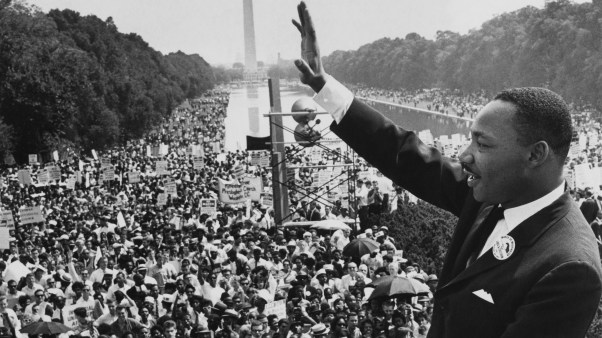
Three mandates for ministry that we can learn from Martin Luther King Jr.
Charitable giving went up nearly five percent during the economic trouble caused by record inflation in 2022, according to a Fundraising Effectiveness Project study of American nonprofits. The number of donors, however, declined by about seven percent—fewer people gave more money.
Number of megadonors -0.4%
Number of medium donors -1.4%
Number of small donors -13%
Money given +4.7%
Source: Editor, “Inflated Giving,” CT magazine (May-June, 2023), p. 14
Who are the most generous givers? As a nation, America tops the charts. The three most charitable cities in America are all in Idaho. On average practicing Christians in those Idaho cities give $17,977. That beats out the giving from people in New York City, Los Angeles, and Chicago, which averages $3,308 per person.
Age also makes a big difference in giving. Eighty four percent of millennials give less than $50 to charity per year even though charitable giving ranks high on their priorities.
Today, the average church attender gives 2.5% of his or her income annually. During the Great Depression, that number was 3.3%. Thirty seven percent of those who consider themselves evangelical Christians don't give at all to their churches. Only 2.7% of evangelical Christians practice tithing.
Editor’s Note: You can read this fascinating Barna survey with all the stats here.
Source: John Lee, On Generosity (Stone Tower Press, 2022), pp. 63-64; Michael Foust, “America’s Most Generous Christians Live in Idaho, Iowa,” Christian Headlines (11-27-19)
The United States recorded its one millionth organ transplant in September of 2022, a historic milestone for the medical procedure that has saved thousands of lives. It's unclear which organ was the record one millionth and details about the patient are unknown at this time.
The very first successful organ transplant occurred in 1954 at Brigham and Women's Hospital in Boston. That was when doctors transplanted a kidney from 23-year-old Ronald Herrick into his identical twin brother, Richard, who was suffering from chronic kidney failure. The lead surgeon, Dr. Joseph Murray, received the Nobel Prize in Medicine for his role in the procedure.
Up until the early 1980s, the number of transplants every year remained low. However, success in transplants organs other than kidneys—such as hearts, livers, and pancreases—and the advent of anti-rejection medication led to a rise in transplants. Since then, transplants have become a far more common procedure. In 2021, more than 41,000 transplants occurred, which is the highest number ever recorded.
Sadly, approximately 5,000 people die waiting on transplant lists ever year. And a study published in the Journal of the American Society of Nephrology in October 2020 found that many donor kidneys in the U.S. are unnecessarily discarded. But organ donors and recipients hope that by sharing their stories, they will inspire people will sign up to donate and help reduce those long waiting lists.
1) Heart; New Life - God has also given millions of new hearts (Ezek. 11:19) through the work of the Great Physician. However, just as the article states, many die while waiting for a new organ, so also many die without taking advantage of God’s gracious offer of salvation (“why will you die?” Ezek. 33:11; Luke 13:34). 2) Christ, substitute for humanity – There is joy for the patients receiving a new heart. Yet, the joy is bittersweet because the cost of that new heart was someone's life. For one to live another had to die.
Source: Mary Kekatos, “US records milestone 1 millionth organ transplant,” ABC News (9-9-22)
In the opening scene of the 2016 film Collateral Beauty, advertising CEO Howard Inlet explains that his strategy is driven by three things. At the end of the day, (1) we long for love. (2) We wish we had more time. And (3) we fear death. These three things, Howard claims, drive every human act.
But then we see him three years later. His six-year-old daughter has died of cancer. It has destroyed him. In his lament at life, he writes letters to love and time and death. To death he writes: “You’re just pathetic and powerless middle management. You don’t even have the authority to make a simple trade.”
Later, he explains what he meant: “When we realized our daughter was dying, I prayed. Not to God or the universe. But to death. Take me. Leave my daughter.”
Like Howard, Jesus volunteered to make the trade for us. But unlike death in Howard’s mind, Jesus wasn’t middle-management. He was completely in control. He is the Good Shepherd. The Good Shepherd lays down his life for his sheep. Jesus really did die for us.
Source: Rebecca McLaughlin, Confronting Jesus, Crossway books, 2022, page 158
Even crows and ravens seem to understand the importance of giving gifts. John Marzluff and Tony Angell, in their book, Gifts of the Crow, detail the intelligence of birds which results in them behaving like humans. The authors relate many accounts of people routinely receiving gifts from crows, thought to be in response to kind actions such as providing food for the birds. Crows are known to give gifts such as coins, bits of colored glass, flowers, a blue plastic Cap’n Crunch figurine, shiny rocks, keys, and even false teeth.
This gift giving could be accidental, intentional, or perhaps a form of reciprocity. The authors write:
Reciprocity may not be a practice exclusive to humans. The ability to quickly associate behavior with reward that is so prevalent in (crows) may underlie their innovative gifting behavior. Leaving gifts suggests that crows understand the benefit of reciprocating past acts that have benefited them and also that they anticipate future reward. In their case … it is a planned activity; the crow has to plan to bring the gift and plan to leave the gift.
Giving and receiving gifts are well known as one way we show love for others. However, there are those who avoid these activities to the detriment of their relationships.
Source: John Marzluff and Tony Angell, Gifts of the Crow: how perception, emotion, and thought allow smart birds to behave like humans, (Atria Books,2013), pp. 110-114
Tim Keller said he would never forget the story about one of his mentors, a college professor named Dr. Addison Leach.
Two young women at the college were both bright and their respective parents wanted them to get Master’s Degrees and go on to careers. But, instead, they both became Christians. Both decided that they were going to become missionaries. Their parents had a fit. One of the mothers called Dr. Leach, thinking that Dr. Leach was one of the reasons that the girls had become (in the mother’s words) “religious fanatics, rather than pursuing the course they had hoped, getting a career and having security. Instead, they were going to go wildly off into the blue.”
This mother said, “We wanted our daughter to get a master’s degree, start a career, and get something in the bank, so she could have some security. Dr. Leach responded:
Please just let me remind you of something. We’re all on a little ball of rock called earth, and we’re spinning along through space at zillions of miles per hour. Even if we don’t run in to anything, eventually we’re all going to die. Which means that under every single one of us there’s a trap door that’s going to open one day and we’re all going to fall off this ball of rock. And underneath will either be the everlasting arms of God or absolutely nothing. So maybe we can get a master’s degree to get some security.
But the biggest savings account in the world cannot stop cancer. It can’t stop traffic accidents. It cannot stop broken hearts. It can’t give you anything … any of the things that only God can give you. He’s the only significance you can have. He’s the only love that you can get and can’t lose.
Source: Excerpt From: Timothy J. Keller. “A Vision for a Gospel-Centered Life.” Apple Books.