

Sorry, something went wrong. Please try again.
Carrie McKean writes in an article on Christianity Today online:
When I think about the night of Jesus’ birth, the first picture that comes to mind is straight from my childhood. It’s like I’m peering into a snow globe manger scene. Snow falls softly, blanketing the hillside in a carpet of quiet. All is calm. All is bright. Give it a good shake, the snow gently swirls, then settles over the pristine couple and silent baby once again.
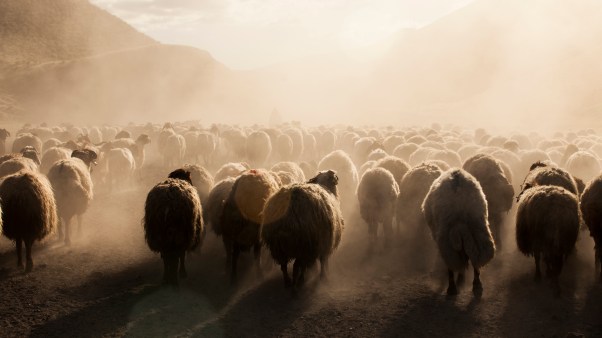
But that image is quickly crowded by another. 15 years ago, my husband and I lived in a dusty Chinese village on the outskirts of Beijing. We volunteered for four years at New Day Foster Home, a private, Christian nonprofit organization. In those days…they helped fund surgeries and provided long-term foster care for medically fragile orphans. We lived in an apartment complex about a mile from the organization’s campus, and most mornings we walked behind a flock of sheep and their shepherd on our way to work.
You could smell that shepherd’s stable before you saw it. Fetid and filthy, the sheep crowded in at the end of a day. In the summer, flies buzzed. In the winter, sludge froze solid. I would pass the sheep and their shepherd, pitying him a little. Around Christmas, I pictured my Savior born amid fresh, sweet hay in an inexplicably warm and comforting stable. The snow globe in my mind was just how I wanted to imagine Jesus’ entrance into the world. But the stable I walked past told the truth: Stables smell like dirty sheep.
I wanted to throw a snow globe against a brick wall. That clean Nativity was plastic, fraudulent, and fake. I felt angry at myself for all the ways I’d cheapened and tamed the gospel. My own faith felt fake and plastic too.
The world I saw outside my window needed a God-become-flesh in circumstances far messier than those perfect little snow globes. And here was this shepherd and his sheep, upending my picture of the Incarnation and revealing that the lack was in my seeing, not in Christ’s coming.
There’s no way around the fact that incarnation means coming to a filthy and fetid world, just like that stable in China…. It’s a world with disease and mental illness. A fallen creation groans with earthquakes, floods, and fires. Sorrow, unending sorrow. It is all too dirty, and yet he came near.
Jesus is God-made-flesh who doesn’t ask us to clean up the mess before he comes. He enters into our messes, always, always with us. He put on human skin…willingly emptying himself (Phil. 2:5-8), becoming a shepherd for you and me, a bunch of dirty sheep (John 10:11). He didn’t leave us in our squalor but led us to green pastures—to healing, rescue, and restoration of our souls (Ps. 23). I love a God who sees dirty sheep and tends them himself.
Source: Carrie McKean, “Filthy Night, Fetid Night,” Christianity Today Online (12-19-23) December 19, 2023
During an office hiking retreat in Colorado’s San Isabel National Forest, an unnamed worker was rescued after being abandoned by his colleagues on Mt. Shavano, a 14,230 feet mountain. The incident occurred after a group of 15 hikers split into two teams: one headed to the summit while the other ascended to a saddle area before turning back.
While 14 of the hikers descended safely, the unnamed person continued to the summit, reaching it around 11:30 a.m. However, he became disoriented on his descent. His colleagues, already on their way down, inadvertently collected markers that were left to help guide the descent. This confusion left the man struggling to navigate the steep boulder field on the northeast slopes of the mountain.
Using his cellphone, the hiker pinned his location and sent it to his team, who advised him to return to the summit to find the correct trail. Shortly after receiving this advice, a severe storm with freezing rain and high winds struck, disorienting him further and losing cellphone signal in the process.
When he failed to check in, his colleagues reported him missing at 9 p.m., approximately eight-and-a-half hours after he started his descent. A search was immediately initiated but was hindered by harsh weather conditions that affected both ground searches and aerial drone operations.
The following morning, the missing hiker managed to regain some cellphone service and called 911. Rescue teams, who had been searching through the night, were then able to locate him in a gully near a drainage creek. He was airlifted to a hospital, where he was found to be in stable condition.
The hiker reported falling at least 20 times and expressed his gratitude for being able to call for help despite his dire situation. Rescue officials noted that his recovery was fortunate given the challenging circumstances.
No matter what mistakes we’ve made or how we’ve been mistreated by others, God will never leave us or forsake us. Even when God chooses not to deliver immediately, he will walk with us and enable us to endure our moments of trial.
Source: Bill Hutchinson, “Office retreat gone awry: Worker rescued after allegedly left stranded on Colorado mountain by colleagues,” ABC News (8-28-24)
Britain's so-called "loneliest sheep," which was stuck at the foot of a remote cliff in Scotland for at least two years, has been rescued. Cammy Wilson, who led the rescue mission, said it was a risky one. That's why, despite past attempts by others, the sheep had been stuck for so long.
The sheep was first discovered in 2021, on the shore of the cliff in Brora by kayaker Jillian Turner. Photos show the sheep at the base of the cliff surrounded by steep rock on one side and water on the other.
In October of 2023 Turner said she has spotted the sheep several times since and the sheep hasn't been able to move off her spot on the base of the cliff. Turner said, “It is heart-rending. We honestly thought she might make her way back up that first year.”
Wilson, runs a Facebook page called "The Sheep Game" that chronicles his life as a farmer. After another farmer brought the sheep to his attention, he named the sheep Fiona and continued to give updates about her on Facebook.
Wilson then had an exciting update for followers. He and four others used a winch, a mechanical device that can act like a pulley, to get to Fiona. One person stayed at the top of the cliff, while the others traveled about 820 feet down the cliff to get to her.
In a statement, the Scottish SPCA said the group was notified of the rescue. Scottish SPCA said, "Our Inspector checked over the sheep and found her to be in good bodily condition, although needing sheared. The ownership of the sheep then was handed over to Dalscone Farm, a tourist attraction in Edinburgh with activities for children.
You can view pictures of the sheep and the cliff here.
Source: Caitlin O'Kane, “Britain's "loneliest sheep" rescued by group of farmers after being stuck on foot of cliff for at least 2 years,” CBC News (11-6-23)
‘We lead the people of God through the preaching of the Word of God.’
A sheep named Baarack received a much-needed shearing after rescuers in Australia found the abandoned animal with more than 75 pounds of wool weighing it down. A video of his transformation on TikTok has more than 18.5 million views. After rescuing Baarack, sanctuary staff gave him the long-overdue shearing and found the fleece clocked in at about 78 pounds.
According to Kelly Dinham with Edgar’s Mission Farm Sanctuary, sheep need at least yearly shearing to keep their coats light enough for the animals, otherwise it will continue to grow. Despite his heavy fleece, Baarack was actually underweight after being sheared. The wool around his face impaired his vision, too. Dinham said they found grit and debris "pooling in the gap between his cornea and the lid." And a grass seed stuck in there had caused an ulcer.
If a sheep goes for an extended period of time without adequate care, the overgrown wool can lead to build up of manure and urine that then could lead to infection, according to a North Dakota State University fact sheet on sheep shearing.
This illustration easily applies to the Chief Shepherd and his sheep (and the undershepherd and their flock). As the sheep of his pasture, we need to be under the care of our Shepherd, otherwise we can wander off (Luke 15:4) or be attacked (Acts 20:29). We need those peaceful streams and quiet pastures, and his loving care (John 10:1-18; Psalm 23:1-6).
Source: Ryan W. Miller, “Baarack, a sheep rescued in Australia with over 75 pounds of wool, is 'getting more confident every day,’” USA Today (2-24-21)
Almost five years to the day after he returned home the first time, the prodigal son emptied his bank account, packed a few changes of clothes, and snuck off for the faraway country. Again.
The first year back he was just glad to be home.
The second year was toughest; he still couldn’t get (rid of) … the shame that chewed away at his soul.
The third year, things leveled out a little. He started feeling more at home, back in synch with his former life.
The fourth year, certain things began to irk him. His old itches longed to be scratched.
And the fifth year, it happened. All the former allurements came knocking, rapping their knuckles on his heart’s front door.
And so the prodigal relapsed. Re-sinned. Re-destroyed his life.
You know him—or her. Maybe it’s your best friend. Maybe it's your child. Or maybe it’s you. That thing you swore you’d never do again, you did it last night. You left the straight and narrow. Prodigals have a way of finding themselves right back in the pigsty.
In that moment … heaven and hell contend within you. Hell shouts, “Now you’ve gone and done it. You stupid piece of garbage. You’re a lost, lonely, hopeless cause. You’re a pig. And that’s all you’ll ever be.”
But there is another voice. It’s the voice of heaven, the familiar lilt of a Dad’s voice, echoing down the long hallways of hope … down to the deepest, darkest caverns of your pain. He doesn’t accuse. He doesn’t berate. He only mouths two simple words … of heaven’s redemptive love: “Come Home.”
The second time, the third time, the thousandth time, he will sprint … to meet you down the street, throw his arms around you, kiss you, and command that the fattened calf be barbecued. The Father is standing on the porch, his hand shading the sun from his eyes, scanning the horizon for the familiar image of the one who will ever remain, his precious, beloved child. “Come home.”
Source: Chad Bird, “When the Prodigal Son Relapses,” 1517.org (5-22-22); David Zahl, “When the Prodigal Son Relapses,” Mockingbird (3-25-22)
A farmer's sheep and pig had escaped. Together they had found a weak rail in the fence and had pressed upon it until it broke under their weight. Seeing their opportunity, they quickly bolted from the field and began to explore their new and unfamiliar surroundings.
It did not take long for the farmer to notice that two of his animals were missing and to set out to find them. But the animals had wandered far and had not left much of a trail behind them. Day soon turned to night and after resting fitfully, he resumed his search in the morning. The animals had now been gone for more than 24 hours and he began to wonder what could possibly have happened to them.
It was in the afternoon of the second day that he began to hear a distant bleating, the sound of his sheep crying out. He then began to follow the sound as it led toward a nearby bog. And it was there that he found his missing sheep and his missing pig. Both had fallen into a deep ditch, both had become coated in muck, both were unable to scramble out. But where the pig had been content to wallow in the mud, the sheep had known to bleat pathetically until the farmer had come to rescue it, to lift it out, and to cleanse it.
Then, said the farmer,
If you are ever deceived into a sin and overtaken by a weakness, don’t lose heart. Go at once to your compassionate Savior. Tell Him in the simplest words the story of your fall and the sorrow you feel. Ask Him to wash you at once and to restore your soul. For if a sheep and a sow fall into a ditch, the sow wallows in it, but the sheep bleats pathetically until she is cleansed by her master. Be the sheep, my friend, and not the pig.
Source: Tim Challies, “The Tale of the Pig and the Sheep,” Challies blog (9-29-21)
Jesus created and redeemed us. Jesus loves us and we have nothing to fear.
God’s invitation for us is to hear his voice, trust him in the valley, see his beauty, and receive his love.
The Telegraph, a British newspaper reported that a flock of over 1,300 sheep "had to be rounded up by police in the Spanish city of Huesca after their shepherd fell asleep." The article continued:
According to city authorities, the police were alerted to the presence of the extremely large flock attempting to negotiate the streets in the center of Huesca at around 4.30am on Tuesday when a local resident dialed Spain's 112 emergency number.
The dozing shepherd was meant to be keeping the animals in check outside the environs of the city while he waited for the clock to strike 7am, when he was due to guide the sheep northwards through Huesca towards Pyrenean uplands where his flock will graze during the hot summer months.
The police eventually found the herder, who was still peacefully slumbering. Together the embarrassed shepherd and police officers were eventually able to extract the sheep from the city and return them to their pastures.
Source: James Badcock, "Sheep run loose in Spanish town after shepherd falls asleep," The Telegraph (6-8-16)
In Palestine today, it is still possible to witness a scene that Jesus almost certainly saw two thousand years ago, that of Bedouin shepherds bringing their flocks home from the various pastures they have grazed during the day. Often those flocks will end up at the same watering hole around dusk, so that they get all mixed up together—eight or nine small flocks turning into a convention of thirsty sheep. Their shepherds do not worry about the mix-up, however. When it is time to go home, each one issues his or her own distinctive call—a special trill or whistle, or a particular tune on a particular reed pipe, and that shepherd's sheep withdraw from the crowd to follow their shepherd home. They know whom they belong to; they know their shepherd's voice, and it is the only one they will follow.
Source: Barbara Brown Taylor in The Preaching Life (Cowley, 1993), p. 147
In his book Building a Church of Small Groups, Bill Donahue relays a story from his time as a part-time youth pastor while attending seminary. He was visiting a farm where two of his students lived, and their father decided to teach Bill a lesson:
He asked if I could help call in the sheep. I enthusiastically agreed. Sheep-calling was like preaching. We stood at the pasture fence, watching 25 sheep graze.
"Go ahead," he dared me. "Call them in."
"What do you say?" I asked.
"I just say, 'Hey, sheep! C'mon in!'"
No sweat, I thought. A city kid with a bad back and hay fever could do this. I began in a normal speaking voice, but Tom interrupted. "You are 75 yards away, down wind, and they have their backs to you. Yell! Use your diaphragm, like they teach you in preaching class."
So I took a deep breath and put every inch of stomach muscle into a yell that revival preachers around the world would envy: "Hey, sheep! C'mon in!" The blessed creatures didn't move an inch. None even turned an ear.
Tom smiled sarcastically. "Do they teach you the Bible in that seminary? Have you ever read, 'My sheep hear my voice, and I know them, and they follow me'?" Raising his voice only slightly, he said: "Hey, sheep! C'mon in!" All 25 sheep turned and ambled toward us. Tom seized this teachable moment.
"Now, don't you ever forget," he said. "You are the shepherd to my kids."
Source: Bill Donahue and Russ Robinson, Building a Church of Small Groups (Zondervan, 2001), p. 106-107
It all started with one self-destructive leap.
Shepherds eating breakfast outside the town of Gevas, Turkey, were surprised to see a lone sheep jump off of a nearby cliff and fall to its death. They were stunned, however, when the rest of the nearly 1,500 sheep in the herd followed, each leaping off of the same cliff.
When it was all over, the local Aksam newspaper reported that "450 of the sheep perished in a billowy, white pile" (those that jumped from the middle and end of the herd were saved as the pile became higher and the fall more cushioned). The estimated loss to the families of Gevas tops $100,000, an extremely significant amount of money in a country where the average person earns about $2,700 annually.
"There’s nothing we can do. They’re all wasted," said Nevzat Bayhan, a member of one of the 26 families whose sheep were grazing together in the herd.
Source: "450 Sheep Jump to Their Deaths in Turkey", washingtonpost.com (7-8-05); "Sheep in Mass 'Ewe-icide,'" The Sun Online (7-8-05)
At Chancy Lutheran Church in Clinton, Iowa, the kids from VBS were preparing for their grand finale production of "The Good Shepherd." Guests slipped into their seats and checked their watches. The special stars of the show were two sheep, kept in a pen outside the church.
Then things got complicated. Ten minutes before the play was to start, the sheep , well they were lost. They ran away. Just got scared (stage fright, maybe?), hopped over the fence, and lit out for points unknown. The play's director, Sandy Mussman, along with her two kids, ran through town, chasing the sheep. "At one point," she later reported, "we passed a lady who was out in her yard. She said, 'Did I just see what I thought I saw?'"
Eventually, they tracked one of the sheep down near Clinton Community College, but at last report the other one was still on the lam, though several people reported seeing it around town. The church's pastor was even out looking. According to Mussman, "When people asked what he was looking for he'd say, 'A lost sheep.' Then he'd have to tell them he really was looking for a lost sheep, that he wasn't looking for sinners."
I suspect that in the finest tradition of the theater, the show went on. After all, the first act was entitled "The Lost Sheep."
Source: Associated Press (8-22-03)
Several years ago we were kneeling on cushions around a long, low dining table in a private hotel suite in Japan. The air was seasoned with celery and leeks and unknown things.
Through a missionary interpreter, an important Japanese industrialist was addressing my husband: "I have come to this city and invited you to join our family at dinner so that I might ask you a question. During the past year my son has become a Christian. I admit that he was rebellious and hard to handle, and now he is a respectful, good boy. But as you know, Christians in Japan are a very small minority and are looked down upon as being low-class, disloyal to family and to country.
"There are so many sons in Japan. Why would this have to happen to my son—to me?"
God suddenly gave the translating missionary a parable. He said, "Suppose a shepherd wanted to take his flock to better pastures. But the way was across a raging stream, and one ram was particularly frightened and refused to budge. How would he get that dear sheep to make the trip? Why, he would take his lamb, his precious lamb, and put it on the other side first."
A tear ran down the father's cheek. "Ah, so," he said.
Source: Anne Ortlund, Up with Worship (Broadman & Holman, 2001)
In Life on the Edge, Dr. James Dobson writes:
What are the characteristics of sheep that remind the Lord of you and me? What is he really saying when he refers to us in that way? Well, shepherds and ranchers tell us that these animals are virtually defenseless against predators, not very resourceful, inclined to follow one another into danger, and they are absolutely dependent on their human masters for safety. Thus, when David wrote, "We all, like sheep, have gone astray," he was referring to our tendency to move as an unthinking herd and away from the watchful care of the Shepherd.
I observed this herd instinct a few years ago in a documentary on television. It was filmed in a packing house where sheep were being slaughtered for the meat market. Huddled in pens outside were hundreds of nervous animals. They seemed to sense danger in their unfamiliar surroundings. Then a gate was opened that led up a ramp and though a door to the right. In order to get the sheep to walk up that ramp, the handlers used what is known as a "Judas goat." This is a goat that has been trained to lead the sheep into the slaughterhouse. The goat did his job very efficiently. He confidently walked to the bottom of the ramp and looked back. Then he took a few more steps and stopped again. The sheep looked at each other skittishly and then began moving toward the ramp. Eventually, they followed the confident goat to the top, where he went through a little gate to the left, but they were forced to turn to the right and went to their deaths. It was a dramatic illustration of unthinking, herd behavior and the deadly consequences it often brings.
Source: James Dobson, Life on the Edge (Word Publishing, 1995), pp.24-25
Back when the sacred authors used the imagery of the shepherd to depict Jesus, they had a clear understanding of the job description. A shepherd is needed only when there are no fences. He is someone who stays with his sheep at all cost, guiding, protecting, and walking with them through the fields. He's not just a person who raises sheep. Though our bishops consider themselves "tenders of the flock," most are nothing more than mutton farmers. They build fence after fence, keeping the flock within sight so they don't have to dirty their feet plodding through the open fields. After all, the landowner frowns upon dirty feet.
Source: Lena Wolter, quoted by Martin E. Marty in Context (Sept. 15, 1995). Christianity Today, Vol. 39, no. 13.
A shepherd owns the sheep and marks them. In some cases, sheep are branded. Although some sheep are branded, that's really not a popular thing because it damages the wool. Even if the brand is placed through the wool and into the hide of the lamb, the wool can overgrow it so the brand won't be seen. Today the ears are pierced with identification tags, but that's a fairly modern invention.
For thousands of years, shepherds around the world marked the ears of their sheep by notching their ears with a sharp knife. Each shepherd had his own distinctive notch for the ear of his sheep. If the sheep gather in a cluster, he can see even from a distance which ones are his.
I think all of this is a lot like being a Christian. For Christians are also those who admit to being owned and marked by Jesus Christ--sometimes marked painfully through suffering and difficulty. It must be painful for Jesus Christ to allow those marks to be burned, pierced, and notched into our lives.
Source: Leith Anderson, "The Lord Is My Shepherd," Preaching Today, Tape No. 136.
I own a marvelous little book written nearly a quarter of a century ago by a former shepherd, Philip Keller. He titled the book A Shepherd Looks at Psalm Twenty-Three, He tells about his experience as a shepherd in east Africa. The land adjacent to his was rented out to a tenant shepherd who didn't take very good care of his sheep: his land was overgrazed, eaten down to the ground; the sheep were thin, diseased by parasites, and attacked by wild animals. Keller especially remembered how the neighbor's sheep would line up at the fence and blankly stare in the direction of his green grass and his healthy sheep, almost as if they yearned to be delivered from their abusive shepherd. They longed to come to the other side of the fence and belong to him.
Christians understand that the identity of the shepherd is everything. It is wonderful to be able to say, "The Lord is my shepherd."
Source: Leith Anderson, "The Lord Is My Shepherd," Preaching Today, Tape 136.