Sorry, something went wrong. Please try again.
Christmas might be a time for vacations, but it sure does require plenty of work. It turns out families are dedicating a staggering amount of time to Christmas preparations over their lifetimes. A survey of festivity enthusiasts reveals that holiday preparations consume almost five years of their lives.
The most substantial chunk of time goes to planning Christmas dinner, consuming nearly two-and-a-half years of preparation over a lifetime. In addition to meal planning, hosts spend a remarkable 164 weeks cleaning and tidying before welcoming holiday guests.
The decorating process itself presents its own time demands. People spend more than two days adorning their Christmas trees, and 34 hours untangling lights. For those with real trees, an additional 36 hours are spent picking up or vacuuming pine needles over a 63-year period.
The research also highlights the stress associated with holiday preparations, with 60% of respondents finding the season stressful and 45% wishing for ways to make it less so. The cost-of-living crisis has amplified these concerns, with 41% expecting this Christmas to be more stressful than last year.
Despite these challenges, people maintain their enthusiasm for the season. The survey revealed that spending time with family and friends (44%), enjoying festive food and drink (41%), and giving presents (34%) rank as the nation’s favorite aspects of Christmas.
Possible Preaching Angle:
Christmas; Contentment; Fellowship; Hospitality - As we prepare for Christmas, it's important to reflect on how we're spending our time. Are we dedicating our efforts to what truly matters, like family, fellowship, community, and the essence of Christmas? Or are we getting caught up in distractions that create stress and detract from the fundamental values of togetherness and the true meaning of the season?
Source: Staff, “Christmas by the numbers: 34 hours untangling lights, 36 hours cleaning up pine needles over a lifetime,” Study Finds (12-24-24)
By CEO standards, Bob Kierlin had modest needs. The co-founder of Fastenal, an international seller of nuts, bolts and other supplies for manufacturing and construction firms, took a salary of $120,000 a year at its peak in the 1990s, with no bonuses or stock options; that was less than some Fastenal store managers earned. He clipped grocery coupons, and bought some of his suits secondhand, for $60 apiece. On business trips, he stayed in discount motels and often shared a room with a colleague. He paid for his own meals on the road.
Kierlin wasn’t hurting financially: He had shares in the company worth hundreds of millions of dollars from his original stake. And the company’s board was willing to pay him far more. But Kierlin said he didn’t need it.
“I was born into a family that never had an awful lot of things,” he told The Wall Street Journal in 2002. “We just learned to live with what we had. I never felt I needed a lot of money.”
Kierlin, who died Feb. 10, 2025 at the age of 85, didn’t have a personal secretary or even his own parking place outside the drab concrete head office in his hometown of Winona, Minn. Much of the furniture inside that headquarters was used.
Source: James R. Hagerty, “Bob Kierlin, Frugal CEO Who Wore Secondhand Suits, Dies at 85,” The Wall Street Journal (3-10-25)
Fine dining typically means splurging a little for high-quality meat or fresh seafood. But what if money were truly no object?
Restaurant owners and chefs around the world create original dining experiences for those who want unique experiences. You know, like spending nearly $10,000 on a pizza or $1,000 on an ice cream sundae.
Here are a few of the world’s most expensive meals:
(1) Salvation and The Lord's Supper—They're both offered free of charge (although Jesus paid the price that we could never have paid), and the Lord's Supper is better than anything on this list. (2) Social Justice—While millions of people are malnourished, a few people can afford outrageously expensive, luxurious meals. (3) Simplicity; Provision—God promised to provide daily bread, not daily slice of "Louis XIII" pizza. (4) Hospitality—Hospitality is more about love and openness than about trying to offer a "world's best meal." Encourage people to keep it simple.
Source: Staff, “20 Most Expensive Foods in the World 2024,” PassionBuzz.com (12-19-23); Lia Sestric, “10 Most Expensive Meals in the World,” Go Bank Rates (5-3-23)
As Christmas approaches, too many parents will be competing to track down and purchase the latest and greatest toy that their child has set their heart on. Take a break from your frenzied competition with other parents to look back at the “5 Best Toys of All Time.” It’s guaranteed that you won’t guess them, even though you should.
So, here are five items that no kid should be without. All five should fit easily within any budget, and are appropriate for a wide age range so you get the most play out of each one. These are time-tested and kid-approved!
1. Stick
This versatile toy is a real classic—chances are your great-great-grandparents played with one. Stick works really well as a poker, digger, and reach-extender. Stick comes in an almost bewildering variety of sizes and shapes, but at least the classic wooden version is biodegradable.
2. Box
Box also comes in a variety of shapes and sizes. You can turn your kids into cardboard robots or create elaborate Star Wars costumes. A large box can be used as a fort or house and the smaller box can be used to hide away a special treasure. Got a Stick? Use it as an oar and the box becomes a boat. One particularly famous kid has used the box as a key component of a time machine, a duplicator and a transmogrifier, among other things.
3. String
Kids absolutely love string. The most obvious use of string is tying things together. You can use it to hang things from doorknobs or tie little siblings to chairs or make leashes for your stuffed animals. Use string with two cans for a telephone, or with a stick to make a fishing pole.
4. Cardboard Tube
The cardboard tube comes free with a roll of paper towels and other products. Some kids have nicknamed the cardboard tube the "Spyer" for its most common use as a telescope. Or tape two of them together for use as binoculars. But if you happen to be lucky enough to get a large size from Christmas wrapping paper, the best use is probably whacking things.
5. Dirt
One of kids’ favorite things to play with is dirt. As we grow up, we pick up an interest in cleanliness and aren’t such a fan of dirt anymore. Many parents aren't so fond of it either. But dirt has been around longer than any of the other toys on this list, and shows no signs of going away. In fact, there are some studies have shown that kids who play with dirt have stronger immune systems than those who don't.
So, what can you do with dirt? Well, it's great for digging and piling and making piles. Dirt makes a great play surface for toy trucks and cars. Just add water and—presto!—you've got mud! Dirt is definitely an outdoor toy, despite your kids' frequent attempts to bring it indoors. If they insist, you'll probably want to get the optional accessories broom and dustpan. But as long as it's kept in its proper place, dirt can be loads of fun.
Source: Jonathan Liu, “The 5 Best Toys of All Time,” Wired (1-31-11)
Assistant Principal Raymond Dolphin knew he was taking a risk in December 2021 when he banned cell phones from Illing Middle School in Connecticut. But more than two years later, the program has become an unqualified success.
Secondary schools all over the U.S. are either enacting or considering some kind of cell phone ban, in part because of stories like Dolphin’s. Dan Connolly, one of the science teachers at Illing, used to have to nag students to put away their phones. “Now the first thing I say is, ‘Good morning,’ not ‘Take your Air Pods out.’”
Following the lead of not only schools but concert halls and comedy clubs, students at Illing are not required to surrender their phones, but place them in a special branded pouch called a Yondr, which can only be unlocked at certain school monitored stations.
Students at Illing predictably resisted the ban at first, but some of them have come around to seeing its benefits. “You can focus more,” said Chioma Brown, who’s grown so accustomed to the ban that she occasionally forgets that her phone is on her person.
Bans on cellphones have become much more commonplace in part because the relationship between students and their phones intensified during the pandemic years of persistent remote learning. According to Harvard Medical School psychologist Susan Linn, drastic actions like these must be taken to restore order and cultivate healthy learning environments. She said, “We have these devices which we know are at best habit-forming and at worst addictive that are increasingly linked to depression and loneliness. So why would we have them in schools?”
Living a life of holiness and devotion to God sometimes requires us to put restrictions on the things that distract us, not because such things are evil, but because they get in the way of hearing from God.
Source: Joanna Slater, “How a Connecticut middle school won the battle against cellphones,” The Washington Post (5-1-24)
A new poll has found 77% of middle-aged Americans between 35 and 54 years old want to return to a time before society was always “plugged in,” a time before the always-on internet and cell phones in our pockets ruled our lives.
But it wasn’t just middle-agers. The poll also found 63% of people aged 18 to 34 years old also want to go back to simpler times—even though most of them never experienced those days. Weirdly, fewer Baby Boomers want to go back, with 60% of people older than 55 saying they want to return to pre-internet days. Overall, two-thirds (67%) of poll respondents said “they’d prefer things as they used to be versus as they are now.”
There’s merit to the desire to go back. Take the work-from-home phenomenon that exploded as the world sunk into the COVID-19 pandemic. Sure, it’s nice to be home, but with the advent of constant connectivity, the work day often starts shortly after you wake up and ends well into the evening. In between, everyone can reach you at all times.
All that is over. Bosses have no qualms about sending workers an email or text at 9 p.m. asking for something to be done immediately. And forget those hourlong lunches (what we called a “lunch break”—and we did it daily, taking off from noon to 1 p.m. to relax and recharge). Now, we slam down a sandwich while tapping away on our computers. It never ends. Makes sense most of us want to go back.
Source: Joseph Curl, “Bye Tech: Two-Thirds Of Americans Want To Go Back To Time Before Internet, Cell Phones, Poll Finds,” Daily Wire (6-20-23)
Starbucks first turned regular drip coffee into a $5 half-caff, extra whipped cream mocha latte. Now they’re producing dozens of bizarre concoctions dreamed up by social-media stars. These complex drinks include a Triple Caramel Threat––cold brew with caramel syrup, vanilla sweet cold foam blended with dark caramel and caramel drizzle––and a Matcha Pink Drink featuring the chain’s Strawberry Açaí Refreshers Beverage with green tea powder and sweet cold foam added. Their complexity is lengthening lines and driving baristas nuts.
“It is a bit exhausting,” said a Starbucks barista in Buffalo, N.Y. The drinks treat Starbucks’s menu less like a lineup of drinks and more like a buffet of ingredients to be mixed together in crazy ways to create off-menu drinks that may list 10 separate customizations on the side of the cup.
The customized beverages center on a Starbucks mainstay––customers’ ability to tailor any drink to their tastes––and take it to the extreme. Starbucks says in addition to the beverage options listed on its menu boards, there are 170,000-plus ways baristas can customize beverages.
American society suffers from a plague of things that are far too complicated
Source: Heather Hadden, “TikTok Fans Brew Even More Complicated Orders at Starbucks,” The Wall Street Journal (11-4-21)
Seventeen-year-old Robin West is an anomaly among her peers--she doesn't have a smartphone. Instead of scrolling through apps like TikTok and Instagram all day, she uses a so-called "dumbphone." These are basic handsets with very limited functionality compared to say an iPhone. You can typically only make and receive calls and SMS text messages. You can take very basic photos, but definitely not connect to the internet or apps.
Robin says, "I didn't notice until I bought a brick phone how much a smartphone was taking over my life. I had a lot of social media apps on it, and I didn't get as much work done as I was always on my phone."
Dumbphones are continuing to enjoy a revival. Google searches for them jumped by 89% between 2018 and 2021. One report said that global purchases of dumbphones were due to hit one billion units last year, up from 400 million in 2019.
It's true that dumbphones can't compete with the latest smartphones when it comes to performance or functionality, but they can outshine them in equally important areas such as battery life and durability.
Tech expert, Sandra Wachter, says that smartphones always "want to grab your attention" with notifications, updates, and breaking news constantly disrupting your day. "This can keep you on edge, might even be agitating. It can be overwhelming."
Wachter adds,
It makes sense that some of us are now looking for simpler technologies and think that dumbphones might offer a return to simpler times. It might leave more time to fully concentrate on a single task and engage with it more purposefully. It might even calm people down. Studies have shown that too much choice can create unhappiness and agitation.
Source: Suzanne Bearne, “Not smart but clever? The return of 'dumbphones',” BBC (3-21-22)
Skye Jethani writes, in Immeasurable, about good versus bad complexity in ministry. He illustrates it this way:
Bad complexity is like a Rube Goldberg machine. Those are the massive, jerry-rigged contraptions that fill an entire room with moving ropes, ramps, bowling balls, and buckets. One small motion, like a marble rolling or a domino tipping, begins a long and complicated chain reaction. A Rube Goldberg machine is a huge, inflexible apparatus that accomplishes one simple task. It’s not very useful, but it can be immensely entertaining.
Good complexity, in contrast, is like a Swiss Army knife—an elegant, nimble instrument that can accomplish an impressive number of tasks. No one would say Swiss Army knives are simple. They are intricate, with many precisely engineered parts, but this complexity of design paradoxically makes them adaptable and easy to use.
Many churches are marked by bad complexity. They are like Rube Goldberg machines—not very effective, but very entertaining to watch. They construct massive systems of control that are far larger than what is required for the task, and they are dangerously fragile. If one element of the system or environment changes, the weakness of the whole church or organization is exposed.
This could be used as illustration of the difference between strong and weak, healthy and unhealthy, complex yet meaningful church organizations and ministries.
Source: Skye Jethani, Immeasurable: Reflections on the Soul of Ministry in the Age of Church, Inc. (Moody Publishers, 2017). pp. 86-87
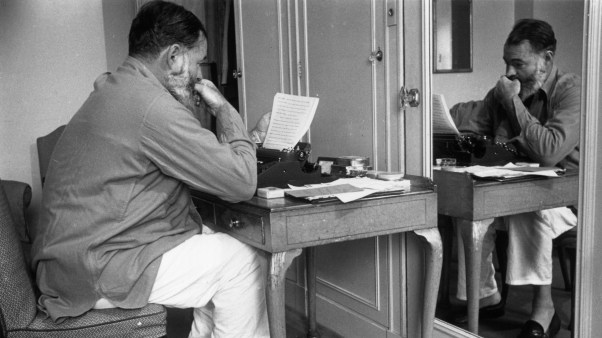
3 ways Hemingway challenges us to open our eyes to ourselves, Scripture, and the world around us.
Mr. Clarke felt like he was losing touch with his son Khobe, who was always on his phone. He partly blames himself. He told the BBC, “If there's any addiction that we have today as individuals and as a family, we (the parents) perpetuated it. They're cool devices, but we began to feel like they were controlling us and not vice versa.”
The issue had come to a head a few years before, when Clarke went with his family to a remote ski lodge. The area had no cell reception. Khobe admits that he was angry that he had to go, and miserable because without Snapchat or Instagram, he had no idea what his friends back home were up to.
That got his father thinking about the role technology had come to play in his family life--and about how to fix it. For a long time, he had dreamed of travelling across Mongolia on a bike. Why not do it with his son? It wasn't an automatic hit. Khobe says, “I said ‘no’ pretty quickly. But it kind of turned into this fun idea … it became such a thing of preparation that it was very exciting to go do it.”
Over the course of the next month they travelled more than 1,367 miles across Mongolia by motorbike, horse, and camel. Khobe said, “I think the whole time I was pretty consumed by missing my phone. What am I going to do, look at the stars and twiddle my thumbs?” But he also says getting to know his dad was worth it, especially the time they spent off the road in their tents or yurts just cooking and bonding. Khobe said, “I was surprised that when he's away from a work environment and family that he acts maybe closer to my age.”
Father’s Day; Parenting; Technology – You don't have to go to the other side of the world just to bond with your children. Parents can plan activities during the week, and especially on vacation, that are screen-free times. Take your children on walks, play a board game, or watch a movie together. It is also important for parents to model screen-free behavior for their children and spend unplugged time with them giving them focused attention.
Source: Robin Levinson-King, “This Dad Took His Son to Mongolia Just to Get Him Off His Phone,” BBC News (1-2-20)
In his book A Journey to Bethlehem, Jason Soroski offers the following definitions of a resolution:
Resolution. Webster defines the word as being "marked by firm determination." The word dominates every New Year's Eve.
To the musician, a "resolution" is a harmony line moving from a dissonant tone (one that does not fit the melody) to a consonant tone (one that fits). Harmonies can dance and amaze us with varied complexities for a while, but they must eventually resolve.
To the writer, a resolution is the end of a story, the final element of a twisting plot wrought with conflict, finally resolved to an ending where all is well.
To the chemist, it is the separation of a chemical compound back into its constituents, or simplest parts.
To the statesman, it is an expression of the determined will of an elected body.
To the graphic artist, it is the sharpness of the pixel count on a screen, and the quality of the image produced.
By any definition, a Resolution is characterized by a return to simplicity, a focus on sharp definition and determination, broken down to its simplest, most harmonious parts. Without resolution, art, science, government, and life in general all fall into chaos. Without resolution, there is no foundation on which to stand.
Source: Jason Soroski, A Journey to Bethlehem (Create Space, 2016), page 25
About 70 years ago, brothers Karl and Theo Albrecht, fresh from military service in World War II, took over their family's store in Germany, a mining neighborhood of the bombed-out industrial city of Essen. Back then, their stores offered just 250 items, the essentials miners' and steelworkers' families needed to survive—flour, sugar, coffee, butter, bacon, peas, and condensed milk. In the 1950s and '60s, Germany's economic miracle took off, and a wave of glitzy supermarkets selling thousands of items sprouted up to serve the newly affluent middle class. But the brothers didn't flinch. They moved forward with a counter-cultural business model: limit choices and keep it simple.
Then The Wall Street Journal noted the remarkable success of the grocery chain started by Karl and Theo—Aldi.
Dim lighting bounces off brownish-tiled floors. The shelves are sparsely filled with cardboard boxes. Checkout lines stretch to oblivion. There is nothing super about these stores. Yet their owner, German discounter Aldi, is betting billions it can win over spoiled American shoppers. How? By offering them fewer choices—way fewer—than rival retailers.
The unlikely proposition has worked nearly everywhere Aldi has set foot. The company that started from a simple suburban grocery store in Germany's industrial northwest is now one of the biggest retail groups in the world with more than 12,000 locations, businesses in 18 countries and annual revenues over $100 billion (as of 1/25).
Possible Preaching Angles: (1) Contentment; Discontentment; Choices; Satisfaction—God may want us to find deep satisfaction through less rather than more choices and options. (2) Parenting—Sometimes parents need to offer there children less rather than more choices.
Source: Zeke Turner, "How Grocery Giant Aldi Plans to Conquer America: Limit Choice," The Wall Street Journal (9-21-17)
Episode 18 | 12 min
Wall Street Journal columnist Joe Queenan made some funny comments on the complexity and information overload of modern life:
I bought a sinus rinse the other day. Just a basic, no-frills sinus rinse. In making this purchase, I thought that rinsing my sinuses would be a fairly straightforward operation. Boy, was I ever wrong. For starters, there was the packaging. Colorful diagrams and instructions festooned the sinus-rinse box, including a long list of the 10 "advantages" of using this particular nasal spray. For example, the nozzle on the "easy-squeeze" plastic bottle fits any nasal opening whatsoever. Very important detail for people with virtually invisible nostrils.
But the sinus rinse makers were just getting warmed up. Inside the box I found a 32-page manual with an introduction, testimonials from physicians and customers, warnings about mishandling the device, a full page of instructions for cleaning and disinfecting the unit, and four pages of answers to frequently asked questions about sinus rinses.
The manual contained tens of thousands of words, all in tiny, tiny print. It did not explain how to launch an intercontinental ballistic missile or how to address the queen when being admitted to the Order of the Garter. No, it just dealt with the whys and wherefores of using a sinus rinse. It went on and on and on.
American society suffers from a plague of things that [are far too complicated].
Source: Joe Queenan, "The Plague of Things That Are Too Long," The Wall Street Journal (5-12-16)
Jason Brown was the highest paid center in the NFL, playing for the St. Louis Rams. In late 2011, Jason had two children, and a mansion with two fully-stocked bars, yet he and his wife were "dying inside" and were likely headed toward divorce. As a professed Christian, Jason had to admit that his relationship with Jesus was a ticket to forgiveness and little else—until he released his grip on money and football. Jason said he started releasing his grip on his lavish lifestyle by pouring thousands of dollars of expensive liquor down the drain.
After leaving the Rams and turning down three other teams, the Brown's put their home up for sale and bought a 100-year-old farmhouse with a dairy barn and 1,000 acres of uninterrupted land in North Carolina. Jason would become a farmer and give away what he grows. Jason learned farm basics from YouTube, which resulted in First Fruits Farm, an organization that seeks, through community and service, to boost Bible literacy.
Ten thousand pounds of cucumbers, and one hundred thousand pounds of sweet potatoes later, Jason says, "I literally still know nothing about farming." But Jason can summarize his business plan and his life these days with one word: "Obedience."
Source: Adapted from Andrew Branch, "Farm Team," WORLD (1-24-15)
Your quick but essential guide to the big idea in expository preaching
An article on NPR claims that we have become "the Impatient Nation." We want quick answers to complex problems. The article puts it this way:
We: Speed date. Eat fast food. Use the self-checkout lines in grocery stores. Try the "one weekend" diet. Pay extra for overnight shipping. Honk when the light turns green. Thrive or dive on quarterly earnings reports. Speak in half sentences. Start things but don't fin ...We cut corners, take shortcuts. We txt.
We: Send new faces to Washington every two years, then vote the rascals out two years later. Clamor for more safety in the skies, then complain when security takes too long—and is inconvenient. Can't take the time to drive to the video store or to wait for a DVD to arrive in the mail, so we order them on demand or stream them on the Web—well, clips of movies at least.
Possible Preaching Angles: (1) God's patience—In our impatient age there is a benefit to God's slowness to act. Scripture tells us that God is slow to act in judgment. God is patient with his people and with a sinful world. (2) Impatience; Patience—Our need to overcome our impatience.
Source: Linton Weeks, "Impatient Nation: I Can't Wait for You to Read This," NPR (12-6-10)
In January 1999 the North Atlantic commercial fishing industry saw a deadly string of accidents. In a 13-day span, the Cape Fear, the Adriatic, and the Beth Dee Bob were lost at sea off the coast of New Jersey. In all, 10 men died, five never to be found. Commercial fishing is dangerous way to make a living, but even so three ships lost in such a short period of time is extraordinarily rare, particularly when all three were from the same docks.
Investigations revealed the following facts about the three separate tragedies:
So what happened? Two of the three ships were carrying too much weight, and the thirdwas carrying its weight improperly. Commercial vessels on the water in early January are mostly clam boats, as were the Cape Fear, the Adriatic, and the Beth Dee Bob. A commercial clam trap is 3' x 3' x 4' and weighs 300 pounds empty. Laden with quahogs, they weigh in at between 1 and 1.5 tons apiece! The Cape Fear and the Adriatic each had 10 extra traps on board. That's 10-15 tons of excess weight!
Interviewers later asked other boat captains who fished these waters the following question: Why would a veteran boat captain completely ignore the papers on his boat and attempt to carry 10-15 tons more than was safe? Time after time, the answer came in the form of a quizzical look and a shrug. Simply put, the behavior was common practice. These captains didn't perceive themselves to be in danger. They were simply doing what was normal in their industry.
Possible Preaching Angles: (1) Busyness; Rest; Sabbath; Success; Simplicity—This could apply to our schedules and commitments, which like these commercial fishermen get overloaded with too much cargo. (2) Greed; Anxiety; Stress; Burdens; Legalism; Resentment—What extra burdens or weights (greed, anxiety, stress, legalism) are we carrying that we need to give to Christ?
Source: Bert Crabbe, "A Seaworthy Soul," Leadership Journal (January 2014)
Our lives are filled with gadgets we can't use (automatic sprinklers, GPS devices, fancy blenders), instructions we can't follow (labels on medicine bottles, directions for assembling toys or furniture) and forms we can't decipher (tax returns, gym membership contracts, wireless phone bills). Every facet of our lives, even entertainment and recreation, is complicated by an ever-widening array of choices delivered at a frantic pace. Consider:
But one company has worked hard to counter this complexity trend—the supermarket chain Trader Joe's. Trader Joe's figured out that trying to give people everything is a lousy business model: It overwhelms customers, clutters stores, and undermines the shopping experience. So Trader Joe's offers many fewer products than other supermarkets (about 4,000 items instead of 50,000). But limiting variety doesn't mean bland selections. The company offers customers the best choices possible. Thus, shoppers don't have to sort through dozens of options for jam or mustard or frozen foods.
Does it work? The chain, which has about 350 stores in the U.S., sells an estimated $1,750 in merchandise per square foot, more than double the sales generated per square foot by Whole Foods Market.
Editor’s Note: These statistics have been updated as of 8/2024
Possible Preaching Angles: (1) Church Life and Church Programs—When the church needs to simplify its options and programs and focus on what's really important. (2) Personal Spiritual Disciplines or Devotions—The need to pare down the distractions in our life so we can focus on what's really important.
Source: Alan Siegel and Irene Etzkorn, "When Simplicity Is the Solution," The Wall Street Journal (3-29-13)