

Sorry, something went wrong. Please try again.
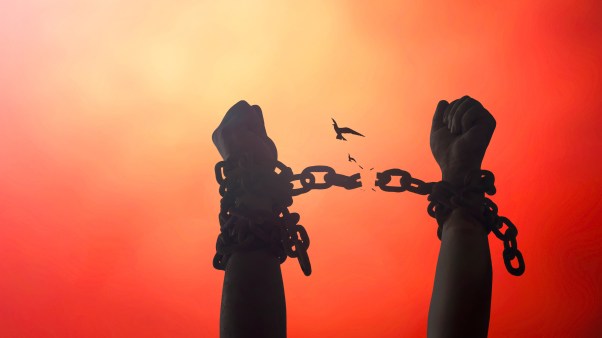
49.6 million. According to the Global Slavery Index that's the latest estimate for the number of slaves in the world today. It could be just another number in a blur of facts that fly by our faces in a day, but this nearly 50 million number has a face. It includes women and men, boys and girls who are held in bondage as sex slaves, domestic servants, and child soldiers.
Of course, that is only an estimate since slavery thrives in darkness. But another news item gives this statistic an even more horrifying angle. A British paper shared a story about “Daniel” (not his real name) who was brought into the U.K. for what he had been told was a "life-changing opportunity.” He thought he was going to get a better job. Instead, it was then that he realized there was no job opportunity and he had been brought to the UK to give a kidney to a stranger.
"He was going to literally be cut up like a piece of meat, take what they wanted out of him and then stitch him back up," according to Cristina Huddleston, from the anti-modern slavery group Justice and Care.
Luckily for Daniel, the doctors had become suspicious that he didn't know what was going on and feared he was being coerced. So, they halted the process.
Daniel was not free of his traffickers though. Back in the flat where he was staying, two men came to examine him. It was then he overheard a conversation about sending him back to Nigeria to remove his kidney there.
He fled, and after two nights sleeping rough, he walked into a police station near Heathrow, triggering an investigation that would lead to the UK's first prosecution for human trafficking for organ removal.
Despite international and domestic efforts, about 10 percent of all transplants worldwide are believed to be illegal—approximately 12,000 organs per year. For example, according to the World Health Organization as many as 7,000 kidneys are illegally obtained by traffickers each year around the world. While there is a black market for organs such as hearts, lungs, and livers, kidneys are the most sought-after organs … The process involves a number of people including the recruiter who identifies the victim, the person who arranges their transport, the medical professionals who perform the operation, and the salesman who trades the organ.
Source: Editor, “Organ Trafficking and Migration,” Ncbi.Nlm.Nih.Gov (5/5/2020); Editor, “Global Slavery Index,” WalkFree.org (Accessed 9/2024); Mark Lobel, et al., “Organ Harvesting,” BBC (6-26-23)
In his book Forgive, Tim Keller tells the story of a friend of his who was a PhD student at Yale. Keller’s friend once told him that modern people think about slavery and say, “How could people have ever accepted such a monstrosity?” Keller continues:
My friend said, “That’s not the way historians think. They ask: considering the fact it was universally believed by all societies that we had the right to attack an enslaved, weaker people, and since everybody had always done it, the real historical question is, why did it occur to anybody that it was wrong? Whoever first had that idea?”
My friend then answered his own question, pointing out that the first voices in the fourth, 17th, 18th, and 19th centuries who called for the abolition of slavery were all Christians. And the Christian, who called for this justice, believed there was a God of love, who demanded that we love our neighbors—all our neighbors—as ourselves.
Source: Tim Keller, Forgive (Viking, 2022), page 77
Abraham Lincoln biographer Jon Meacham notes, “There was no evident political gain to be had for Lincoln [to be anti-slavery]; quite the opposite. So why did he … state so clearly that slavery was unjust?”
Someone close to Lincoln pointed to the following story:
One morning in … the city [Lincoln] passed a slave auction. A vigorous and comely [young woman] was being sold. She underwent a thorough examination at the hands of the bidders; they pinched her flesh and made her trot up and down the room like a horse, to show how she moved, and in order, as the auctioneer said, that “bidders might satisfy themselves” whether the article they were offering to buy was sound or not.
The whole thing was so revolting that Lincoln moved away from the scene with a deep feeling of “unconquerable hate.” Bidding his companions follow him he said, “By God, boys, let's get away from this.”
Meacham concludes, “That experience formed one element of Lincoln's reaction, if not the main one. ‘The slavery question offered bothered me as far back as 1836 to 1840’, Lincoln said in 1858. ‘I was troubled and grieved over it.’”
In the same way, are we today troubled and grieved by the injustice of the world?
Source: Jon Meacham, And There Was Light (Random House, 2022), p. 61
In an interview about his book (2020), apologist Timothy Paul Jones was asked:
In your final chapter, you talk about how one barrier to the faith is the way Christians, both throughout history and today, have used the Bible in ways that are abusive to the Bible. So many today find it difficult to trust a book that was used to justify the Crusades or used to justify chattel slavery. How would you answer the individual who’s struggling with that objection?
Jones replied:
Well my answer is the Beatles’ White Album. As we all know, the Beatles’ White Album, especially the song “Helter Skelter” was used by Charles Manson as an excuse for the Manson murders. He felt like the White Album was calling him to commit all of these murders, and yet nobody has ever indicted Paul McCartney for those murders. And the reason that they haven’t is because of the fact that the misuse of the White Album doesn’t reflect on its creator. Just because the White Album was misused doesn’t mean the creator of it was at fault. And I think we have to help people recognize that: The Bible is used [to justify terrible things]. But was it rightly used for these things?
Source: Jared Kennedy (Ed.), “Author Interview: Timothy Paul Jones explains why the Bible is still trustworthy,” Southern Equip (2-13-20)
The life of St. Patrick connects to issues we struggle with today.
An article in Christianity Today traces how early African American Christianity proved the power of the Resurrection against oppression.
In their book The Genesis of Liberation, scholars Emerson Powery and Rodney Sadler Jr. explore what they call the "miracle" of how many African American slaves came to faith in Christ. For most of them, Jesus was the "White Man's Savior." They used Jesus and the Bible to pacify slaves and justify their enslavement.
Miraculously, many African Americans, though not all, became Christians and attributed authority to the Bible. The question that remains is why. Why did enslaved Africans embrace the religion of their captors, who used the Bible to justify the brutal trans-Atlantic slave trade?
Here is their simple answer: "They fell in love with the God of Scripture … In Christ they found salvation from their sins and reconciliation." They write that in the Bible they found not just an otherworldly God offering spiritual blessings, but a here-and-now God who cared principally for the oppressed, acting to deliver the downtrodden from their abusers. They also found Jesus, a suffering Savior whose life and struggles paralleled their own struggles.
As they came in contact with this God, they found a different reality in him: the reality of Resurrection power. It was the reality of Jesus' death and resurrection that created a community of faith and … provided slaves with a theology of "resistance." The Resurrection had proved its power; there are Christians—even among African Americans.
Source: Dante Stewart, "Why the Enslaved Adopted the Religion of Their Masters—and Transformed It," Christianity Today (2-12-18)
In his 77 years, Frederick Douglass, America's most famous abolitionist, delivered thousands of speeches, wrote three autobiographies, started newspapers, met with President Abraham Lincoln, and championed the cause of African American civil rights. But most people downplay a crucial part of his life: his radical Christian faith.
The crucible of Douglass' prophetic Christian faith was his childhood suffering as a slave. Before his escape at age 20, Douglass witnessed and endured great cruelty, especially at the hands of Christian masters. He saw first-hand brutal whippings, cold-blooded murder, and the daily trials of physical and psychological abuse. He watched a slave master beat his aunt, a 15-year-old girl of striking beauty, nearly to death.
In 1826, Douglass was sent to Baltimore to live with Hugh and Sophia Auld. When he heard Sophia, a devout Christian, read from the Book of Job, Douglass decided he had to know more about this man Job—how he could say, despite his suffering, "blessed be the name of the Lord." He secretly taught himself to read. As a teenager, he formally converted to Christianity, shepherded by free black Methodists. Assurance of salvation came slowly, but once he cast all his cares upon God, Douglass wrote, he found faith in Christ as "Redeemer, Friend, and Savior."
In March 1833, Hugh Auld unexpectedly sent Douglass back to the Eastern Shore. For the next three years, Douglass worked as a field hand before escaping and settling in New Bedford, Massachusetts. By 1841 he was involved in the abolition movement. His task was to convince Americans to see the antislavery cause as a great moral necessity. To that end, he repeated a chastening refrain: "Between the Christianity of this land, and the Christianity of Christ, I recognize the widest possible difference."
For Douglass, the problem was not Jesus or Christianity; it was the hypocrisy of Christians. He condemned what he called the "corrupt, slaveholding, women-whipping, cradle-plundering, partial, and hypocritical Christianity" everywhere present in America. He blasted "the man who wields the blood-clotted cowskin during the week, fills the pulpit on Sunday, and claims to be a minister of the meek and lowly Jesus." He derided the slaveholder who "covers his infernal business with the garb of Christianity."
Like the Pharisees condemned by Jesus (in Matthew 23 and other places), slaveholders and their apologists "attend with Pharisaical strictness to the outward forms of religion, and at the same time neglect the weightier matters of the law, judgment, mercy, and faith." They had utterly abandoned the true Christianity of Christ and invited the wrath of a just and avenging God.
Source: D.H. Dilbeck, "The Radical Faith of Frederick Douglass," Christianity Today (January/February 2018)
In his book A Selfish Plan to Change the World Justin Dillon relates the courage of a missionary couple who stood up against corruption:
In the late 1800s, Leopold II, the King of Belgium, started colonizing the Congo, a land rich with natural resources, such as rubber. At the same time, the demand for bicycle and car rubber was starting to spike. Within a few years' time, Leopold was enslaving millions of men, women, and children through brutal armed force to do the labor-intensive work of harvesting the rubber.
The pressure to fulfill the impossible rubber quotas fell on a brutal police force—the Force Publique. To prove that the bullets Leopold provided were being used to kill unproductive slave workers, Leopold required a severed hand or foot for every victim. So the soldiers stockpiled baskets of hands and feet to account for the bullets.
It was a barbaric situation, but no one dared to rebel, except a mild-mannered British missionary couple named John and Alice. Both felt a divine calling to this place to bring the love of Christ. But they also could not ignore the violence against people they loved. So Alice had a brilliant idea—she grabbed her Kodak Brownie camera and started taking pictures, documenting the atrocities. She captured images of right hands cut off by Force Publique sentries. She documented mass graves. She filmed tribesmen shackled together.
This young woman with no professional photography skills started collecting images in order to topple an evil king she had never met. Alice and John had no plan, strategy, certainty, or guarantee of success. In fact, her actions increased her chances of dying in the Congo. But news about the atrocities started to reach Europe.
Churches. Town halls. University lecture halls. Parlors. Halls of government. There wasn't a room that Alice wasn't willing to bring her magic lantern show to. The people who came to witness her images and stories were moved by this fearless woman. Her story spread quickly, making its way into the writings of Mark Twain. Political and social pressure started to build against the mad king's maniacal exploits. King Leopold II would ultimately be responsible for the deaths of close to ten million people, but his stranglehold on the people of Congo came to an end. And it all started with an unknown missionary and her cheap camera and a lot of courage.
Source: Adapted from, Justin Dillon, A Selfish Plan to Change the World (Thomas Nelson, 2017), pages 166-170
The first missionary from North America was George Liele, a former slave who left the American colonies for Jamaica in 1782 and began a ministry of preaching in 1783, nearly a full decade before William Carey sailed for India from England. Liele was born a slave (circa 1750) in the colony of Virginia. He launched his preaching career in 1773, and a year later he gathered slaves for what could be considered the first African-American church in America. After the Revolutionary War, the recently freed Liele fled to Jamaica to escape being re-enslaved.
George Liele arrived in Jamaica as an indentured servant, but would serve as a missionary-evangelist to the island. Liele became the first Christian to win a significant number of slaves on the Island to Christ, and the first to plant a church composed of slaves. He preached in private homes and public settings drawing crowds of slaves. In a letter written in 1791, Liele reported 500 converts and 400 baptisms. In 1789 Liele's congregation had organized and by 1793 they had completed the Windward Road Chapel, the first Baptist church on the island.
Liele achieved these successful evangelistic and church planting efforts despite opposition from a powerful constituency on the island. White slave owners feared the impact upon the slave population if the slaves were to embrace Christianity. Concern arose that "if their minds are considerably enlightened by religion, or otherwise, that it would be attended with the most dangerous consequences."
Despite Liele's numerous efforts to appease the slave owners, he still faced stiff opposition. He was charged with sedition and jailed on numerous occasions on trumped-up charges. Despite these obstacles, Liele was able to baptize new converts as well as plant and organize new churches. His evangelistic and church-planting efforts led to the establishment of the Baptist denomination on the island, with slaves, freedmen, and whites joining churches started by Liele. The impact of Liele's ministry continues to this day; however, Liele himself is buried in an unmarked grave in Jamaica.
Source: Adapted from Soong-Chan Rah, Prophetic Lament (IVP Books, 2016), pages 101-103
In a powerful scene during the film Lincoln, starring Daniel Day Lewis, the bloody Civil War has tested the nation's endurance, but the tide is finally turning. Although the secession of the Southern States may have started the war, President Lincoln now sees that it will not truly be over unless slavery is abolished. Since a constitutional amendment would require a 2/3-majority vote, getting it passed will mean nothing short of all-out war in Congress. There's a core of support, but many in Lincoln's own party are lukewarm ... and they still need to win votes from some Democrats. The rhetoric is strong on all sides, with many saying things like, "Congress must never declare equal those whom God has made unequal!" Having failed a year earlier to abolish slavery, many think it's foolish to invest more political capital in trying again.
While his own inner circle quibbles about the merits of curing slavery and whines about the impossibility of getting enough votes, President Lincoln slams his fist on the table and says:
I can't listen to this anymore. I can't accomplish a [darn] thing of any human meaning or worth until we cure ourselves of slavery and end this pestilential war. And whether any of you or anyone else knows it, I know I need this. This amendment is that cure. We're stepped out upon the world stage now. Now, with the fate of human dignity in our hands. Blood's been spilt to afford us this moment. Now! Now! Now! And you grouse and heckle and dodge about like pettifogging Tammany Hall hucksters. See what is before you! See the here and now, that's the hardest thing, the only thing that counts. These votes must be procured.
Editor's Note: The actual scene uses the Lord's name in vain (instead of using the word 'darn").
Source: Adapted from Leslie Sisman, "Popcorn Preview: Lincoln," HuffPost Entertainment (1-16-13); source; Steven Speilberg. Lincoln. DVD. Dreamworks: Los Angeles, CA, 2012
Harriet Tubman was born into slavery on a Maryland plantation in 1822. As she grew up, she was made to work driving oxen, trapping muskrats in the woods, and as a nursemaid. Harriet's owners frequently whipped her. And she endured the pain of seeing three of her sisters sold, never to be seen again. But when her owner tried to sell one of her brothers, Harriet's mother openly rebelled. The would-be buyer gave up after Harriet's mother told him, "The first man that comes into my house, I will split his head open."
Her mother's actions likely implanted in Harriet the idea that resistance to evil was right—and could sometimes be successful. As a child, Harriet herself … would run away for days at a time. But there were rays of joy in her life, as well. Harriet's mother told her stories from the Bible, which developed in her a deep and abiding faith in God.
When Harriet was about 26 years old, she learned that she might be sold away from her family. The time had come to try to escape. She made her way some ninety miles along the Underground Railroad. She traveled at night to avoid slave catchers, following the North Star, until she reached Pennsylvania, and freedom. Once there, she dared to make a dangerous decision: She risked her own freedom in order to give others theirs.
For eight years, she led scores of slaves north to freedom. During these trips she relied upon God to guide and protect her. She never once lost a runaway slave. As Harriet herself later put it, "I never ran my train off the track and I never lost a passenger."
She gave all the credit to God, explaining, "'Twant me, 'twas the Lord. I always told him, 'I trusts to you. I don't know where to go or what to do, but I expect you to lead me,' and he always did." Her faith deeply impressed others. As abolitionist Thomas Garrett put it, "I never met with any person of any color who had more confidence in the voice of God, as spoken direct to her soul."
Source: Adapted from Eric Metaxas, "Harriet Tubman, on the Money," Breakpoint (5-6-16)
Pastor Kevin DeYoung responds to the assertion that Christians can no longer hold to traditional views of homosexuality. The argument usually goes like this: "You Christians are on the wrong side of history with regard to homosexuality. Look at slavery, for instance." DeYoung writes:
While it's true that Christians in the South often defended chattel slavery, this was not the position of the entire American church, and certainly not the universal position of the church throughout history. Unlike slavery, the church has always been convinced (until very recently) that homosexual behavior is sinful. There are no biblical passages that suggest the contrary. There are, however, passages in Scripture that encourage the freeing of slaves (Philem. 15—16) and condemn capturing another human being and selling him into slavery (Ex. 21:16; 1 Tim. 1:8—10).
Furthermore, it's not as if Christians never spoke against the institution until the nineteenth century.
As early as the seventh century, Saith Bathilde (wife of King Clovis III) campaigned to stop slave-trading and free all slaves. In the ninth century Saint Anskar worked to halt the Viking slave trade. In the thirteenth century, Thomas Aquinas argued that slavery was a sin, a position upheld by a series of popes after him. In the fifteenth century, after the Spanish colonized the Canary Islands and began to enslave the native population, Pope Eugene IV gave everyone 15 days "to restore to their earlier liberty all and each person of either sex who were once residents of said Canary Islands … these people are to be totally and perpetually free and are to be let go without exaction or reception of any money." Slavery was condemned in papal bulls in 1462, 1537, 1639, 1741, 1815, and 1839. In America, the first abolitionist tract was published in 1700 by Samuel Sewall, a devout Puritan.
Clearly, the church's opposition to slavery is not a recent phenomenon. We do not find anything like this long track record when it comes to the church supporting homosexual practice.
Source: Adapted from Kevin DeYoung, What Does the Bible Really Teach About Homosexuality? (Crossway, 2015), pp. 107-108
There's a story that has been told from Civil War days before America's slaves were freed, about a northerner who went to a slave auction and purchased a young slave girl. As they walked away from the auction, the man turned to the girl and told her, "You're free."
With amazement she responded, "You mean, I'm free to do whatever I want?"
"Yes," he said.
"And to say whatever I want to say?"
"Yes, anything."
"And to be whatever I want to be?"
"Yep."
"And even go wherever I want to go?"
"Yes," he answered with a smile. "You're free to go wherever you'd like."
She looked at him intently and replied, "Then I will go with you."
The African nation of Mauritania was the last nation in the world to outlaw slavery—in 1981—and it wasn't until 2007 that a law was passed allowing for the prosecution of slave owners. The situation of slavery in the country is the worst in the world, and in rural areas entire communities of slaves still exist as the authorities turn a blind eye.
The New Yorker's Alexis Okeowo reports on the situation: "No one in their community who looks like them has ever known another way of life. One former child slave told me, 'In the village, when a slave says he does not want to be a slave anymore, people will ask, Why? Who are you? Your mother was a slave; your grandmother was a slave. Who are you?' … 'To the slave, his identity is his master,' [local abolitionist and member of the country's slave caste Biram Dah] Abeid said. 'The master is his idol, one he can never become, and he is invincible.'"
What a description of the enslaving power of sin. Our whole identity can become consumed, leaving us unable to imagine a life of freedom.
Source: Alexis Okeowo, “Freedom Fighter,” The New Yorker (9-1-14)
In their Pulitzer Prize-winning book, Half the Sky, Nicholas Kristof and his wife Sheryl WuDunn report on [the] worldwide slavery [in sex trafficking], telling stories of girls who had been kidnapped or taken from their families on a ruse and then sold as sex slaves. These girls, many under ten years of age, are drugged, beaten, raped, and forced to sell their bodies night after night. It is a slavery even more horrifying than the slavery colonial America practiced, and the numbers are beyond imagination.
Kristof reports that it is far more effective to crack down on the perpetrators than to try to rescue the victims. That is because rescuing the girls from external slavery is the "easy part," but rescuing them from the beast within, such as the drug addictions that cause them to return or the shame they feel, is enormously challenging. They keep returning to their abusers.
Kristof tells of rescuing Momm, a Cambodian teen who had been enslaved for five years. Momm was on the edge of a breakdown—sobbing one moment, laughing hysterically the next. She seized the chance to escape, promising she'd never return. When Kristof drove Momm back to her village, Momm saw her aunt, screamed, and leapt out of the moving car.
A moment later, it seemed as if everybody in the village was shrieking and running up to Momm. Momm's mother was at her stall in the market a mile away when a child ran up to tell her that Momm had returned. Her mother started sprinting back to the village, tears streaming down her cheeks …. It was ninety minutes before the shouting died away and the eyes dried, and then there was an impromptu feast.
Truly it was a great rescue—and there was singing and dancing and celebrating, reminiscent of the singing and dancing of Miriam and the Israelite women when they were rescued out of their slavery in Egypt.
But as with the Israelites, the celebration didn't last long. Early one morning Momm left her father and her mother without a word and returned to her pimp in Poipet. Like many girls in sex slavery, she had been given methamphetamine to keep her compliant. The craving had overwhelmed her. No doubt she thought, I just have to have this or I can't go on. Perhaps she imagined she'd be able to escape after she got it, but even if she didn't, she thought, I have to have this.
Possible Preaching Angles: (1) Struggle against Sin—Use this story to illustrate our personal struggle with sin and how to work out the freedom we have in Christ. (2) Social Justice and Evangelism—This story also provides a powerful way to illustrate the need to work for justice and preach the Gospel. People need justice and compassion, but they also need to hear the good news that sets them free on the inside.
Source: Dee Brestin, Idol Lies (Worthy, 2012), pp. 88-89
[Slavery in the Greco Roman cultures of the New Testament] is more like indentured servanthood. It's not what we think of as slavery. When you and I see the word "slave" in the Bible, you immediately think of 17th, 18th, and 19th century New World slavery: race-based, African slavery. When you do that, when you read it through those blinders, you aren't understanding what the Bible's teaching.
Historian Murray Harris … wrote a book about what slavery was like in the 1st century Greco-Roman world. He says that in Greco-Roman times, number one, slaves were not distinguishable from anyone else by race, speech, or clothing. They looked and lived like everyone else and were never segregated off from the rest of society in any way. Number two, slaves were more educated than their owners in many cases and many times held high managerial positions. Number three, from a financial standpoint, slaves made the same wages as free laborers and therefore were not themselves usually poor and often accrued enough personal capital to buy themselves out. Number four, very few persons were slaves for life in the first century. Most expected to be manumitted after about ten years or by their late thirties at the latest.
In contrast, New World slavery—17th, 18th, 19th century slavery—was race-based, and its default mode was slavery for life. Also, the African slave trade was [started] and resourced through kidnapping, which the Bible unconditionally condemns in 1 Timothy 1:9-11 and Deuteronomy 24:7. Therefore, while the early Christians, like Saint Paul … discouraged [1st century slavery] … saying to slaves, "get free if you can," [they] didn't go on a campaign to end it. [But] 18th and 19th century Christians, when faced with New World-style slavery, did work for its complete abolition, because it could not be squared in any way with biblical teaching.
So the point is that when you hear somebody say, "The Bible condones slavery," you say, "No it didn't—not the way you and I define 'slavery.' It's not talking about that."
Source: Timothy Keller, in the sermon Literalism: Isn't the Bible Historically Unreliable and Regressive?, Redeemer Presbyterian Church, New York, New York (preached 11-5-06); source: Murray Harris, Slave of Christ (IVP, 2001)
Glory dramatizes the true story of the first black regiment to fight for the North during the Civil War. The 54th Regiment from Massachusetts was a rag-tag company of inexperienced soldiers who volunteered to fight the oppression of their African-American kin.
The soldiers were not valued by their white colleagues, and initially were not issued guns or uniforms. They were assigned only to non-combat posts. When Colonel Robert Shaw (Matthew Broderick) took command of the men, he worked to get them equal status. Eventually, the men were outfitted with weapons and Union uniforms and allowed to fight.
This scene begins as the volunteers endure basic training at Readville Camp. Shaw receives an important letter from Washington D.C. Even though it is late at night he asks that the men be gathered immediately. The half-trained volunteers are assembled in the midst of a heavy rain. As they stand soaking wet in the mud, Shaw reads the letter.
"In accordance with President Lincoln's wishes, you men are advised that the Confederate Congress has issued a proclamation."
As he gazes out into a sea of brown faces, the Colonel continues, "Any Negro taken at arms against the Confederacy will immediately be returned to the state of slavery. Any Negro taken in Federal uniform will be summarily put to death."
He once again looks up at his men, many of whom are freed or runaway slaves and cherish their freedom.
Shaw continues reading. "Any white officer taken in command of Negro troops shall be deemed as inciting servile insurrection and shall likewise be put to death."
Assuming many (if not most) will not want to continue serving, Shaw looks up from the letter and says, "Full discharge will be granted in the morning to all those who apply."
After dismissing the men, he turns to Major Forbes, who is white, and says, "If you're not here in the morning, I understand."
Trip (Denzel Washington), a runaway slave with a chip on his shoulder, turns to a soldier who's been wondering when the uniforms will arrive and says, "Still want that blue suit, nigger?"
Through the stormy night a solitary black volunteer walks slowly back and forth in the drenching rain keeping sentry. Meanwhile, Major Forbes can be seen on his bunk staring into space. Colonel Shaw is seen pondering what the morning will bring, while smoking a cigar.
At daybreak, Shaw emerges from his quarters buttoning his uniform jacket as the trumpeter blows reveille and the flag is raised.
Major Forbes announces, "Sir, formed and ready, sir."
Expecting a depleted regiment, Shaw quietly asks, "How many are left?"
Forbes looks straight ahead and does not face his commander. Shaw continues to walk forward and turns to see the entire company standing at attention. No one has left.
He gazes into their faces and in amazement blurts out, "Glory, Hallelujah!"
Elapsed Time: 00:24:45 to 00:29:00
Content: Rated R for graphic violence and some profanity
Source: Glory (Tri-Star Pictures, 1989); written by Kevin Jarre, directed by Edward Zwick