

Sorry, something went wrong. Please try again.
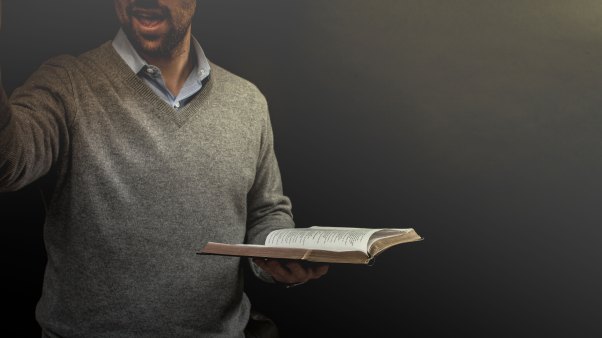
Our sermons ought to reflect a more accurate, hope-filled, Christianly communication.
According to Alyssa Mercante at video game site Kotaku, many gamers today lament what they perceive to be woke culture running amok. According to them, the multiethnic casting of central characters must be a result of diversity consultants forcing racial quotas on otherwise uninterested creators. If not for these overly aggressive interlopers, goes the thinking, the characters would hew more closely to their established norm (which just happens to be mostly male and/or white).
This is especially the case with Sweet Baby, Inc., a creative firm that works with game studios like Remedy Entertainment, publisher of titles like Control, Quantum Break, and Alan Wake 2. Mercante says that there’s a group on Steam, the main PC-gaming marketplace, with 100,000 members, dedicated to detecting which games that Sweet Baby has consulted on. Many such gamers think that Sweet Baby’s influence led to Remedy casting a black actress in one of protagonist roles.
“It’s absolutely not true,” said Kyle Rowley, Remedy game director for Alan Wake 2, when asked on X whether Sweet Baby mandated the casting. And when Mercante spoke to people at both Remedy and Sweet Baby, she found the opposite to be true.
Kim Belair, CEO of Sweet Baby, Inc., said, “Sweet Baby is, at its core, a narrative development company. That means anything from script writing to narrative design to narrative direction, to story reviews. One of the things that we do offer is cultural consultations or authenticity consultations … but the perspective is never that we’re coming in and injecting diversity. For the most part, it’s the reverse. It’s that a company has created a character, and they want to make that character more representative and more interesting.”
Sweet Baby co-founder David Bedard insists that the diversity of representation in video games is a byproduct of developers wanting to make the game better for all players. Blair said, “We are not censors. We have no interest in false diversity or in tokenization. We have an interest in making stories better, and making characters more interesting, and in developing a stronger language around narrative design…Those are the things that we are really passionate about.”
You don’t have to be politically liberal or woke or whatever to consider the needs of others as more important than your own. That’s the kind of life that Jesus modeled and that the Apostle Paul wrote about.

Source: Alyssa Mercante, “Sweet Baby Inc. Doesn’t Do What Some Gamers Think It Does,” Kotaku.com (3-6-24)
This Christmas let’s tell and trust the greatest story that never gets old.
Laying bare your story and soul before congregations for the sake of bearing witness to the One who holds your story and breathes life into your soul.
Do we always have to find a new spin on the Christmas story?
As a Christian I love Christmas; but as a preacher I dread it.
In your eagerness for the New Kingdom of God, do not rush past the Cross. Look where Jesus looks.
Business consultant Morgan Housel claims that the best arguments seldom win the day; it’s the best story that changes minds and hearts. Housel writes:
A truth that applies to many fields, which can frustrate some as much as it energizes others, is that the person who tells the most compelling story wins. Not who has the best idea, or the right answer ...
[For example], the Civil War is probably the most well-documented period in American history. There are thousands of books analyzing every conceivable angle, chronicling every possible detail. But in 1990 Ken Burns’ Civil War documentary became an instant phenomenon, with 39 million viewers and winning 40 major film awards. As many Americans watched Ken Burns’ Civil War in 1990 as watched the Super Bowl that year. And all he did – not to minimize it, because it’s such a feat – is take 130-year-old existing information and wove it into a (very) good story.
It's the same for writer Bill Bryson. His books fly off the shelves, which I understand drives the little-known academics who uncovered the things he writes about crazy. His latest work is basically an anatomy textbook. It has no new information, no discoveries. But it’s so well written – he tells such a good story – that it became an instant bestseller.
This drives you crazy if you assume the world is swayed by facts and objectivity – if you assume the best idea wins … The novelist Richard Powers summarized it this way: “The best arguments in the world won’t change a single person’s mind. The only thing that can do that is a good story.”
Source: Morgan Housel, “Best Story Wins,” Collaborative Fund (2-11-21)
Hollywood stuntman Robert Wilton shares his journey through doubt and fear to faith in Christ.
Beginning in my 20s, I worked for decades as a film and television stuntman, facing injury and even death for a living. On the set, I rubbed elbows with celebrities and movie stars. I was living my dream. At age 26, however, I received a gut punch when my 32-year-old brother suddenly collapsed dead from a heart attack. In rare moments of quiet, usually after a considerable intake of alcohol, I would ponder the senselessness of his death.
While doing film work one day, I overheard someone talking about God with one of the stunt guys. To my utter surprise, it was none other than the movie stunt coordinator himself. Eavesdropping on that conversation conjured up some old memories and questions. Did I still believe in God, or had I outgrown the childishness of Sunday school stories?
For one film gig up the coast, I caught a ride with the stunt coordinator—a man I dubbed “the Preachernator.” When conversation inevitably turned to religion, I told him I was doing fine without God. I began regaling him with stories of my close calls and narrow escapes on set. There was the time, for instance, when I was tapped for a fire stunt. The idea was to paint myself with a flammable substance, land on the roof of a car, whose driver would set me on fire, and peel out toward a wooden wall. But nothing went according to design. First, my rope line snagged. Then the fire wouldn’t light and I gave up and signaled for the driver to floor it. When he stomped on his brakes, I went flying through a wooden wall, only not on fire as planned.
As I picked myself up my heart leapt into my throat. I realized I had completely forgotten to apply the protective stunt gel to my head and face. Had I actually been set ablaze, I almost certainly would have sustained serious, possibly fatal, injuries.
The Preachernator listened to my story and said, “Sounds like God was still looking after you.” His words cracked my pride; Could God have been looking out for me, even when I was so far astray? I found myself thinking about God on a daily basis. Could he really love me again after I had turned my back on him?
Everything came to a head one night. I had been hired to jump off of a 60-foot-high catwalk, grab a chain with one hand and slide down to the cement floor below while firing a pistol. Fear began to overwhelm me, and I couldn’t shake the thought of possible catastrophe. I wondered if the moment to give my life to Jesus had finally arrived.
An internal debate raged within. One side of me said, “You’re only doing this because you might die, you hypocrite! Do it after you finish the stunt.” But another side said, “No, the whole point in giving my life to Jesus is in case I die. It’s smarter to do it right now.” So that’s what I did.
The following weeks confirmed (that) God had indeed heard my prayer. Before long, I worked up the confidence to evangelize my fellow crew members. God granted me dramatic change in some areas, but in others he gave the gift of struggle. In fact, I have experienced some of the greatest grief life has to offer. Once, a crew member asked me why his friend’s child had died. Where was God in this tragedy? I tried explaining God’s heart to him. The crew member said that much of what I shared made sense. But he also wondered whether my faith would survive the death of one of my own children. So did I.
I think of this conversation from time to time, because the question has been answered. I have lost children since that day. I watched my wife as she rocked our 19-day-old son while he died in her arms. Three years later, my wife watched me cradle our newborn daughter as she met the same fate.
God never promises us a life without pain and suffering. However, he more than sustains us through challenges. From the tremendous joy of a beautiful, 20-year-old daughter to the depths of deep sorrow, my life attests to the truth that absolutely nothing can separate me from God’s love (Rom. 8:39).
Source: Robert Wilton, “Meeting the Lord in the Air,” CT Magazine Testimony (January/February, 2021), pp. 103-104
Learning the dos and don’ts of narrative preaching.
Katherine Beim-Esche tells a moving story of meeting the living God after escaping the cult of Christian Science:
After the terrorist attacks of September 11, 2001, the world reeled in shock and disbelief. I did too—not only at the events themselves but also at the response I saw within my church. Raised a fourth-generation Christian Scientist, I lived within a Christian Science cocoon. In many ways, I acted like a Christian, reading my Bible every day, praying the Lord’s Prayer, and attending church twice a week.
Then everything exploded. Literally. The day after 9/11, hoping for comfort, I sought out the Wednesday night meeting at my Christian Science church. But what I heard left me feeling profoundly uneasy. Some congregants boldly declared that a tragedy like this never could have occurred in God’s perfect world. Others … subtly implied that the victims were to blame. How, I wondered, could they be so cavalier about the suffering we had witnessed? Little did I know that this terrible day would launch me on a journey to saving faith in Jesus Christ.
Not to be confused with Scientology, Christian Science was founded by Mary Baker Eddy in the late 1800s. Its core teaching is influenced by gnostic, pantheistic, and metaphysical beliefs that portray sin, sickness, and death as illusions.
After 9/11, I could no longer deny the reality of evil. (Then) … by God’s providence, I overheard a coffee-shop conversation on faith. Something in my heart stirred. One of the men in that discussion invited me to his church and gave me a copy of Francis Schaeffer’s book The God Who Is There. Schaeffer said that the spiritual and physical world originated with a Creator God. I didn’t totally understand this, but it filled me with deep hope and a desire to learn more.
I visited Grace and Peace Fellowship, where I came face to face with the living God. In my Christian Science church, sin was never mentioned, but here it was freely confessed. I wept as I heard, for the first time, of God’s deep, sacrificial love for me. I was convicted of my sin and selfishness.
When I met with pastor Aaron Turner and he told me I was a sinner, I actually thanked him. After a lifetime of denying and repressing my very humanity, I was relieved to finally admit my brokenness. Then I met Jesus. Pastor Aaron introduced me to the Jesus of Scripture, who came to earth, took on flesh, and died and rose again to redeem his people and restore all creation. Praise God for untangling my heart and mind from the delusion of self-salvation—and for rescuing me into new life with Christ and his church.
Source: Katherine Beim-Esche, “Escaping the Cocoon of Christian Science,” CT Magazine Testimony (April, 2021), pp. 71-72
Joshua Haldeman grew up on the prairies of Saskatchewan. When the domino effect of the Great Depression hit Canada, Haldeman lost his five-thousand-acre farm and had to start from scratch. He tried his hand at chiropractic medicine and politics. Then Haldeman discovered his passion—flying airplanes.
In 1950, Haldeman uprooted his family and moved halfway around the world to South Africa, a place he had never even been to before! With the help of his wife, Winnifred, and their children, he disassembled his 1948 single-engine airplane. The airplane was packed into crates, shipped to South Africa, and reassembled by the family once it got there.
A few years later, Joshua and Winnifred Haldeman embarked on a thirty-thousand-mile round-trip flight from Africa to Australia and back. They are believed to be the only private pilots to have ever made that flight in a single-engine airplane. As a comparison point, Charles Lindbergh's legendary transatlantic flight in 1927 was only 3,600 miles. Twenty-seven years later, the Haldemans flew more than eight times as far!
Few people have heard of Joshua and Winnifred Haldeman, but I bet you've heard of their grandson Elon Musk. Musk's entrepreneurial exploits are well documented. He has turned the automotive and aerospace industries upside down. At SpaceX headquarters, there are two giant posters of Mars. One shows a cold, barren planet. The other looks a lot like Earth. The second poster represents Musk's life purpose—colonizing Mars.
How does someone even conceptualize colonizing a planet, in the non-science-fiction sense? Dreams are not conceived in a vacuum. One of Musk's biographers noted, "Throughout his childhood. Elon heard many stories about his grandfather's exploits and sat through countless slide shows that documented his travels.” Those stories were the seedbed of Musk's imagination. Those stories were the shoulders he stood on.
Source: Excerpted from Win the Day: 7 Daily Habits to Help You Stress Less & Accomplish More Copyright © 2020 by Mark Batterson, pages 24-25. Used by permission of Multnomah, an imprint of Penguin Random House LLC.