Sorry, something went wrong. Please try again.
In May 2020, two months after the world shut down due to the COVID-19 pandemic, Tim Keller was diagnosed with a particularly invasive and lethal form of cancer. The following year, in an essay for The Atlantic titled “Growing My Faith in the Face of Death,” he gave powerful voice to his sadness—and his unshakable hope.
Keller wrote, “[My wife] Kathy and I cried a lot together last night. Sometimes the reality of the shortness of what we have left just overwhelms us.” But then nstead of trying to “make a heaven out of this earth”—whether through things like vacations (in Kathy’s case) or ministry productivity (in Tim’s)—they were coming to apprehend a surprising truth: When you stop trying to manufacture heaven, it actually enhances earthly joys:
The joys of the earth are more poignant than they used to be… There’s a whole lot of things [Kathy and I] never really enjoyed that much. But the more we make heaven into the real heaven, the more this world becomes something we are actually enjoying for its own sake—instead of trying to make it give us more than it really can. So oddly enough . . . we’ve never been happier. We’ve never enjoyed our days more. We’ve never enjoyed hugs more. We’ve never enjoyed food more. We’ve never enjoyed walks more. We’ve never enjoyed the actual things we see, touch, taste, hear, and smell more. Why? What’s the matter with us? And the answer is, we got our hearts off those things and so, weirdly enough, we enjoy them more.
Source: Matt Smethurst, “The Most Powerful Message Tim Keller Ever Preached,” Crossway blog (5-19-25)
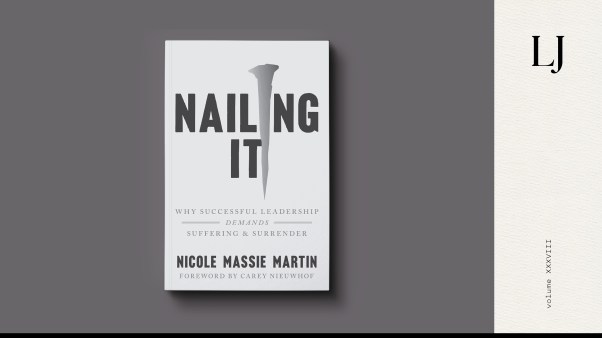
In Nailing It, Nicole Massie Martin offers personal, poetic reflections that invite pastors to embrace their wounds—and the God who heals through them.
Researcher Arthur C. Books told the following story about how we all can benefit from self-control and waiting.
My father-in-law, with whom I was very close, spent most of his life on the same working-class street in Barcelona’s El Clot neighborhood. Born in 1929, he saw Spain’s bloody civil war taking place literally in front of his house. His family experienced a lot of suffering. Some died; others spent years in jail or were forced into exile. He himself spent a year in a refugee camp, an experience that affected him for the rest of his life. Every time he wanted to make a point about society or culture, he always started with: “Well, during the civil war …”
One evening, a few months before he died, he read in his local paper an article of mine about unhappiness. “You have a lot of complicated theories,” he told me, “But the real reason people are unhappy is very simple.” I asked him to elaborate. “They don’t enjoy their dinner,” he responded. I asked him what he meant. “Well, during the civil war, we were always hungry,” he said. “But one day a year—Christmas—we got to eat whatever we wanted, and we were so happy. Today, people snack all day long, are never hungry, don’t enjoy their dinners, and aren’t happy—even on Christmas.”
He was not wrong in his main contention: Happiness rises, paradoxically, when you do not get whatever you want, whenever you want it. Rather, well-being requires that you discipline your will and defer your gratifications. Understanding this and taking action to change your habits can make you a much happier person.
Source: Arthur C. Books, “Postpone Your Pleasures,” The Atlantic (12-19-24)
Constructed during the early 18th-century during the reign of Sultan Ismail bin Sharif, the Kara Prison is a vast subterranean prison in the city of Meknes, Morocco. Its most unusual feature is that it lacked doors and bars, but it’s believed that no one ever escaped.
Its inescapability despite lacking bars and doors was due to its complex labyrinth-like design. It was named after a Portuguese prisoner who was granted freedom on the condition that he constructed a prison that could house more than 40,000 inmates.
The entrance is located in Ismaili Qasba, but the labyrinth goes on for miles. Some believe it’s roughly the size of the city itself. According to legends, a team of French explorers attempted to discover the vastness of the prison and never returned. Each hall of the dungeon contained several corridors, which led to another hall, into another, then into another.
As time went on, the prison was discontinued and was utilized as a storage facility for food. Today, a portion of the former prison is open to the public, but its true extent is still unknown.
While this Moroccan prison may have claimed to be escape-proof, it is certain that there is no escape from hell. An inescapable horror of black darkness (Jude 1:4,13), eternal fire (Matt. 25:41), undying worms (Mark 9:44, 48), and everlasting destruction (2 Thess. 1:9) await those who reject Christ.
Source: Fred Cherryarden “Prison de Kara,” Atlas Obscura (10-15-20)
The UN Refugee Agency says the country of Columbia has hosted 3 million refugees and migrants from neighboring Venezuela. Columbia has also had the second highest number of Internally Displaced Persons, IDPs, in the world. Since 1985, violence and threats from armed groups have caused 6.7 million Columbians to flee their homes and go elsewhere in the country. Almost 20% of Columbia's population have been traumatized by the refugee, migrant or IDP experience. Here's one pastor’s story:
In 1984, Pastor Jose Higinio Licona and his family experienced violent displacement themselves in their hometown. His family owned a 6-acre farm, milked cows, and grew yucca and corn. One evening, when Licona returned from church, he found dozens of uniformed men with guns in his house, nonchalantly sipping his wife's lemonade. They demanded that he join their force. Pastor Jose decided it was time to flee with his family and a few animals. During their flight, they had to sell their animals and food became scarce. They never got their land back. Pastor Licona's current church is small, only about two dozen people. But most of them could report similar stories of loss as IDPs.
Since they were IDPs themselves, Licona's church started helping Venezuelan migrants when they started coming about 4 years ago. They butchered cows and harvested a half ton of yucca. They helped migrants pay rent and apply for temporary protection status. They hosted dinners offering Venezuelan dishes, offered counseling, and shoulders to cry on. They're helping 2,000 Venezuelan migrants who settled in the area. Pastor Jose says helping migrants is instinctive, "How could they not? We are all IDPs!"
This church has given from what little it had. What sacrifice!
Source: Sophia Lee, “The Crossing,” Christianity Today magazine (November, 2023) pp. 34-45
In an issue of CT magazine, E.F. Gregory shares the following story of how a persecuted pastor in China prayed for her during the devastating fires in Southern California:
On January 7, 2025, a series of devastating wildfires erupted in the Los Angeles area. As I drove home to Alhambra, strong winds and sirens filled the air, and flames were visible in the mountains. As I drove, strong winds threatened to push my car to the curb. Broken tree branches littered the streets. The Eaton Fire was igniting near Altadena, a suburb north of my location. The community of Altadena would soon be severely affected by the fire.
The Los Angeles wildfires were catastrophic, killing at least 29 people, destroying nearly 17,000 structures, and displacing over 100,000 individuals. The sheer scale of the disaster is overwhelming, making it difficult to know how to respond.
A phone call with Pastor Zhang from eastern China offered a different perspective. While facing persecution and challenges in his ministry, Zhang relies heavily on prayer and a network of believers. When he learned about the fires near my home, he prayed for my family and our community.
Zhang’s thoughtful, empathetic questions surprised me. After all, we were meeting to talk about how he felt to know that Christians outside of China are interceding for his community. Instead, Zhang was remembering and praying for me.
Zhang's empathy was striking, especially given the isolation Chinese Christians often feel from the global Christian community. He emphasized that prayer unites believers across distances and cultures. "We pray for all parts of the world," he said, including the California fires, asking for God's mercy and grace. For Zhang, the fires were an opportunity to connect the struggles of his church with those of mine.
Recent years have been particularly challenging for Chinese Christians due to increased persecution. Zhang said, “In the latter half of the last century, the Chinese church was like an orphan, separated from the family of the universal church.”
Despite these challenges, Zhang believes prayer is a mutual act that strengthens relationships between believers worldwide. Zhang prayed that the disaster in Los Angeles would bring American Christians together to demonstrate God's care for the affected communities.
As we grieve our losses, I’m comforted and humbled to know that the persecuted church is interceding on our behalf. This is why I believe that praying for the church in China is more important than ever. When they suffer, I also suffer. But prayer does not move in only one direction. If I focus only on caring for my Chinese brothers and sisters without allowing them to care for me, we are not in real relationship. We need to pray for one another.
Source: E. F. Gregory, “Los Angeles, My Chinese Christian Friends Are Praying for Us,” CT magazine online (2-5-25)
The group Open Doors USA figures that in 2023, 360 million Christians lived in countries where persecution was “significant.” Roughly 5,600 Christians were murdered, more than 6,000 were detained or imprisoned, and another 4,000-plus were kidnapped. In addition, more than 5,000 churches and other religious facilities were destroyed.
American Christians talk of persecution, but that is what real persecution looks like. Every year Open Doors USA releases its World Watch report of the 50 states most likely to punish Christians for their faith. Last year 11 nations were guilty of “extreme persecution.”
Afghanistan took over the top spot from North Korea in 2024. Open Doors explains that it long was “impossible to live openly as a Christian in Afghanistan. Leaving Islam is considered shameful, and Christian converts face dire consequences if their new faith is discovered. Either they have to flee the country or they will be killed.”
Unfortunately, the August 14, 2023 collapse of the U.S.-backed Kabul government made the situation immeasurably worse. According to Open Doors: “Christian persecution is extreme in all spheres of public and private life. The risk of discovery has only increased, since the Taliban controls every aspect of government—including paperwork from international troops that may help identify Christians.”
No. 2 on the list of the worst persecutors was North Korea, usually in the news for its nuclear weapons program and missile launches. Christianity was strong in Korea before the Soviet occupation after World War II of what became the Democratic People’s Republic of Korea. The Kim dynasty—Kim Jong-un represents the third generation—then created a personality cult that treats its members as semi-divine. Consequently, the North views Christianity, which claims a higher loyalty, as particularly threatening.
According to Open Doors, another 48 countries are guilty of “very high persecution.” Christianity is the most persecuted faith, but most religions face persecution somewhere, and some religious adherents, such as Jews, Baha’is, and Ahmadis, are targeted with special virulence.
Source: Doug Bandow, “Christianity Is the World’s Most Persecuted Religion, Confirms New Report,” Cato (3-7-22)
Kamal Bherwani is on a mission to use his tragedy to prevent other parents from suffering. But rather than just making a public service announcement, he’s using an innovative strategy. He’s turning his message into a video game. Bherwani’s game is called “Johanna’s Vision.”
He said in a recent news interview “It’s loosely based on my family’s story. It’s about a girl who finds out her brother died of fentanyl poisoning.”
Bherwani’s 26-year-old son Ethan died from a fentanyl overdose in May of 2021 during a trip to a casino to celebrate his college graduation. Now his father says:
He wanted to be a lawyer. He was going to go on to law school. He had so many other talents – whether it was musical talents or his gift for even being a journalist. He had written articles about sports and sports journalism that were published.
Security footage from the casino showed Ethan at a blackjack table, suddenly slumping over, and falling out of his seat. His father said, “He was on the ground for 11 minutes before help arrives. Took them several more minutes to revive him. They never gave him Narcan.” Officials from the casino say that Narcan, also known as naloxone, was available at the time but that it wasn’t administered because none of the staff knew at the time that he’d ingested fentanyl.
As a result, the video game “Johanna’s Vision” is intended to help its players understand the dangers of fentanyl and to train them how to administer revival aids like naloxone to help save lives.
The Office of Addiction Services and Supports (OASAS) took notice of Bherwani’s innovative videogame and contacted him. The chairman of OASAS said:
This is an emerging area where people are looking at recreational gaming and how that can be harnessed to inform the public. It is through efforts like expanding Naloxone, which can reverse overdose deaths. We are definitely grateful to Kamal and others like him who have taken their personal tragedy and really channeled that into advocacy.
A powerful message is sent when we harness our tragedies to warn others.
Source: Editor, “Father turns grief over son’s fentanyl overdose into video game to help others,” WNYT (10-1-24)
How can we as preachers better deal with our own grief and the grief of others?
For some governments, persecuting Christians is the default mode. Matthew Luxmoore reports that Evangelical churches are being targeted by Moscow in Russian-held cities in Ukraine. In occupied Ukraine, some evangelical churches continue to operate after pledging fealty to the Russian authorities.
Others, such as Melitopol’s Church of God’s Grace and parishes in the villages surrounding Melitopol, continue to meet in secret at followers’ houses, scrambling to hide their Bibles and their instruments as soon as they hear a dog bark or a gate creak open. One evangelical minister who now leads clandestine prayer services at his home said: “We have gone underground.”
Underground services have become a necessity because of incidents like this in Zaporizhzhia, Ukraine. Moments after the band struck up a song of praise at a Christian church in a Russian-held city, Russian soldiers stormed in wearing full tactical gear. One of them mounted the stage and told the congregation to prepare their documents for inspection.
Source: Matthew Luxmoore, “Russia Tries to Erase Evangelical Churches From Occupied Ukraine,” The Wall Street Journal, (6-16-24)
Suffering and struggles can open the door to discovering true meaning in life. This is what Celine Dion learned after her diagnosis with Stiff Person Syndrome (SPS).
When Dion first discovered her diagnosis, it was a devastating blow. The rare condition, characterized by severe muscle spasms and rigidity, began to take over her life, causing both physical pain and emotional distress. Most significantly, the disease affected her vocal cords. Dion, who is passionate about performing, was forced to cancel performances and take a step back from the public eye, which added to her sense of isolation.
Despite the physical and emotional toll of the illness, she found new purpose in her journey. Dion shared:
No one should suffer alone. A lot of people are going through things alone for many, many, many years. If I would have just stayed secretly behind, my home would have become a prison, and I would have become a prisoner of my own life. Today I live one day at a time. The fact that I found the strength to communicate my condition with the world makes me very proud. Maybe my purpose in this life is to help others, and that is the greatest gift.
Source: Melody Chiu, "The Power of Celine,” People Magazine, (June, 2024)
An article in The Wall Street Journal notes that “Some American soldiers returned from Afghanistan bearing scars or missing limbs. Others have wounds invisible to those around them, or even to themselves.”
The article highlights the story of Tyler Koller. Raised in a conservative Christian home, Koller joined the Army at the age of 18, and his first deployment was with Bravo Company. In his Army days, the fire in Koller’s belly was stoked by belief in his mission and faith in a just and loving God. He’d gather his squad to say a prayer before they stepped out of the wire to go on patrol, and he wouldn’t ever say a cuss word, even though his fellow troops used to offer him money to say the F-word out loud. “No way,” he’d say. It would be an affront to the Lord and to his mother, who raised him in the Pentecostal church.
Koller wasn’t physically broken in Afghanistan, but something did happen to him. Like many men and women who went to Iraq and Afghanistan in over 20 years of war, he suffered a moral injury. A soldier heads to a war zone with a carefully tuned moral compass that parents and preachers and teachers and friends have helped to calibrate.
But in a combat zone, soldiers see, hear, and do things that aren’t aligned with the true north of that moral compass. Koller saw horrible things in Afghanistan: the killing of American and Taliban soldiers but also the inadvertent maiming of children. He learned of bacha bazi, a slang term for the sexual abuse of young boys by corrupt Afghan policemen.
“The faith that I had went away,” Koller said, though “I have hope in my heart that there’s a higher being out there.”
This is a negative illustration, but it can raise questions around suffering or the problem of evil. What does your sermon text or biblical theme say about how to maintain your faith in the midst of suffering and evil?
Source: Ben Kesling, “Life After War: The Men of Bravo Company,” The Wall Street Journal (11-11-22)
How do you make sense of the problem of pain and the wonder of beauty occurring in the same world? If you’ve ever had the privilege of visiting the Louvre in Paris, you probably braved the crowds to get a glimpse of the statue of Venus de Milo.
Millions have been captivated by the woman’s physical beauty displayed in stunningly smooth marble. They’ve also been disturbed by seeing her arms broken off. Somehow the damage done to her arms doesn’t destroy the aesthetic pleasure of viewing the sculpture as a whole. But it does cause a conflicted experience—such beauty, marred by such violence.
I doubt if anyone has ever stood in front of that masterpiece and asked, “Why did the sculptor break off the arms?” More likely, everyone concludes the beautiful parts are the work of a master artist and the broken parts are the results of someone or something else—either a destructive criminal or a natural catastrophe.
We need a unified perspective on created beauty and marred ugliness that can make sense of both. The Christian faith provides that. It points to a good God who made a beautiful world with pleasures for people to enjoy. But it also recognizes damage caused by sinful people. Ultimately, it points to a process of restoration that has already begun and will continue forever.
Source: Randy Newman, Questioning Faith (Crossway, 2024), n.p.
Silinia Pha Aphay was sprinting in the preliminary Olympic rounds of the 100-meter dash event, when something unexpected happened.
Aphay, who ran for her native Laos, must have felt a sense of solidarity with the other runners in the preliminary rounds. Alongside sprinters from Turkmenistan, Niger, Paraguay, South Sudan, Palau, and Congo, Aphay was not expected to contend for a medal, but simply to enjoy the prestige of competition and serve as an inspiration to others in her nation.
So, when she crossed the finish line, and heard the crowd reacting in dismay, she immediately turned around and saw one of her competitors, Lucia Moris of South Sudan, laying on the ground in agony. Without pausing, Aphay ran back to console her fellow racer, who was shrieking in pain and holding her right leg.
“We are athletes,” Aphay said. “All 100 meters athletes have to know how being hurt feels. And this is a big competition. It’s a big dream to come here. But you get hurt here. So, everybody knows the feeling.”
Ultimately, Aphay couldn’t do much to physically assist Moris. “Just cry out,” she told Maris. But she stayed with her fallen friend until medics came and placed her on a gurney.
“I can only share her pain.”
When we are present with those who are suffering, we model the love of Jesus, who reached out to the afflicted and downcast.
Source: Adam Kilgore, “An Olympic sprinter fell injured. So her opponent turned back.” The Washington Post (8-2-24)
Pastor John Yates III once worked for the British scholar and Bible teacher John Stott. Yates reflected on the time when Stott’s aging and disability started to slow Stott down. Yates says:
Stott spent the last 15 years of his life going completely blind. It began with a small stroke that knocked out the peripheral vision in his left eye, forcing him to surrender his driver’s license. And over the years that followed, this man who wrote more books during his lifetime than most of us will read in an average decade became unable to see the pages in front of him. But that wasn't all. His body grew increasingly weak. He needed more sleep. He was eventually confined to his bedroom.
I spent three years working closely with John when he was in his early 70s. I was in my mid-20s. It was absolutely exhausting. I've never been around another person with a capacity for work as fast as his. He was the most disciplined and efficient man I've ever known. But there he was, years later, now in his 80s and into his early 90s, with his mind as sharp as ever. But then he was unable to do much of anything, except to sleep, eat, and listen out his bedroom window for the call of a familiar bird.
Now I found this personally incredibly difficult to understand. Why would God allow a man like John to suffer the loss of precisely those faculties that made his life so meaningful and has worked so successful, if it just seemed cruel? It would have been better, I thought, for him to die or to suffer from Alzheimer's, because at least then he wouldn't have known what he was missing.
But then I finally begin to understand why John never seemed to complain. That's because God was giving him the gift of absolute dependence. God was showing him that he delighted to offer Stott a dependence on him.
Source: John Yates III, “Season 1, Episode 1: We Have Forgotten We Are Creatures, Why Are We So Restless podcast (7-7-22)
For the past eight years, the non-profit organization CARE has been tracking what it calls the year’s ten worst humanitarian crises. This year places like Angola, Zambia, Burundi, and Uganda faced famines, wars, or crises that impacted at least one million people. CARE uses a media monitoring service to count the number the crisis gets mentioned in mainstream media sources. Then it compares that number to the number of times more popular stories get mentioned.
Here are some examples from their annual report: There were over 273,000 online articles about the new Barbie film, while the abuse of women’s rights in every country in the report received next to no coverage. The crisis in Angola received the least media attention in 2023. Despite 7.3 million people in the country in desperate need of humanitarian aid, it received just 1,049 media mentions.
By comparison, 273,421 articles were written about the new iPhone 15. Taylor Swift’s world tour garnered 163,368 articles while Prince Harry’s book Spare got 215,084. Meanwhile, drought and floods in Zambia had 1,371 articles.
The CARE report concludes: “In a world where news cycles are becoming more short-lived, it is more important than ever that we collectively remember that every crisis, whether forgotten or not, brings with it a human toll.”
Source: Staff, “Breaking the Silence: The 10 most-under-reported crises of 2023,” CARE International (2023)
An official investigation by The Washington Post has revealed a troubling trend of officers committing sexual abuse upon minors in their custody, many of whom were already attempting to report other different incidents of sex abuse.
By analyzing an extensive database of police arrests around the nation, reporters identified instance after instance of officers gaining the trust of minors, preying on them when they’re alone, and threatening them to ensure their silence afterward.
The Post highlighted the story of Officer Rodney Vicknair of the New Orleans Police Department. Officer Vicknair was recently sentenced to 14 years for violating the civil rights of a teenaged girl under his care.
Vicknair’s conduct was terrible, but also predictable. He’d been investigated for allegations of misconduct twelve times in his first twelve years on the job. Months before he assaulted the girl, he made inappropriate comments to her in the presence of another officer, but those comments went unreported. He also made a habit of visiting her alone in her home. After Vicknair’s pattern of inappropriate behavior had been reported to superiors, he remained on duty for another week, during which his assault took place.
The child eventually sued the city for allowing Vicknair to remain on the job. While the child’s attorneys were preparing for the trial, they deposed high level police officials to find out if Vicknair’s case had prompted any procedural changes. The truth, they found out, was disturbingly familiar.
“You don’t know of anything NOPD has done differently,” the attorney asked, “to prevent another Officer Vicknair?” “Correct,” replied the police official.
Experts say that part of the problem is the limited nature of police background checks, which often fail to investigate red flags or allegations of impropriety.
Those who serve in positions of power and influence are held to a higher standard; God will judge them even more harshly if they abuse their power.
Source: Jessica Contrera, et al., “A police officer took a teen for a rape kit. Then he assaulted her, too.,” The Washington Post (3-14-24)