Sorry, something went wrong. Please try again.
Extravagantly powerful and noisy engines helped make Ferrari the ultimate sports car brand. Now the company wants to persuade the superrich to buy a model with no engine at all.
The Italian carmaker this week started lifting the hood on its first fully electric vehicle, a yearlong project that has cost the brand hundreds of millions of dollars and promises to set a benchmark for how battery-powered sports cars should look, sound and drive.
…EVs pose a particular challenge for luxury sports-car brand, which say roar and rumble are central to their identities and appeal. Ferrari, perhaps more than any other automaker, has built its brand on internal combustion engines.
Ferrari said its EV wouldn’t mimic engine sounds, as some competitors have. Instead, it will pick up the sound of what it calls the “electric engine” and amplify it into the cabin to give the driver feedback when required.”
Maybe Ferrari is onto something but for many who adore their cars a Ferrari without a roar seems like a love sung played on a kazoo or a passionate love that goes unspoken, or a marriage without warmth and fire, or a honeymoon without a dessert, or a love poem written by autocorrect, or finally a romantic dinner on paper plates. It may all be there but it’s missing something essential.
Source: Stephen Wilmot, "Can Ferrari Persuade the Superrich to Buy an EV Sports Car That Won’t Rev?" The Wall Street Journal, (10-10-25)
Imagine the awful inconvenience of being declared dead by the United States Government. Consider this true story:
Susan and Darby Nye of Arlington, Virginia, have been married for 30 years and were looking forward to many more in retirement when Susan started receiving condolences from various federal agencies regarding the death of her husband. But there was one big problem: Darby was alive and well.
It started when Darby’s purchase at a pharmacy was declined. He called to find out why. “Well, they said the Social Security Administration has informed us that you are dead,” he said.
When someone dies, they’re supposed to be put on the Death Master File. The Social Security Administration uses the death data to terminate benefit payments and report deaths to other agencies. But one typo can mistakenly declare someone dead, digging a grave that buries them along with their finances.
Darby’s plight as a categorized deceased person is not singular: it is estimated that every year, some 12,200 U.S. citizens are declared dead by the Social Security Administration due to "keystroke errors." Those affected become like the walking dead, unable to secure a job, make financial transactions, file taxes, or visit the doctor, and for months on end, must endure the nightmare of convincing a large bureaucracy that they haven't yet bit the dust.
Possible Preaching Angle:
Being declared legally dead is a terrible inconvenience for people in our society. But being declared legally dead to sin is a tremendous blessing for believers that promises incredible freedom and hope.
Source: Susan Hogan, et al., “Thousands of People Mistakenly Declared Dead Every Year,” NBC 4 Washington (3-25-22)
Over the past few years, Christians have often been warned that we're "on the wrong side of history" in regards to same-sex marriage. Robert P. George, a law professor from Princeton and co-author of What Is Marriage, said:
I do not believe in historical inevitability …. No good cause is permanently lost. So, my advice to supporters of marriage is to stay the course. Do not be discouraged. Do what the pro-life movement did when, in the 1970s, critics said, 'The game is over; you lost; in a few years abortion will be socially accepted and fully integrated into American life ….' Speak the truth in season and out of season …. Keep challenging the arguments of your opponents, always with civility, always in a gracious and loving spirit, but firmly.
If you are told that you are on 'the wrong side of history,' remember that there is no such thing. History is not a deity that sits in judgment. It has no power to determine what is true or false, good or bad, right or wrong. History doesn't have 'wrong' and 'right' sides. Truth does. So, my message to everyone is that our overriding concern should be to be on the right side of truth.
Source: Ryan Anderson, “Robert P. George on the Struggle Over Marriage,” Public Discourse (7-3-09)
Ewan Valentine discovered that his cherished 2016 Honda Civic Type-R—a sleek black car with a distinctive custom exhaust system—had been stolen overnight. Distraught by the loss, he set out to replace it and soon found what seemed to be a perfect replacement.
"Sure enough, I found one for sale. Same color, same year, same custom exhaust system," Valentine shared on social media, explaining how the similarities initially seemed like a lucky coincidence. The car he purchased had a different license plate and VIN, so he didn’t suspect anything amiss and paid over $26,000 for the vehicle.
However, after bringing the car home, Valentine began to notice some peculiar details. "I started to notice some odd things when I got it home. I noticed a tent peg and some Christmas tree pines in the boot. I noticed the locking wheel nut was in a Tesco sandwich bag. I noticed some wrappers in the central storage section. All oddly similar to my stolen car," he recounted. These familiar artifacts raised his suspicions, prompting him to check the car’s onboard GPS. To his astonishment, the GPS history revealed visits to his home, his parents’ house, and his partner’s parents’ house-places only his original car would have been.
Seeking answers, Valentine took the car to a Honda dealership, where a technician conducted a quick test by extracting the physical key.
“The first Honda technician, he pulled the physical key out, puts it straight in the door and unlocks it and he's like, 'Yes, it's your car,'” Valentine recalled. Although a fleeting sense of triumph briefly surfaced, he soon admitted to the BBC, “A part of me felt sort of triumphant for a moment until I realized, actually, no, this isn’t some heroic moment; you didn’t go and get your car back; you’ve actually done something a bit stupid.”
Authorities are investigating the case before handing the vehicle to his insurance company.
1) Deception; Discernment; Truth - The twist in Valentine’s story in discovering that the “replacement” car was actually his stolen vehicle highlights the biblical theme of deception and the importance of seeking truth. Scripture repeatedly warns against deceit and emphasizes that lies will ultimately be exposed; 2) Redemption; Hiddenness - The story also parallels biblical narratives where apparent defeat or loss leads to unexpected redemption. For example, the resurrection of Jesus, which turned apparent loss into ultimate victory, or the story of the disciples on the road to Emmaus, where what seemed hidden was revealed for a greater purpose.
Source: Ben Hooper, “British man unknowingly buys back his own stolen car,” UPI (4-25-25)
Does this sound familiar? You’ve read rave online reviews about a restaurant or hotel and made a reservation. Then you show up and wonder if you’re even in the same place the reviewers visited. That’s when you know: They were fake reviews.
Phony reviews make up a big percentage of the total out there—anywhere from 16% to 40%, according to some estimates. Some fakes are raves by employees, artificial-intelligence software, or people hired to wax poetic about the place. Others are negative write-ups by disgruntled ex-employees or competitors.
The problem is so widespread that the Federal Trade Commission just created a new rule that will seek civil penalties for violators who pay for fake reviews or testimonials. Meanwhile, review platforms and online travel agencies are stepping up their efforts to weed out fake reviews before they ever show up online.
The article in The Wall Street Journal continued by listing six ways to check the validity of online reviews to distinguish a fake review from a true review (such as, “look for a picture,” or “avoid extremes,” and “check the timing of the review”). But how about us? How do we tell the difference between truth and falsehood, good doctrine from bad doctrine?
Source: Heidi Mitchell, “How to Spot Fake Reviews Online,” The Wall Street Journal (10-29-24)
Certain words that many companies use in their annual reports—words like ethical, integrity and responsibility—are meant to convey trustworthiness. But research suggests that companies that use such words in annual filings known are often hiding their untrustworthiness.
The study found that use of “trust” words in annual statements was linked with a decreased interest in the stock of the company in question. Basing their findings on 21 words that seek to evoke a sense of trustworthiness, the authors also found that companies whose annual filings included the words tended to pay about $100,000 more in auditing fees than firms without the words.
Companies using trust words were also about 15% more likely to receive a comment letter from the Securities and Exchange Commission asking them to clarify information on their annual report than companies that didn’t use trust words.
One of the researchers wrote, “Companies likely use trust words to project a positive image and better manage information within the annual report, but it seems that no one is really fooled.”
Source: Lisa Ward, "Beware When a Company Says Its Trustworthy," The Wall Street Journal (6-24-24)
In his novel, This Is Happiness, Niall Williams’ elderly narrator, Noe (pronounced No), remembers when electricity and light came to their little Irish village of Faha:
I’m aware here that it may be hard to imagine the enormity of this moment, the threshold that once crossed would leave behind a world that had endured for centuries, and that this moment was only sixty years ago.
Consider this: when the electricity did finally come, it was discovered that the 100-watt bulb was too bright for Faha. The instant garishness was too shocking. Dust and cobwebs were discovered to have been thickening on every surface since the sixteenth century. Reality was appalling. It turned out Siney Dunne’s fine head of hair was a wig, not even close in color to the scruff of his neck, and Marian McGlynn’s healthy allure was in fact a caked make-up the color of red turf ash.
In the week following the switch-on, (store owner) Tom Clohessy couldn’t keep mirrors in stock, as people came in from out the country and bought looking glasses of all variety, went home, and in merciless illumination endured the chastening of all flesh when they saw what they looked like for the first time.
Such is the illumination of the gospel—in a person’s heart, in a community, even in a culture. It’s no surprise, then, that John 3:19 says, “Light has come into the world, but people loved darkness instead of light because their deeds were evil.” James 1:23-24 warns against the folly of looking in the mirror of God’s Word only to walk away without changing.
Source: Niall Williams, This Is Happiness, (Bloomsbury, 2020), p. 53
According to Business Insider, a big turn off for Gen-Z workers is what workplace experts call “a double bind.” Jeanie Chang is an expert on mental health in the workplace, and she defines it as “giving two or more contradictory messages at the same time.”
For example, claiming to value work-life balance by insisting workers are off their computers by 6pm, while at the same time supervisors routinely send messages after hours. Or when a job advertises unlimited paid time off, but workers are routinely denied PTO requests. Chang says that many Gen-Z workers use another name to describe the practice: “corporate gaslighting.”
As a member of Generation X, Chang doesn’t exactly blame managers for their double-bind habits. She thinks that many of them had the same practices modeled for them in their younger years, and just assumed that’s how work has to be. “People my age and up didn’t talk about mental health,” said Chang. She said that many of her coworkers adopted a survivalist mindset in order to battle burnout and fatigue, but they didn’t understand what was happening since they didn’t have the same common language to describe it.
By contrast, many Gen-Z workers adopt what Chang calls “a thriving mindset.” If they perceive that the company is an impediment to their happiness, many of them will quit, even without a backup plan in place.
“At the end of the day, you can't blame those older folks because they don't know what that is. So, it's a learning curve, but all sides have to be open. No one generation is better than the next.”
Business; Church Staff; Volunteer Recruitment; Volunteers - Whether managing people in an office, or working with volunteers in a church, leadership must be clear about their expectations and open about the amount of time and effort that is expected and not take advantage of workers.
Source: Lindsay Dodgson, “The 'double bind' is a big mistake employers make that's turning off Gen Z staff,” Business Insider (7-23-24)
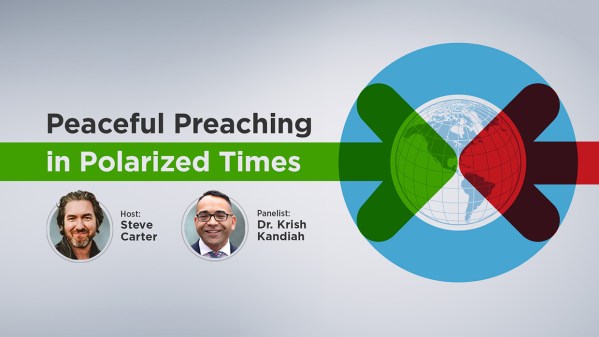
Five themes to prepare us and our congregations for Election Day.
In this webinar, Krish Kandiah shares with us about how to speak into these turbulent times with grace, dignity, and peace.
Sharing a Christian worldview with others can often create tense situations. Especially when we are talking with friends and family who do not share our views.
A "Profile" article in The New Yorker spotlighted Ross Douthat, a popular Times columnist. The title of the article is noteworthy: "The Believer: Ross Douthat's Theories of Persuasion." Douthat is a conservative leaning Catholic who is a pro-lifer and an advocate for traditional marriage.
How does he negotiate working with colleagues whose views are radically different from his own? The article offers one example that might be instructive.
In 2015, Douthat wrote a piece critical of the Supreme Court's decision to legalize gay marriage, expressing concern that it reflected a "more relaxed view of marriage's importance." Before releasing it, he thought of Michael Barbaro. Barbaro has been a close friend of Douthat's since childhood. He refers to himself as Douthat's "sidekick." And Barbaro was married to a man. Barbaro recalls:
We hadn't been in touch that much, but Ross reached out to me to say, “I'm about to publish a column in which I come out against same-sex marriage. I want you to know that it didn't come to me easily. It's something I know may be sensitive to you. And, as somebody I care about, I want you to understand it. I don't want you to read about it in my column without us talking about it.”
When Barbaro shared how much he appreciated the note, Chotiner, the New Yorker reporter conducting the interview, was surprised, Barbaro should have been furious! Why wasn't he? Barbaro explained:
I was wounded by the position he took on a personal level. How could I not be? But it was meaningfully tempered by the reality that I knew where he was coming from, and that he had gone to the trouble to reach out to me.
Barbaro and his husband later divorced. When Chotiner interviewed him, Ross was on vacation with his wife and two children. He shared, "I've been on a long journey that I know Ross generally approves of. But, although I didn't do it for him, it's very funny, as I have had children, I can just sense his glee. It's no secret that he wants people to have children and to enter into monogamous heterosexual relationships." Barbaro let out a laugh. "And that wasn't my plan, but I have sensed his joy at that outcome."
Part of the pressure of sharing our Christian worldview comes from our mistaken belief that we must convince others of our views. But our job is much simpler than all that. We are called only to speak the truth in love. And you'd be surprised at how persuasive that simple act can be.
Source: Isaac Chotiner, "The Believer; Ross Douthat's Theories of Persuasion," The New Yorker (September, 2023)
After a two-week battle with a sudden fast-spreading infection, Joshua Dean, a former quality auditor at Boeing supplier Spirit AeroSystems, passed away. Dean had recently given a deposition alleging that his firing in 2023 was in retaliation for having disclosed what he called “serious and gross misconduct by senior quality management of the 737 production line.”
The Boeing 737 MAX has a troubled safety record, with high-profile crashes in 2018 and 2019 killing hundreds, and an Alaska Airlines flight in early 2024 that had to make an emergency landing after an explosive decompression due to an insufficiently secured door plug.
According to The Seattle Times, Dean was 45 years old, in relatively good health, and known for a healthy lifestyle. In February, he spoke to NPR about Spirit’s troubling safety practices.
"Now, I'm not saying they don't want you to go out there and inspect a job … but if you make too much trouble, you will get the Josh treatment,” Dean said, about his previous firing. “I think they were sending out a message to anybody else. If you are too loud, we will silence you.”
Dean’s death comes two months after another Boeing whistleblower, John Barnett, was found dead of a potentially self-inflicted gunshot wound. Barnett was also in the process of testifying against Boeing about potential safety lapses in the manufacturing of the Boeing 787, and claims that he was similarly retaliated against for his whistleblowing. Barnett was 63 at the time of his death, and known for a vocal criticism of what he perceived to be Boeing’s declining production standards.
Dean’s attorney Brian Knowles, whose firm also represented Barnett, refused to speculate on whether the two deaths are linked, but insisted that people like Dean and Barnett are important.
Knowles said, “Whistleblowers are needed. They bring to light wrongdoing and corruption in the interests of society. It takes a lot of courage to stand up. It’s a difficult set of circumstances. Our thoughts now are with John’s family and Josh’s family.”
Sometimes telling the truth can be costly. But this should never inhibit us from standing for the truth.
Source: Dominic Gates, et al., “Whistleblower Josh Dean of Boeing supplier Spirit AeroSystems has died,” Seattle Times (5-1-24)
Because the British royal family lives under constant media scrutiny, it’s usual for any member of the family to stay out of the limelight for an extended period. So, when Catherine of Wales hadn’t been seen in public for months, and her Mother’s Day photo was scrutinized as possibly being doctored, conspiracy theories began to proliferate.
All these theories proved to be irresistible for online jokesters. “Perhaps Kate Middleton had been using a body double, or was in a coma, or was engaged in an illicit tryst,” people speculated online. Even American late night comedy hosts were getting in on the action.
But it turns out the truth was much less exciting, and much scarier: Kate Middleton was undergoing chemotherapy treatments for a form of cancer.
For many people, this news created a regretful reckoning. A 58-year-old woman named Dana spoke to reporters at The Washington Post about this. Dana had been joking with her friends about the Kate Middleton rumors; when she heard the truth, she was filled regret. She said, “This woman’s sick and afraid. And I just lost my mom to cancer. I am devastated at my inhumanity.”
Many of the online entertainment personalities simply ceased joking and moved on to other targets, but CBS’ late-night host took an extra step, apologizing during a segment of The Late Show with Stephen Colbert. He said:
There’s a standard that I try to hold myself to. And that is I do not make light of somebody else’s tragedy. Any cancer diagnosis is harrowing for the patient and for their family. Though I’m sure they don’t need it from me, I and everyone here at The Late Show would like to extend our well wishes and heartfelt hope that her recovery is swift and thorough.
Telling jokes can be a great way to bring levity to your friends, but take care that your jokes do not veer into harassment or defamation of character.
Source: Maura Judkis, et al., “They obsessed over Catherine. Now they’re hit with a sobering truth.” The Washington Post (3-22-24)
Controversial activist Ayaan Hirsi Ali became well known when she published her 2007 memoir Infidel, which was an account of her life as a Muslim woman and her fight against radical Islam. She made headlines worldwide when she converted to atheism, receiving numerous death threats. In November 2023, she announced her conversion to Christianity. Her reasons address in part what is happening in the world today. She writes:
Atheists were wrong when they said rejection of God would usher in a new age of reason and intelligent humanism. But the 'God hole'—the void left by the retreat of the church—has merely been filled by a jumble of irrational, quasi-religious dogma. The result is a world where modern cults prey on the dislocated masses, offering them spurious reasons for being and action. This is mostly by engaging in virtue-signaling theater on behalf of a victimized minority or our supposedly doomed planet. The line often attributed to G.K. Chesterton has turned into a prophecy: 'When men choose not to believe in God, they do not thereafter believe in nothing, they then become capable of believing in anything.'
In this nihilistic vacuum, the challenge before us becomes civilizational. We can’t withstand China, Russia, and Iran if we can’t explain to our populations why it matters that we do. We can’t fight woke ideology if we can’t defend the civilization that it is determined to destroy. And we can’t counter Islamism with purely secular tools. To win the hearts and minds of Muslims here in the West, we have to offer them something more than videos on TikTok.
The lesson I learned from my years with the Muslim Brotherhood was the power of a unifying story, embedded in the foundational texts of Islam, to attract, engage, and mobilize the Muslim masses. Unless we offer something as meaningful, I fear the erosion of our civilization will continue. And fortunately, there is no need to look for some New Age concoction of medication and mindfulness. Christianity has it all.
Source: Ayaan Hirsi Ali, “Why I Am Now a Christian,” The Free Press (11-14-23)
In an interesting piece of science, Nautilus looks at what happens to our brains when we don’t tell the truth. It turns out that the more you lie, the more truthful it seems. Because while a lie might initially appear to the brain as a lie—a fabricated memory sets off your brain’s alarm bell—over time its “source-monitoring” fatigues with each fib. Lying cements the false details at the expense of the real ones.
Psychologist Quin Chrobak said that if a lie or fabrication provides an explanation for something, it’s more likely to become confused with what’s true. He said, “People are causal monsters. We love knowing why things happen,” and if we don’t have an explanation for something, we “like to fill in the gaps.” The pressing human need to fill those gaps, might also pertain to beliefs we hold about ourselves.
Another important factor underlying this effect is repetition. Psychology professor Kerri True explained, “If I tell the lie to multiple people, I’m rehearsing the lie.” And rehearsing a lie seems to enhance it. “The more you repeat something,” Chrobak said, “the more you actively imagine it, the more detailed and vivid it becomes,” which further exploits the brain’s tendency to conflate detail with veracity.
What’s at stake here is more than a scientific explanation for the pathological liar in your life. This process is at work in every self-rationalization and self-justification we tell ourselves.
If falsehood fatigue could explain how people can fall down the rabbit hole of online echo chambers. It’s also a glowing advertisement for a daily/weekly reminder that we cannot trust ourselves. That the devices and desires of our heart—what we believe to be true about ourselves—are all plagued by faulty wiring.
Regularly confessing one’s frailty in this regard might just reset the brain’s falsehood fatigue and bring you closer to the Truth that sets you free.
While this primarily applies to a person’s personal life, it also applies to politicians and governments. Hitler and his henchmen famously said, “If you tell a big enough lie and tell it frequently enough, it will be believed.” Quoting from the book The Crown of Life (1869). Ultimately all lies can be traced to Satan for “he is a liar and the father of lies” (John 8:44).
Source: Todd Brewer, “Falsehood Fatigue,” Mockingbird (8-18-23); Clayton Dalton, “The George Santos Syndrome,” Nautilus (8-17-23)
Separating fact from fiction is getting harder. Manipulating images—and creating increasingly convincing deepfakes—is getting easier. As what’s real becomes less clear, authenticity is “something we’re thinking about, writing about, aspiring to and judging more than ever.” This is why Merriam-Webster’s word of the year is “authentic,” the company announced in November of 2023.
Editor Peter Sokolowski said, “Can we trust whether a student wrote this paper? Can we trust whether a politician made this statement? We don’t always trust what we see anymore. We sometimes don’t believe our own eyes or our own ears. We are now recognizing that authenticity is a performance itself.”
According to the announcement from Merriam-Webster, “authentic” is a “high-volume lookup” most years but saw a “substantial increase” in 2023. The dictionary has several definitions for the word, including “not false or imitation,” “true to one’s own personality, spirit, or character” and “worthy of acceptance or belief as conforming to or based on fact,” among others.
Sokolowski said, “We see in 2023 a kind of crisis of authenticity. What we realize is that when we question authenticity, we value it even more.”
Other words that saw spikes this year include “deepfake,” “dystopian,” “doppelgänger,” and “deadname,” per Merriam-Webster. This year’s theme of searching for truth seems fitting following last year’s focus on manipulation. The 2022 word of the year was “gaslighting,” a term that originated from a 1938 play by Patrick Hamilton. In the play, a woman complains that the gas lights in her house are dimming while her husband tries to convince her that it’s all in her head.
As technology’s ability to manipulate reality improves, people are searching for the truth. Only the Word of God contains the absolute truth “your word is truth” (John 17:17), as revealed by Jesus, who is “the way, the truth, and the life” (John 14:6).
Source: Teresa Nowakowski, “Merriam-Webster’s 2023 Word of the Year Is ‘Authentic,’ Smithsonian Magazine (11-29-23)
A chorus of discontent is emerging from the users of several popular dating apps like Hinge, Match, and Bumble. The consensus is that the experience has been gradually declining. Dating apps are not as fun, as easy, or as enjoyable as they used to be.
Which is not to say that they’re not still popular. According to a recent Pew Research Center survey, 10% of people in committed romantic partnerships say they met their partner on a dating app or website.
“Our goal is to make meaningful connections for every single person on our platforms," according to a spokesperson for Match.com. "Our business model is driven by providing users with great experiences, so they champion our brands and their power to form life-changing relationships.”
That statement notwithstanding, it’s hard for an app to develop a dedicated customer base when the most satisfied customers, finding a loving relationship, leave the app behind. Each successful outcome results in the loss of two paying customers.
On the contrary, most apps gain financial success by generating repeat users and maximize their time spent on the platform. This dynamic creates a situation described as “adverse selection,” where the people who spend the most time on dating apps are beset with suspicion from prior bad experiences on the app, making it harder to find meaningful connections. Anyone who remains must either lower their standards or risk engaging with people who are less-than-truthful in their behavior. What results is a less enjoyable experience all around.
Economist George Akerlof says there are solutions to the problem, which often revolve around providing more truthful information to counter dishonest actors. But that would require users on dating apps to share potentially embarrassing details of how or why their previous attempts at relational connection failed.
Alas, when it comes to honest self-reflection and authentic disclosure, there appears to be no app for that.
Long lasting relationships are built on the time-tested biblical principles of honesty, trust, and openness. Any other basis for a relationship will lead to suspicion and heartache.
Source: Greg Rosalsky, “The dating app paradox: Why dating apps may be worse than ever,” NPR (2-13-24)
Ride sharing apps (like Uber and Lyft) ratings have become almost meaningless. A recent report says, “Confusion over what constitutes 5-star behavior for certain services, combined with the guilt of potentially hurting someone’s livelihood, has people defaulting to perfect scores. Ratings padding is particularly rampant for services involving personal interactions. Everyone is ‘above average’ on some apps—way, way above.”
A customer named Mike Johnson has endured some awkward Uber rides. He once held his nose throughout a trip because the driver was carrying chopped-up Durian—the world’s smelliest fruit. Another time, he was stuck in the back seat while a driver bickered with her boyfriend. Yet another driver tried to sell him a Ponzi scheme. He rated each one five out of five stars.
Johnson explained: “They all seemed like nice people. I didn’t want them to be kicked off the app over my bad rating,” the 33-year-old New Yorker said. “Isn’t 5 stars, like, the norm?”
Ratings are so inflated that Lyft drivers whose scores dip below 4.8 out of 5 stars are asked to boost their performance. Drivers under 4.6 risk getting deactivated.
1) God is not afraid to tell us the truth about our sin. 2) Christians should resist this rating inflation and be willing to speak the truth in love to one another.
Source: Preetika Rana, “Customer Ratings Have Become Meaningless. ‘People Hand Out 5 Stars Like It’s Candy,’” The Wall Street Journal (6-5-23)
The moment we’ve all breathlessly waited for is finally here: Dictionaries are announcing their words of the year. In December, the US’s most esteemed lexicon, Merriam-Webster, revealed its choice: “authentic.”
In its announcement, the dictionary said the word had seen a big jump in searches this year, thanks to discussions “about AI, celebrity culture, identity, and social media.” The concept of authenticity sits at the intersection of what’s been on our collective minds.
Large language models like ChatGPT and image generators like Dall-E have left us uncertain about what’s genuine, from student essays to the pope’s fashion choices. When it comes to the news, online mis- and disinformation, along with armies of bots, have us operating under different sets of facts.
Sure enough, other leading dictionaries’ words of the year are remarkably similar. Cambridge chose “hallucinate,” focusing its announcement on generative AI: “It’s capable of producing false information – hallucinations – and presenting this information as fact.” Collins didn’t beat around the bush: its word of the year is “AI.”
In a polarized world, the dictionaries’ solidarity suggests there’s something we can all agree on: robots are terrifying. AI is an obsession that seems to cross generations. Whether you’re a boomer or Gen Z, OpenAI feels like a sign of change far beyond NFTs, the metaverse, and all the other fads we were told would transform humanity.
Social media feeds have become carefully curated extensions of ourselves—like little aspirational art projects. As Merriam-Webster points out, authenticity itself has become a performance. In other words, we’re getting very good at pretending to be real.
Source: Matthew Cantor, “Hallucinate, AI, authenticity: dictionaries’ words of the year make our biggest fears clear,” The Guardian (12-5-23)