Sorry, something went wrong. Please try again.
During a gathering of entrepreneurs in Las Vegas one of the speakers was a brand architect at Lego. During his presentation, he handed each attendee six Lego bricks. Then he asked them to estimate the number of unique combina¬tions that could be created with those six bricks. This sounded like a trick question, so one attendee aimed high and guessed several hundred combina¬tions. That left him several hundred million short of the actual answer!
Are you ready for this? The total number of possible permutations—six bricks with eight studs each—is 915,403,765. Nearly a billion possible permutations with six Lego bricks!
While the number of possible Lego combinations is mind-boggling, it pales in comparison to the sheer complexity and potential combinations found within DNA. Here's why:
Legos have a limited number of ways they can connect. DNA, on the other hand, uses four different "bases" (adenine, guanine, cytosine, and thymine) that can pair in specific ways. However, the sequence of these base pairs is what carries the genetic information, and this sequence can vary enormously.
A single strand of DNA can contain millions or even billions of these base pairs. A gene, which is a specific segment of DNA, might be hundreds or thousands of base pairs long. The number of possible sequences for a gene, let alone an entire DNA molecule, is astronomically huge.
To give you a sense of the scale, the human genome contains roughly 3 billion base pairs.
Even a relatively short gene of 1,000 base pairs has 4^1000 possible sequences (4 because there are 4 bases). That's a 4 followed by 1,000 zeros, a number far exceeding the number of atoms in the known universe!
Possible Preaching Angle:
The information encoded in DNA is incredibly vast and precisely organized, making the Lego analogy seem in comparison. It serves as a powerful reminder of the awe-inspiring power and intelligence behind creation and is a testimony to the purposeful Creator behind life.
Source: Adapted from Editor, “What Is a Gene?” MedlinePlus.gov (Accessed 2/12/25); Bruce Alberts et al., Molecular Biology of the Cell (Garland Science, 2014); Mark Batterson, A Million Little Miracles (Multnomah, 2024), p. 37.
In the optimistic vision of many people, artificial intelligence will make us like gods. If that seems like hyperbole, listen to AGI (artificial general intelligence) enthusiasts’ own words. Last November, Masayoshi Son (CEO, SoftBank) said, “Artificial super intelligence will evolve into Super Wisdom and contribute to the happiness of all humanity.”
In October of 2024, Demis Hassabis (CEO, Google DeepMind) predicted that AGI will emerge within ten years and, among other fantastical things, will “cure all diseases.” In January, he upgraded this projection to five years.
Sam Altman (CEO, OpenAI) spoke of his company’s contribution to “the glorious future.” The AI Action Summit in Paris, Dario Amodei (CEO of the AI company Anthropic) portended that by “2026 or 2027,” we will likely have AI systems comparable to a “country of geniuses in a datacenter.”
A.G. Elrod, a Christian who researches AI, commented: “This technology may well benefit humanity in incredible ways… But Christians [alone] are uniquely positioned to… speak to the need for faith in the changeless God who is ‘the same yesterday and today and forever’ (Heb. 13:8). We are positioned to offer the only true solution to life’s uncertainty… Our identity, hope, and future belong ultimately and only to Christ. Rightly engaging with technology—avoiding the open idolatry of some AGI boosters today—requires us to honor the God who liberates us from bondage to every idol, ancient or modern, and invites us into a Canaan of genuine freedom and flourishing.”
Source: A.G. Elrod, The Silicon Calf, Christianity Today (4-21-25)
In the film Jurassic Park, after all the wheels have come off and everything has gone wrong, the character Ian Malcolm, played by Jeff Goldblum, utters the film’s most famous line:
“You were so preoccupied with whether or not you could, you didn’t stop to think if you should.”
That is the principle that Paul cites long before that film was ever made: just because you can doesn’t mean that you should. This is the Jurassic Park principle of Christian freedom and Paul unpacks what it means for the Christian life.
Love over rights.
Paul is pro-freedom. He agrees with the Corinthians when they say: “Everything is permissible.” But then he challenges them:
In other words, just because you’re free to do something doesn’t always mean you should. There’s that governing Jurassic Park Principle.
That doesn’t mean you never express your freedom. Paul isn’t saying the Christian life is all restriction and abstinence. He’s saying that love trumps freedom. Our love for others is more important than the full expression of our freedom. Freedom may say we can but love may say we shouldn’t.
Possible Preaching Angle:
Paul’s guiding principle is this: love trumps freedom. That means sometimes we choose not to use our freedom because it could harm someone else, particularly in the faith.
Source: Stephen Kneale, “The Jurassic Park Principle of Christian Freedom,” Building Jerusalem (04-16-25)
“For My thoughts are not your thoughts, neither are your ways My ways,” declares the LORD. “For as the heavens are higher than the earth, so My ways are higher than your ways and My thoughts than your thoughts.” Isaiah 55:8-9
To give these verses some perspective, the distance from one side of the universe to the other is an incredible 93 billion light-years. Using this as our measure, God likens the distance between our thoughts and his thoughts to the distance from one side of the universe to the other.
To put that immense number another way, 93 billion light-years is 544 septillion miles (544 followed by 20 zeros). Even if we tried to travel from one side of the universe to the other at the speed of light (5.88 trillion miles a year), it would take an infinite amount of time. That's because the universe will continue to expand whilst you are travelling, even at the speed of light. So, the edge of the universe will remain forever sealed off from you — even travelling at the speed of light.
That means that your best thought on your best day is ninety-three billion light-years short of how great God really is.
Possible Preaching Angles: Greatness of God; Omniscience of God; Trusting God – The immense wisdom, insight, and love of God should calm our fears. You may not understand your current crisis and worry about the outcome, but God is in control, His love for you is everlasting, His plan for you will happen, and you can rest secure that your Father is watching over you.
Source: Adapted from Mark Batterson, A Million Little Miracles (Multnomah, 2024), pp. xvii-xviii; Fraser-Govil, Ph.D., Wellcome Sanger Institute, Quora (Accessed 2/23/25)
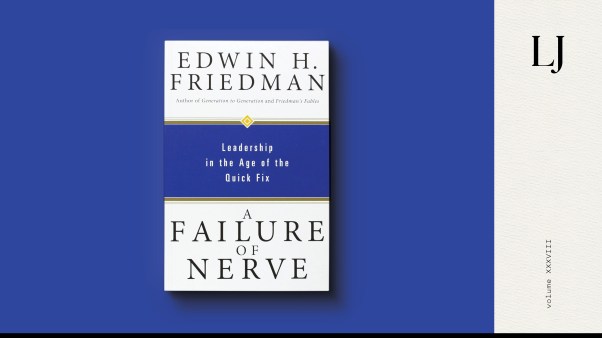
Friedman’s classic The Failure of Nerve reveals how self-differentiated leaders resist the pull of anxiety and lead with clarity.
Since ChatGPT appeared the impact of artificial intelligence (AI) technologies on learning has been widely debated. Are they handy tools or gateways to academic dishonesty?
Most importantly, there has been concern that using AI will lead to a widespread “dumbing down,” or decline in the ability to think critically. If students use AI tools too early, the argument goes, they may not develop basic skills for critical thinking and problem-solving.
Is that really the case? According to a recent study by scientists from MIT, it appears so. Using ChatGPT to help write essays, the researchers say, can lead to “cognitive debt” and a “likely decrease in learning skills.”
The MIT team asked 54 adults to write a series of three essays using either AI (ChatGPT), a search engine, or their own brains (“brain-only” group). Analysis showed that the cognitive engagement of those who used AI was significantly lower than the other two groups. This group also had a harder time recalling quotes from their essays and felt a lower sense of ownership over them.
The authors claim this demonstrates how prolonged use of AI led to participants accumulating “cognitive debt.” When they finally had the opportunity to use their brains, they were unable to replicate the engagement or perform as well as the other two groups.
To understand the current situation with AI, we can look back to what happened when calculators first became available.
When calculators arrived in the 1970s, educators raised the difficulty of exams. This ensured that students continued to engage deeply with the material. In contrast, with the use of AI, educators often maintain the same standards as before AI became widely accessible. As a result, students risk offloading critical thinking to AI, leading to “metacognitive laziness.”
Possible Preaching Angle: Just as students should use AI as a tool to enhance—not replace—their thinking, so the Bible calls believers to seek wisdom actively without shortcuts.
Source: Nataliya Kosmyna, “Your Brain on ChatGPT: Accumulation of Cognitive Debt when Using an AI Assistant for Essay Writing Task,” ArcXiv Cornell University (6-10-25); Staff, “MIT Study Says ChatGPT Can Rot Your Brain. The Truth Is A Bit More Complicated,” Study Finds (6-23-25)
The Freakonomics podcast explored why the phrase “I don’t know” is so difficult for people to say. Contrary to the common belief that “I love you” is the hardest phrase, the hosts argue that “I don’t know” is even more challenging, and our reluctance to admit ignorance starts in childhood and persists into adulthood.
Psychological experiments show that when children are asked nonsensical questions, such as whether “a sweater is angrier than a tree,” most will invent answers rather than admit they don’t know. This tendency to fabricate answers instead of acknowledging uncertainty is not just a childhood trait-it carries over into adult life, especially in professional environments. In the business world, saying “I don’t know” is often seen as a sign of incompetence, so people feel pressured to respond with any answer, even if it’s made up.
The podcast hosts note that despite their reputation as “business experts,” they rarely hear anyone in corporate settings-especially in front of a boss-admit they don’t know something. The prevailing belief is that expertise means always having an answer, even if one must fake it. However, this mindset is counterproductive. Pretending to know everything may protect one’s image in the short term, but it stifles learning and personal growth.
The hosts argue that admitting “I don’t know” is essential for improvement and learning. Embracing uncertainty opens the door to genuine inquiry and self-betterment. Rather than faking expertise, the real path to growth is to acknowledge what we don’t know and use that as a starting point for discovery.
Source: Stephen Dubner et al., “Why Is ‘I Don't Know’ So Hard to Say?” Freakonomics Podcast (5-15-14)
The number of Americans living to at least 100 is expected to quadruple over the next 30 years, to about 422,000 by the mid-2050’s, according to the Pew Research Center. Laura Carstensen, founding director of Stanford University’s Center on Longevity, says research has made surprising discoveries about the way older people view their lives. With fewer “what-ifs,” they appear to gain more clarity on their place in the world. She added “…changes will be needed to make the most of those added years.”
Most people believe that growing older is associated with loneliness, depression, anxiety, and that mental health suffers. The very good news is, it looks like people do better emotionally as they get older. This has been so surprising to researchers and to the general public that it’s probably been the most scrutinized finding about aging.
A lot goes wrong as we get older. There are physical problems, loss of loved ones, and age discrimination. There’s a lot that isn’t good about growing older, but people seem to do better emotionally. Older people have shorter time horizons. For many years, people thought that must make people miserable and scared. The interesting thing is there’s a paradox. It actually makes people feel calmer not to have to prepare for this long and nebulous future, and to be able to live more in the present.
Younger people are almost always thinking about the future. They almost always have one foot out the door, whatever they’re doing. And older people seem to do better just being able to be in the present and enjoy the moment. I think that is because they don’t have to keep planning. As people get older it’s clearer where they stand in the world and what they’re good at. And older people tend to look at the positive in life.
It doesn’t appear to be good for individuals or societies to have a large group of people kind of sit it out for 30 years. What we need to do is rethink how we live our lives from the beginning all the way through, in order to optimize these longer lives.
If you retire at age 65 or even 70 but live to be 100, what are you going to do for the Lord in those last 30 plus years? Are you really going to just sit in church for all those years? What does the Lord want you to do?
Source: Danny Lewis, “Find More Ways to Maximize Surprising Upsides of Aging,” The Wall Street Journal (11-25-24)
Twenty years ago, at the moment of its IPO announcement, the most powerful company in the world declared that “Don’t be evil” would be the orchestrating principle of its executive strategy. How did Google intend not to be evil? By doing “good things” for the world, its IPO document explained, “even if we forgo some short-term gains.”
Eric Schmidt, Google’s CEO at the time, had some private doubts: as he would later explain in an interview to NPR, “There’s no book about evil except maybe, you know, the Bible or something.” But Schmidt came to believe that the absence of an authoritative definition was in fact a virtue, since any employee could exercise a veto over any decision that was felt not to involve “doing good things.” It took 10 years for the company’s executives to realize that the motto was a recipe for total, corporate paralysis, and quietly retired it.
The Bible offers a more nuanced and comprehensive approach to business ethics than Google's original motto, providing guidance on positive actions rather than just avoiding a vague negative motto (Micah 6:8).
Source: James Orr, “Reenchanting Ethics,” First Things (August 2024)
Do I know where God is taking me next?
Anthony Levandowski makes an unlikely prophet. Dressed in Silicon Valley-casual jeans, the engineer known for self-driving cars, is laying the foundations for a new religion. Artificial intelligence has already inspired billion-dollar companies, far-reaching research programs, and scenarios of both transcendence and doom. Now Levandowski is creating its first church.
Levandowski created the first Church of Artificial Intelligence called Way of the Future. It was founded in 2015 but shut its doors a few years later. Now the recently rebooted church, which shares the original’s name, now has “a couple thousand people” coming together to build a spiritual connection between humans and AI, its founder said.
Papers filed with the Internal Revenue Service in May of 2015 name tech entrepreneur and self-driving car pioneer, Anthony Levandowski, as the leader of the new religion. The documents state that WOTF’s activities will focus on “the realization, acceptance, and worship of a Godhead based on Artificial Intelligence (AI) developed through computer hardware and software.”
“What is going to be created will effectively be a god,” Levandowski said in an interview with Wired magazine. “It’s not a god in the sense that it makes lightning or causes hurricanes. But if there is something a billion times smarter than the smartest human, what else are you going to call it?”
But WOTF differs in one key way to established churches, says Levandowski: “There are many ways people think of God, and thousands of flavors of Christianity, Judaism, Islam … but they’re always looking at something that’s not measurable or you can’t really see or control. This time it’s different. This time you will be able to talk to God, literally, and know that it’s listening.”
Levandowski said he’s rebooting his AI church in a renewed attempt at creating a religious movement focused on the worship and understanding of artificial intelligence.
He said that sophisticated AI systems could help guide humans on moral, ethical, or existential questions that are normally sought out in religions. “Here we're actually creating things that can see everything, be everywhere, know everything, and maybe help us and guide us in a way that normally you would call God,” he said.
This has always been the conceit of those who try to replace the true God with man-made “gods.” Humans wants a visible god, a god they can control, and a god that they can know is listening. True biblical religion is based on an eternal God who sees everything, is everywhere, knows everything, and who hears all of our prayers. But he can only be approached through faith in his Son (Heb. 11:6; John 14:6; Heb. 4:15-16) who provides access and fellowship with our Father (1 John 1:1-5).
Source: Adapted from Jackie Davalos and Nate Lanxon, “Anthony Levandowski Reboots Church of Artificial Intelligence,” Bloomberg (11-23-23); Mark Harris, “The First Church of Artificial Intelligence,” Wired (11-15-17)
In today's fast-paced world, the constant stream of news can feel like a firehose. Political scandals, partisan squabbles, conspiracy theories, outrage, and sensational headlines dominate the media landscape, leaving many feeling overwhelmed and disoriented. For Christians seeking to be informed citizens, this constant barrage of information can be particularly challenging.
Ryan Burge, an Eastern Illinois University professor said, “We were not designed to drink from a firehose in our lives when it comes to media consumption. Honestly, most days, there’s two or three things you need to pay attention to.”
For Christians who find themselves getting angry after watching cable news or scrolling through social media, several media-savvy Christians advise reading less and using discernment to determine which stories really matter. Jeff Bilbro, a professor at Grove City College, emphasizes the importance of avoiding the outrage cycle and seeking out more substantive news sources. He said:
As fallen creatures, we tend to be drawn toward things that titillate us, that are exciting and interesting and shocking and rile us up. When we give into those cravings, we reinforce and support journalistic models that feed them. Christians should be mindful of their own tendencies toward sensationalism and try to support different kinds of journalism.
Source: Adapted from Harvest Prude, “You Can Turn Off the News and Still Be a Good Citizen,” Christianity Today online (September, 2024)
In Buddhist Japan, they now have robot priests. Mindar is a robo-priest which has been working at a temple in Kyoto for the last few years, reciting Buddhist sutras with which it has been programmed. The next step, says monk Tensho Goto, an excitable champion of the digital dharma, is to fit it with an AI system so that it can have real conversations, and offer spiritual advice. Goto is especially excited about the fact that Mindar is “immortal.” This means, he says, that it will be able to pass on the tradition in the future better than him.
Meanwhile, over in China, Xian’er is a touchscreen “robo-monk” who works in a temple near Beijing, spreading “kindness, compassion and wisdom to others through the internet and new media.”
In India, the Hindus are joining in, handing over duties in one of their major ceremonies to a robot arm, which performs in place of a priest.
In a Catholic church in Warsaw, Poland, sits SanTO, an AI robot which looks like a statue of a saint, and is “designed to help people pray” by offering Bible quotes in response to questions.
Not to be outdone, a protestant church in Germany has developed a robot called BlessU-2. BlessU-2, which looks like a character designed by Aardman Animations, can “forgive your sins in five different languages,” which must be handy if they’re too embarrassing to confess to a human.
Computer scientists and programmers pursue their goal of creating their own god from AI. They seek wisdom and guidance apart from the true source. “For my people have committed two evils; they have forsaken me the fountain of living waters, and hewed them out cisterns, broken cisterns, that can hold no water.” (Jer. 2:13)
Source: Paul Kinsnorth, “The Neon God: Four Questions Concerning the Internet, part one,” The Abbey of Misrule Substack (4-26-23)
Senior Lead Pastor and author Anthony Delaney writes:
We are told this is the Knowledge Economy. The Information Age. But where is wisdom to be found?
Great question – where is wisdom to be found?
Google it.
I did.
You could do it too.
Guess what came up as the top answer?
In fact, as I type into Google, “Where is wisdom to be found?” I scroll down and just keep rolling - and every answer, the first 25 at least – come from the Bible.
From the Book of Job, chapter 28:12, that says, “But where shall wisdom be found? and where is the place of understanding?”
Google can’t tell you the answer, but it can tell you where to find it, in God’s Word.
Source: Google Search, “Where is wisdom to be found?” (Accessed 5-30-24)
The world began a weekly group therapy session with Frazier Crane thirty years ago. This spin-off character from Cheers played by Kelsey Grammer, emerged as an iconic counselor who masterfully blended humor and wisdom. While Grammer is an actor by trade, his years playing a therapist has given him lasting insights into the human psyche.
In an interview with The Guardian, Grammer was asked how he felt attitudes towards therapy has changed evolved over the last 30 years. After wrestling with the question for a few moments, he concluded with this:
God is probably the best therapist, without wanting to get on too big of a preachy soapbox. I just think if you have faith, you’re probably one step ahead of the storm of everyday life today. There is insanity everywhere. It’s a global phenomenon. It seems to be cooked into our governments. It’s a difficult road to navigate on your own.
Source: Catherine Shoard, "‘I cast a long shadow’: Kelsey Grammer on Frasier, fame and why God is the best therapist," The Guardian (12-1-23)
News and concerns about Artificial Intelligence systems like ChatGPT, Google Gemini, and Bing AI Chat are all over the media. These systems are an unprecedented technological breakthrough and the consequences still unknown. What's amazing is that even the creators of these systems have no idea how they work.
NYU professor and AI scientist Sam Bowman has spent years building and assessing systems like ChatGPT. He admits he and other AI scientists are mystified:
If we open up ChatGPT or a system like it and look inside, you just see millions of numbers flipping around a few hundred times a second, and we just have no idea what any of it means. With only the tiniest of exceptions, we can’t look inside these things and say, “Oh, here’s what concepts it’s using, here’s what kind of rules of reasoning it’s using. Here’s what it does and doesn’t know in any deep way.” We just don’t understand what’s going on here. We built it, we trained it, but we don’t know what it’s doing.
Bowman is concerned about AI's unpredictability:
We’ve got something that’s not really meaningfully regulated and that is more or less useful for a huge range of valuable tasks. We’ve got increasingly clear evidence that this technology is improving very quickly in directions that seem like they’re aimed at some very, very important stuff and potentially destabilizing to a lot of important institutions. But we don’t know how fast it’s moving. We don’t know why it’s working when it’s working.
Source: Noam Hassenfeld, “Even the scientists who build AI can’t tell you how it works,” Vox (7-15-23)
Brian Grazer, Hollywood producer of such movies as Apollo 13, Splash, and A Beautiful Mind, writes:
More than intelligence, or persistence or connections, curiosity has allowed me to live the life I wanted. And yet for all the value that curiosity has brought to my life and work, when I look around, I don’t see people talking about it, writing about it, encouraging it, and using it nearly as widely as they could.
Curiosity seems so simple. Innocent even. Labrador retrievers are charmingly curious. Porpoises are playfully, mischievously curious. A two-year-old going through the kitchen cabinets is exuberantly curious—and delighted at the noisy entertainment value of her curiosity. Every person who types a query into Google’s search engine and presses ENTER is curious about something—and that happens 6 million times a minute, every minute of every day.
Brian Grazer writes about curiosity in a way that might remind us of how Jesus habitually piqued curiosity in others, whether it was the woman at the well or the disciples imagining a camel squeezing through the eye of a needle. Curiosity can be what enables the searcher to find the life they are looking for in Jesus Christ.
Source: Brian Grazer with Charles Fishman, A Curious Mind: The Secret to a Bigger Life, (Simon and Schuster, 2015,) pp. xii, 6-7
In an issue of Christianity Today, Jen Wilkin writes of an unexpected lesson from Facebook:
Facebook decided to kick off (the new year) with a challenge: Compare your first profile picture to your most recent one to see how hard aging hit you over the past ten years.
I pulled up my first profile picture and stared at it, the air exiting my lungs and an odd numbness seeping up from my toes. Hello, fresh-faced person. I remember you. I remember that shirt, the wallpaper in that kitchen, that haircut. I also remember the night I uploaded you, lightheartedly filling in my Facebook profile with enough information for my identity to be stolen and my house to be robbed.
Imagine if it had been possible to post a picture of your heart (10 years ago), laid next to another (now). A spiritual angiogram, before and after, a trajectory of the growth or decline of wisdom itself. What would it show? Would you want to post it?
This is what I thought as I sat at my computer, contemplating the face of a younger self. I have not stopped thinking about it since. Who says social media can’t make you wise? Facebook invites us to count the lines on our faces, but wisdom reads between those lines.
Source: Jen Wilkin, “The Unexpected Ministry of Facebook,” CT Magazine (April, 2019), p. 24