Sorry, something went wrong. Please try again.
The King James Version of the Bible has been a blessing through the years to countless numbers of people, in many different ways. As 2 Timothy 3:16-17 tells us, the inspired word of God has “thoroughly equipped” the people of God “for every good work and is useful for teaching, rebuking, correcting, and training in righteousness.” Psalm 119:105 also reminds us that God's Word “is a lamp unto my feet, and a light unto my path.”
At a Seminar held in Sri Lanka for students of Journalism a few years ago, Senior Indian Journalist and Politician, M. J. Akbar, highlighted yet another meaningful benefit of the King James Version of the Bible. In his address to aspiring journalists, Mr. Akbar had initially highlighted an urgent need to raise the standards of English writing in print journalism.
Thereafter, he had advised the aspiring journalists to read the King James Version of the Bible, to improve their English. He said, “The basic structure of the English language can be found in the King James Version of the Bible and thus it can be called 'the holy book' for all the journalists.”
So, if you need to improve your English writing skills, a good way to do so would be to read the King James Version of the Bible.

Source: Adapted from Aviral Mishram “King James bible a must for aspiring writers, says veteran Indian journalist,” The Sunday Times Newspaper Sri Lanka (11-9-14)
An often-overlooked effect of missionary influence has been the preservation of languages. Language is the breath of a culture, and so the death of a language almost always results in the loss of a way of life. MIT linguist Norvin Richards expressed the importance of the preservation of languages and cultures well: “There are jokes that are only funny in Maliseet and there are songs that are only beautiful in Wôpanâak …. If we lose those languages, we lose little pieces of the beauty and richness of the world.”
In 2019, the United Nations warned, “Almost half the world’s estimated 6,700 languages are in danger of disappearing.” Many minority languages are lost when younger generations are educated in national languages. Written languages have a much better chance of survival than exclusively oral ones and many small, unique languages have been preserved by Bible translation.
In one remarkable case, the Wôpanâak language was brought back to life a hundred years after its last speakers died. The linguistic revival was based on the translation work of missionary John Eliot. The first Bible published in colonial America was in the Wôpanâak language in 1663. As a result of Eliot’s literacy efforts, the Wampanoag tribe left behind a collection of written documents when disease ravaged their population.
In the 1990s, Jessie Little Doe Baird, a descendant of the tribe Eliot sought to reach, used those records to revive the Wôpanâak language as part of a linguistics program at MIT. Her daughter is the first native Wôpanâak speaker in seven generations and six other Wampanoags have become fluent in the language. Interestingly, one of Baird’s Wampanoag ancestors publicly opposed missionary work in the eighteenth century.
Source: Steve Richardson, Is the Commission Still Great? (Moody Publishers. Kindle Edition, 2022) pp. 144-145
Two school officials have been suspended after a firestorm of controversy involving a single email. Nicole Joseph and Hasina Mohyuddin are the associate dean and assistant dean, respectively, at the Peabody College of Vanderbilt University. The pair of staffers were required to “temporarily step back from their positions,” after they authored an all-campus email responding to the mass shooting at Michigan State University just days earlier. The email sparked outrage because some of the text was credited as having been written by ChatGPT, the popular AI writing tool.
It’s ironic that both deans worked in the college’s Office of Equity, Diversity & Inclusion, because most of the complaints stemmed from the fact that students didn’t feel the emails were particularly inclusive or equitable. On the contrary, student Bethanie Stauffer felt it was “disgusting.” She said, “There is a sick and twisted irony to making a computer write your message about community and togetherness because you can’t be bothered to reflect on it yourself.”
The next day, Joseph sent an apology email, but the damage had been done. Senior Laith Kayat said, “Deans, provosts, and the chancellor: Do more. Do anything. And lead us into a better future with genuine, human empathy, not a robot. [Administrators] only care about perception and their institutional politics of saving face.”
It is better to be authentic and make an effort to communicate, rather than using shortcuts. Leaders must demonstrate a commitment to serving and resist thoughtless communication.
Source: Aaditi Lele, “Peabody EDI deans to temporarily step back following ChatGPT-crafted message about MSU shooting,” Vanderbilt Hustler (2-19-23)
Alison Gerber and Jonathan P. Gerber
Could the work of preachers be replaced by a machine?
Queen Elizabeth II passed away on September 8, 2022, at the age of 96. But it turns out that Britain's longest-reigning monarch still has something to say. We just won't know what it is for another 60 years or so. That's because a letter that she wrote to the people of Sydney, Australia, is sealed in a vault with instructions not to be opened until 2085, about 100 years after it was written.
The Queen wrote the letter in November of 1986 on one of her 16 visits to Australia. She addressed the letter to "the just and honorable Lord Mayor of Sydney, Australia" with very specific instructions: "On a suitable day to be selected by you in the year 2085 A.D, would you please open this envelope and convey to the citizens of Sydney my message to them." She then signed the mysterious message, "Elizabeth R.”
The secret letter left by Queen Elizabeth II to the people of Sydney was written to honor the restoration of the Queen Victoria Building. This building was first constructed in Sydney in 1898 for the occasion of the Diamond Jubilee of Queen Victoria, who was also the Queen's great-grandmother. The Queen chose to celebrate that restoration, completed in 1986, with her secret letter.
The letter is located in a restricted part of the historic building inside a glass case. The Queen did not even tell her personal staff what the message to the future contains. Only the Queen was aware of the letter’s contents and it’s to be opened by the city’s future mayor.
1) Bible; Word of God – The scriptures can only be truly read and understood by God’s people (Isa. 29:11-12; Matt. 13:11); 2) Prophecy; Secret – God has revealed many things in his Word--past, present, and future. But there are some things that God has sealed up until the proper time. God told Daniel to “seal up the vision for it concerns the distant future” (Dan. 8:26). At the proper time it will be unsealed along with the prophecy of Revelation for all to read “Do not seal the words of the prophecy of this scroll because the time is near” (Rev. 22:10).
Source: Editor, “The Queen’s Letter,” Atlas Obscura (Accessed 11/2/22); Liv Brinkley, “What Queen Elizabeth Wrote In This Secret Letter Won't Be Known For Another Six Decades,” Grunge (9-21-22)
In 2020, the world came to a screeching halt in a sweeping act of human solidarity against COVID-19. It became clear that seniors were among the highest risk from the disease. Unfortunately, protecting our elders meant staying away from them. Older folks are already more prone to loneliness than other age groups, and sadly the pandemic exacerbated the feeling of isolation many seniors experience.
Sisters Shreya and Saffron Patel, 16 and 18 at the time, recognized the issue with their own grandparents early in the pandemic. So, they made a point of calling them frequently. But when their grandmother shared how “ecstatic” she was at receiving a handwritten letter from a friend one day, they got an idea. “This small gesture of connection meant the world to her. We realized that many other seniors may also be feeling disconnected, and that they may appreciate a letter.”
Shreya and Saffron reached out to local assisted living facilities and care homes in the Boston area to ask if it would be okay if they sent residents letters. The responses were enthusiastically positive. Demand quickly outpaced their own ability to write letters, so they decided to organize and invite others to join them.
They dubbed their collective letter-writing effort Letters Against Isolation (LAI), and the idea quickly took off. What started as two sisters writing letters has now grown into an award-winning non-profit organization. In just over two years, LAI’s 28,000 volunteers have written more than 460,000 letters to seniors at assisted living homes and care facilities in seven countries—the US, Canada, Ireland, England, Australia, South Africa, and Israel.
The feedback from those who work in care facilities speaks to the power of these letters. Christine, activities director at Shepherd’s Care Foundation said, “It is such a pleasure to deliver your letters to our residents. The honor of being on the receiving end of their surprise and delight when we get to say to each of them, ‘You have mail!’ Their faces are priceless, and their hearts are so warmed by your kindness … on their behalf, my most deep and sincere gratitude."
Senior recipients have also expressed joy at getting the handwritten notes. “They really made my day,” said Florence after receiving her letters. “I keep them and I read them every day. The letters took me back to when I was a teenager receiving love letters!"
Shreya and Saffron have helped thousands spread thoughtfulness and kindness to fight the pandemic of loneliness. What a beautiful way to connect people and for younger generations to let older folks know they are not forgotten.
Source: Annie Reneau, “A young spin on an old idea: Two teens tackled senior isolation with 460,000 handwritten letters,” UpWorthy (8-18-22)
Novelist Mitali Perkins was raised in a Hindu home, where her father taught his children that God was a divine spirit of love. But when her friend, Clayton, was killed in a car accident involving a drunk driver, Mitali’s eyes were opened to a world of suffering. What kind of God would allow this? She grieved for her friend and put aside God for the rest of high school.
College engaged her in different philosophies and world religions. The first assignment in her humanities course was to read the Book of Genesis. She read it eagerly but was left scratching her head. “Did my Christian friends really believe this stuff?”
During her junior year she studied in Vienna and began reading Mere Christianity by C.S. Lewis. A dorm buddy also gave her a copy of the New Testament. Mitali joined a few students in travelling to Russia during midwinter break. As they toured prisons, cemeteries, and churches with their history of massacres and torture she felt overwhelmed by evil. “How could God—if God existed—leave humanity alone to endure so much?”
She writes:
One afternoon, they headed to the world-renowned museum the Hermitage. Again, many of the paintings depicted Jesus’ life, death, and resurrection. As our group was about to leave, the museum official pulled me aside. “What are you thinking about so deeply?” he asked in a low voice. I was surprised into telling the truth. “A loving God. Human suffering. How can both exist?” He said, “You are at an intersection of choice. Either you decide that Jesus is the Son of God, or you turn your back on him forever. You must choose.”
When we returned to Vienna, I decided to go to the original source of his story: the New Testament. Soon, I was encountering a Jew with olive-colored skin, black hair, and dark eyes. This Middle Eastern man healed foreign women; he knew what it was to feel lonely and rejected. Oddly, his life and words seemed familiar. I started to realize that most of my beloved stories had illuminated the life of this man. Or was he a man? In the Gospels, he was enraging religious and political leaders by claiming a divine identity. They killed him. He let them. I was stunned.
If he was telling the truth, then this was God submitting to the four enemies of humanity—pain, grief, evil, and death—in order to destroy them all. The Cross was where a loving God and the suffering of humanity could finally be reconciled.
One snowy evening in Vienna, I made my decision. I would follow Jesus as God. I would quietly try to do what he did and said. I wrote to my friend to thank him for the New Testament and shared my decision to follow Jesus.
Bit by bit, I also fell in love with the church, and ended up married to a Presbyterian pastor. In the American church, I still sometimes feel like an outsider. But I know from the Bible that the global church belongs to one person: Jesus of Nazareth, the author of faith, the defender of the outcast, the healer of the brokenhearted. All blood is the same color: Red, like his, spilling lavishly from the Cross at the perfect intersection of human suffering and divine love.
Source: Mitali Perkins, “When God Writes Your Life Story,” CT magazine (Jan/Feb, 2016), pp. 95-96
The hottest new book in the Lake Hazel branch of the Ada Community Library had a waiting list more than 50 people strong. But it wasn’t just word-of-mouth advertising that propelled the book into must-read territory. It was also its exclusivity. Unlike most mass-produced works on library shelves, The Adventures of Dillon Helbig’s Crismis is one-of-a-kind. And its author Dillon Helbig is eight-years-old.
Dillon made his authorial intent clear when, after writing and illustrating his 81-page creation by hand at home, he snuck it onto a library shelf during a recent visit with his grandmother. After returning home, he admitted the scheme to his mother, who immediately called the library to ask if anyone had seen it.
“It was a sneaky act,” said branch manager Alex Hartman. Dillon himself admitted this, calling his clandestine act “naughty-ish.” Nevertheless, Hartman was impressed, calling the book “far too obviously a special item for us to consider getting rid of it.” Hartman eventually read it to her six-year-old son, who loved it. She said:
Dillon is a confident guy and a generous guy. He wanted to share the story. I don’t think it’s a self-promotion thing. He just genuinely wanted other people to be able to enjoy his story. ... He’s been a lifelong library user, so he knows how books are shared.
The other librarians agreed that it met the criteria for inclusion onto its stacks. So, Hartman got Dillon’s permission to add a barcode to the back of The Adventures of Dillon Helbig’s Crismis, and officially added it to the collection. They also gave Dillon a Best Young Novelist award, which they created specifically for him.
Dillon’s mom said, “His imagination is just constantly going, and he is a very creative little boy. He just comes up with these amazing stories and adventures, and we just kind of follow along.”
Just like these librarians encouraged Dillon, we should also encourage the young people we encounter. We can promote their gifts and talents and prepare them to keep on serving others.
Source: Christina Zdanowicz, “An 8-year-old boy snuck a book he wrote onto a library shelf,” CNN (2-7-22)
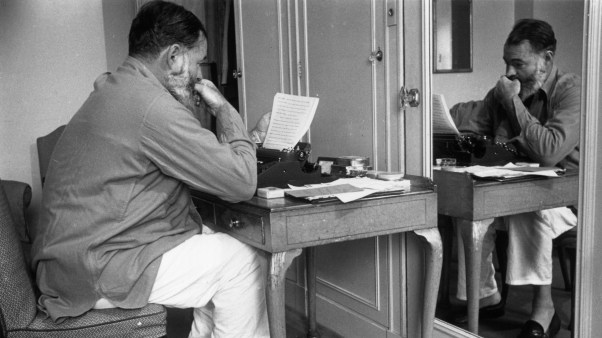
3 ways Hemingway challenges us to open our eyes to ourselves, Scripture, and the world around us.
Gary Chapman has been a household name since the mid-1990s after publishing his book that helped people discover their primary ways of giving and receiving love. The Five Love Languages sold 8,500 copies its first year. It more than doubled that in the second year. It was still the top-selling Christian book for much of 2021. It has sold more than 20 million copies worldwide.
But an article in Christianity Today is titled, “Gary Chapman Doesn’t Know That He Is Famous.” The article says Chapman continues to live a humble and faithful walk with Jesus and his church:
Gary Chapman is constant. He’s lived in the same red-brick house for more than 20 years. He still counsels couples in the same Baptist congregation he has pastored for five decades in Winston-Salem, North Carolina. He blocks Sundays from his busy speaking schedule so he can attend worship there, even if it means taking a redeye flight to make it on time. Many weeks, he stands at the door after services to greet parishioners.
He doesn’t drink. He seems to have worn khakis for most of his life. His guiltiest pleasure is that he can’t finish lunch or dinner without a dessert. … He waters his backyard flowers in the mornings and pulls kudzu. He prays through his first round of daily calisthenics: “I come to you in the name of Jesus,” he recites, swinging his arms up and down, then intercedes for people by name. During heel raises, he covers some refugee camps and rescue missions. He does it all over again at night, “but at night I’m just talking to God and praising God.”
Even when he retired in October, 2021, not much changed about Gary. He kept his church office and continues counseling.
Source: Kara Bettis, “Gary Chapman Doesn’t Know He’s Famous,” Christianity Today (September, 2021)
Actor Charlie Hunnam has recently begun a transition to writing. About to turn 40, he had reached a place in life for some evaluation. Hunnam knew he would be out of work for a while due to COVID-19. And in his heart, there were stories that he had been carrying around. He shares, "They had been sort of given to me like gifts. And I wasn't honoring the gifts."
As he started the process of honoring these gifts, Hunnam found new energy. He started to get up around 4:00 am daily to go on a short hike. He would be back home, showered, and ate breakfast by 6:00 am. Then he would sit down to write until 7:00 pm. That's 13 hours! He explains the sensation this way:
I just started to get this really “now” feeling of life. Like there's nothing else in the world that would be better for me than what I'm doing right now. And the result of it was more positive than anything I've ever done in my career. ... And I've worked really, really hard to cultivate this gift and be proud of the work that I'm able to do now. But part of me feels like it's an uphill struggle.
But when I write, I feel as though I'm honoring the innate gifts that God gave me. I feel like I really can do this [stuff] at a high level. And that's a feeling that I've never had in my life before, in any regards. I feel like we all have one or two innate talents, and a task of life is to identify those and then do that as much as you possibly can. Because that's where the joy and the presence is going to come from. That's where the grace is going to come from.
Source: Frazier, Tharpe, "Charlie Hunnam On Choosing Vulnerable Roles.,” GQ (November, 2020)
Don’t you love receiving a handwritten letter in the mail? It’s so much more personal than an email. You see the other person’s handwriting, knowing that they took the time to write out each word, and then fold the letter, place it in an envelope, affix a stamp, and send it to your mailbox.
Well now, if you’d like to bless someone with a handwritten letter, but don’t have the time or energy to do it, there are online services that will do it for you! All you need to do is log-on to a service like “Handywrytten,” type in what you’d like to say, choose your preferred script, and their handwriting robots will write out the words for you and send the letter to your loved one. For an extra fee, some services will even mimic your own handwriting style. Others can include a smudge or ink blot to give your letter a more authentic touch. It’s as easy as sending a text message!
As one customer says, “To me, it’s the same, whether a robot writes it or I do. What matters is that I was thinking of them.” Others think this service is a way to fake authenticity. Yale Professor Ellen Spitz says, “It seems like a complete betrayal. Handwritten notes are special precisely because they are intimate, because a part of your body is touching the paper, creating a personal connection.”
Communication doesn’t get more personal and intimate than the Incarnation. When God decided to reveal the fullness of his love for humanity, he didn’t ask someone else to do it for him. Instead, he sent his Son, in flesh and blood.
Source: Abha Bhattarai, “The art of imperfection: People are turning to robots to write their ‘handwritten’ cards,” The Washington Post (12-21-19)
Writing systems are thousands of years old and are found in ancient Sumer, China, and Egypt. But even in the most literate ancient societies only a small fraction of people ever learned to read, rarely more than 10 percent. So, when did people decide that everyone should learn to read?
The move toward mass literacy began in the 16th century with the belief that every person should read and interpret the Bible for themselves. This belief began to rapidly diffuse across Europe with the eruption of the Protestant Reformation. It was initiated in 1517 by Martin Luther’s delivery of his famous 95 theses. Protestants came to believe that children had to study the Bible for themselves to better know their God. In the wake of the spread of Protestantism, the literacy rates in Britain, Sweden, and the Netherlands rose. Motivated by eternal salvation, parents and leaders made sure the children learned to read.
Religious beliefs also helped spur the beginning of state-funded schooling. As early as 1524, Martin Luther emphasized the need for parents to ensure their children’s literacy and placed the responsibility for creating schools on secular governments. In the 16th century, reformer John Knox pressured the Scottish government to initiate free public education for all children. One of his reasons was that everyone should have the skills to study the Bible.
Source: Joseph Henrich, “Martin Luther Rewired Your Brain,” Nautilus (2-17-21)
3 word crafting techniques we can learn from presidential speechwriters.
Episode 16 | 11 min
Preachers need to be more like filmmakers when crafting their sermons.
Use the skills, talents, and knowledge of everyone on your team.
Live into your role as theological leader of your church.