Callings come in many forms—a moment of epiphany, a wise word from a mentor, a quiet prayer before an altar. Dan Claire’s came when the Rapture failed to happen.
A fifth-generation Floridian who dropped out of medical school to pursue ministry, Claire pastors the Church of the Resurrection (affectionately nicknamed “Rez”) in Capitol Hill, where he’s served since moving to Washington, D.C. 17 years ago. Before going to seminary, though, he was a student ministry leader at the University of Florida—at a time when Christians in his town were busy preparing for Christ’s imminent second coming. Here’s how he tells the story:
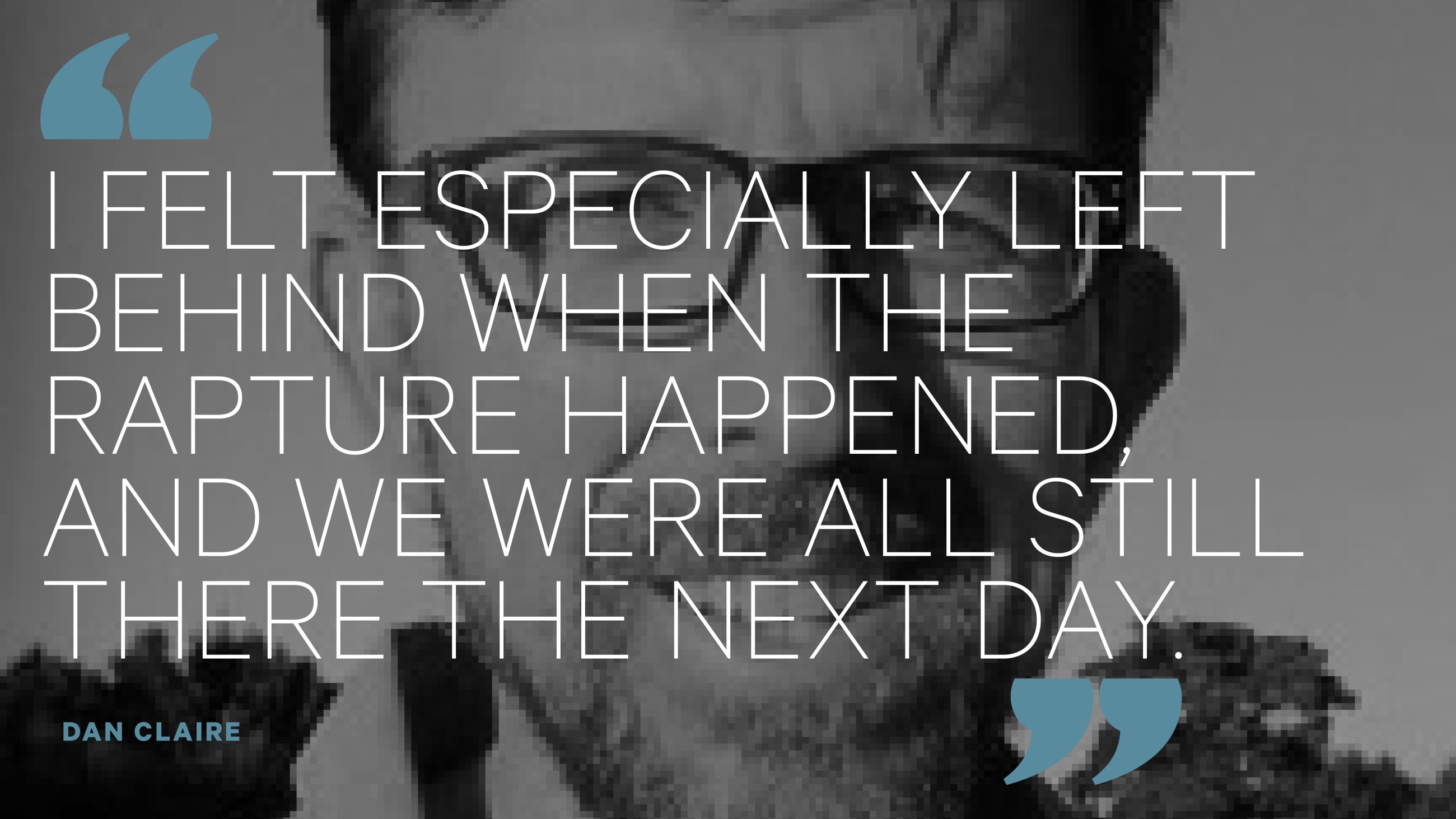
When I was elected president [of the Baptist Student Union], starting my sophomore year, there was a movement in the city—“88 Reasons Why the Rapture Will Occur in 1988.” It was based on a book that was pretty popular in many circles, and the largest Baptist church in the city at the time got on board with this and started preparing people for the Rapture in the fall of 1988. . . . The campus minister of the BSU was ill—he had amnesia, he was hospitalized—and so there weren’t really any adults in charge. As an unsupervised 19-year-old leader of a ministry of 300 people, I felt especially left behind when the Rapture happened and we were all still there the next day. . . .
There were some very crazy things that happened. There was one family in the church who put all their pets to sleep so their pets wouldn’t be left behind, and another family that sold their house and gave the money to a non-Christian family. These were well-known in the community. People were seriously committed to Rapture Day. . . .
I was kind of on the fence; I didn’t know what to make of it. The next day—the day after the “Rapture”—I spent a lot of time at the Baptist Student Union talking with people who were furious, and rightfully so . . . and they asked really good questions, and I didn’t have very good answers. The little book that argued for the Rapture on that particular day used different verses from the prophets of the Old Testament and from Revelation, and I just didn’t know enough to be able to sort out those things.
There was one fellow at the BSU who worked there as a kind of housekeeper, and he took me aside and said, “I think you would really benefit from reading the Bible in a different way, learning how to read the Bible as a narrative.” He was the first person in my life who welcomed me into a more robust, grand story of creation, fall, redemption, and consummation, and understanding the different parts of the Bible within that grand story. . . .
The call to leadership—I felt it at that time, because I felt greatly responsible for what was happening to these people. I was in charge, and I hadn’t been a very good watchman.
If you’ve also been left behind, then it may be the perfect time to listen to this week’s episode of The Calling, where you’ll hear CT managing editor Richard Clark chat with Dan Claire about being a med school dropout, getting ordained in the Rwandan church, and the challenges he faces pastoring a transient congregation in the heart of the nation’s capitol. Trust us . . . it’ll be (ahem) rapturous.