Political, cultural, and media elites are increasingly raising alarm over what has become one of the world's largest illegal commercial sectors—the trade in human beings. The U.S. Government estimates that 600,000 to 800,000 men, women, and children are trafficked across international borders each year. ...
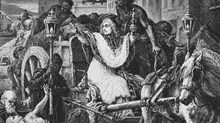
Christian and non-Christian activists against the exploitation of women look back for inspiration to the 19th-century Indian social reformer Pandita Ramabai. Ramabai disguised herself as a sannyasini (female mendicant), determined to rescue destitute women who were being forced into servitude and sexual degradation. She beheld unspeakable horrors: hundreds of agents enticing abandoned and helpless child-widows into institutions where they were shut up or rented out to men. Her initial effort to rescue seven wretched women nearly cost her life. She returned twice, during a terrible famine, to rescue and carry away scores of victims in her train of bullock carts—starving little girls (and on occasion a few boys) clad in filthy rags—and to give them a new life at her Mukti Mission. Literate and skilled "graduates" of Mukti went out into the world. Many became teachers or widely sought-after wives. Some attended colleges in America and became medical doctors. —Robert Eric Frykenberg
They traveled, preached, wrote books and letters, challenged church leaders, ministered to the poor and sick, defended those in need, and inspired faith and courage in others. You can learn more about all of these women, and many others, in our archives.
February 10, 60 (traditional date): The Apostle Paul is shipwrecked at Malta (see issue 47: Apostle Paul and His Times).
February 10, 1535: A dozen Anabaptists run stark naked through the streets of Amsterdam. Such strange actions, usually by Melchoirite Anabaptists, led to the group's ridicule by Protestants and Catholics alike. Former Catholic priest Menno Simons (1496?-1561) was finally able to bring the group into a nonresistant, discipled, and disciplined vision (see issue 5: Anabaptists).
February 10, 1751: John Wesley suffers a fall on the ice-covered London Bridge and is carried to the home of Mary Vazeille, a sailor's widow. Within a week, the two were married—with disastrous results. The unhappy couple spent so little time together that, in 1771, Wesley recorded this in his journal: "I came to London and was informed that my wife died on Monday. This evening she was buried, though I was not informed of it" (see issue 2: Wesley and issue 69: Charles & John Wesley).