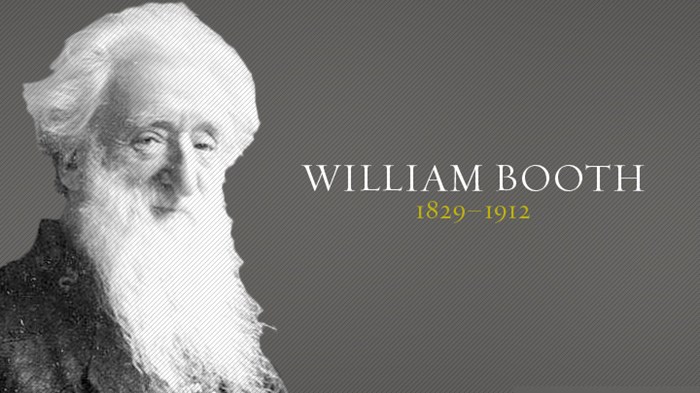
William Booth


"I seemed to hear a voice sounding in my ears, 'Where can you go and find such heathen as these, and where is there so great a need for your labors?'"
After he died, 150,000 people filed by the casket, and 40,000, including Queen Mary, attended his funeral. It was a remarkable end for a man born into poverty and who worked in the midst of poverty his whole life.
But William Booth was a remarkable man, who was given the title "The Prophet of the Poor." He is best known today as founder and first general of the Salvation Army.
Pawnbroker's apprentice
Booth was born in relative poverty, in Sneinton, a suburb of Nottingham, England. His parents were not religious and at best laboring class, with little education. His father, "a Grab, a Get," by William's definition, died when William was just 14. By that time, William was helping to earn the family income as a pawnbroker's apprentice.
Sometime during his fifteenth year, William was invited by a Wesleyan couple to attend chapel, where he was converted. He wrote in his diary, "God shall have all there is of William Booth."
Then came another life-changing experience: he heard an American revivalist who led "a remarkable religious awakening" at Nottingham's Wesleyan Chapel. The rush of souls to hear the gospel led Booth to see that "soul-saving results may be calculated upon when proper means are used for their accomplishment." Booth went on to make a lifelong commitment to the scientific revivalism methods of Charles G. Finney.
Booth and a group of friends set out to evangelize the poor. They held nightly open-air addresses, after which they invited people to meetings in cottages. Their use of lively songs, short exhortations calling for a decision for Christ, and visitation of the sick and of converts (whose names and addresses they recorded) anticipated methods Booth would write into Salvation Army Orders and Regulations 30 years later.
Timeline |
|
|
1804 |
British and Foreign Bible Society formed |
|
1807 |
William Wilberforce succeeds abolishing slave trade |
|
1817 |
Elizabeth Fry organizes relief in Newgate Prison |
|
1829 |
William Booth born |
|
1912 |
William Booth dies |
|
1914 |
World War I Begins |
When he was criticized for using secular tunes to attract crowds, he replied, "Secular music, do you say, belongs to the devil? Does it? Well, if it did I would plunder him for it, for he has no right to a single note of the whole seven."
When his pastor proposed that William himself prepare for ordained ministry, he accepted, and soon found himself pastor to Reform Methodists in Spaulding, though their disorganized ways repelled him.
During this period, William met Catherine Mumford. Beginning with their second meeting on Good Friday 1852, they entered one of the most remarkable relationships in religious history. They married in a South London Congregational chapel in June 1855.
By 1861 William was finding that "settled ministry" did not suit him, and he resigned. He and Catherine became itinerant evangelists in Wales, Cornwall, and the Midlands, Britain's "burned-over" districts. The Booths preached in naphtha-lit tents on unused burial grounds, in haylofts, in rooms behind a pigeon shop—anywhere to fulfill his famous words, "Go for souls and go for the worst!"
Labyrinth ministry
An invitation for Catherine to preach in London in 1865 led him to accept support from lay-run East London missions as a temporary ministry. East London in the 1860s was, in the words of one writer, "a squalid labyrinth, with half a million people, 290 to the acre … Every fifth house was a gin shop, and most had special steps to help even the tiniest [children] reach the counter."
After seeing some of East London's gin palaces, he told Catherine, "I seemed to hear a voice sounding in my ears, 'Where can you go and find such heathen as these, and where is there so great a need for your labors?'"
William soon organized his own East London Christian Mission which, by 1870, resembled a Methodist society. His mission failed to attract the "heathen masses," however. So in 1878, he energized it by giving it the name "Salvation Army," an idea he borrowed from the successful British Volunteer Movement. A military structure was installed with "General" William Booth at the top. Military trappings were added over the next couple of years. The idea caught the imagination, and within ten years, the Salvation Army was established in the United States, Canada, and Europe as well.
Booth was single-minded in his zeal. He once said, "While women weep, as they do now, I'll fight; while little children go hungry, I'll fight; while men go to prison, in and out, in and out, as they do now, I'll fight—while there is a drunkard left, while there is a poor lost girl upon the streets, where there remains one dark soul without the light of God—I'll fight! I'll fight to the very end!" His zeal, however, made for less than happy personal relationships, which led to strains and schism especially in the American branch.
Over the years, he created an elaborate social relief system because he believed charity would speed the work of evangelism. In 1890, he published In Darkest England and the Way Out (which became a bestseller) to explain his social relief scheme.
At the time of his death on August 20, 1912, the Salvation Army had become a family-run Christian empire, with seven of the Booths' eight children taking leadership positions. Today, following the pattern established by the first general, the Salvation Army marches on with over 25,000 officers in 91 countries.

Support Our Work
Subscribe to CT for less than $4.25/month