











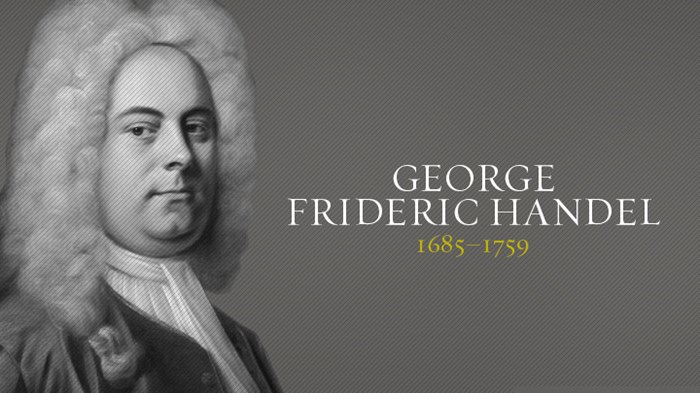
George Frideric Handel


"He [Handel] would frequently declare the pleasure he felt in setting the Scriptures to music, and how contemplating the many sublime passages in the Psalms had contributed to his edification."
—Sir John Hawkins
By 1741 George Frideric Handel was a failure. Bankrupted, in great physical pain, and the victim of plots to sabotage his career, the once-great opera composer scheduled a "farewell" appearance in London in April. To the London elite, it looked like this "German nincompoop," as he was once called, was through. That summer, however, he composed Messiah, which not only brought him back into the spotlight, but is still deemed by some to be "an epitome of Christian faith."
Opposition begins
Unlike Handel's fellow countryman and contemporary Johann Bach (the two were born the same year but never met), Handel never had a musical family. George's father was a practical "surgeon-barber" who discouraged his son's musical career at every turn. His son was to be a lawyer. Indeed, George studied law until 1703, even though his father (who finally allowed his son to take music lessons at age 9) died when he was 11. By age 12, Handel was substituting for his organ teacher and had written his first composition.
After musical studies in Germany and Italy, Handel moved to England, where he stayed for the rest of his life and became a composer for the Chapel Royal. His greatest passion was for the opera—an ill-timed passion, for the form was quickly falling out of fashion in England. The most popular work was the 1728 Beggar's Opera, which satirized the form itself. Still, Handel continued to pen operas into the 1740s, losing more and more money.
Handel's friends expressed concern that the concert hall was nearly empty. Never mind, he joked, an empty venue would mean great acoustics.
Timeline |
|
|
1653 |
Cromwell named Lord Protector |
|
1654 |
Blaise Pascal has definitive conversion experience |
|
1682 |
William Penn founds Pennsylvania |
|
1685 |
George Frideric Handel born |
|
1759 |
George Frideric Handel dies |
|
1793 |
William Carey sails for India |
He didn't joke for long. In 1737 Handel's opera company went bankrupt, and he suffered what seems to be a mild stroke. But to make matters worse, his latest musical fascination—the oratorio (a composition for orchestra and voices telling a sacred story without costumes, scenery, or dramatic action)—was his most controversial yet. His first oratorio (actually, the first of its kind in English), Esther, was met with outrage by the church. A Bible story was being told by "common mummers," and even worse, the words of God were being spoken in the theater!
"What are we coming to when the will of Satan is imposed upon us in this fashion?" cried one minister. The bishop of London apparently agreed and prohibited the oratorio from being performed. When Handel proceeded anyway, and the royal family attended, it was met with success—but the church was still angry.
In 1739 advertisements for Israel in Egypt were torn down by devout Christians, who also disrupted its performances. All of this angered the devoutly Lutheran Handel. As his friend Sir John Hawkins commented, "Throughout his life, [he] manifested a deep sense of religion. In conversation he would frequently declare the pleasure he felt in setting the Scriptures to music, and how contemplating the many sublime passages in the Psalms had contributed to his edification."
Though irritated—and Handel was often irritated, earning a reputation for prolific cursing in five languages—he dismissed the Puritans' concerns. "I have read my Bible very well," he said, "and will choose for myself." In fact, Handel maintained that he knew the Bible as well as any bishop. Financially, however, it did him little good. Once the composer for royalty, he was now threatened with debtor's prison.
Delivered by Messiah
Deeply depressed, Handel was visited by his friend Charles Jennens. The wealthy, devout Anglican had written a libretto about the life of Christ and the work of redemption, with the text completely taken from the Bible. A fussy perfectionist, Jennens had written it to challenge the deists who denied the divinity of Jesus. Would Handel compose the music for it? he asked. Handel answered that he would, and estimated its completion in a year.
Soon thereafter, a group of Dublin charities approached Handel to compose a work for a benefit performance. The money raised would help free men from debtor's prison, and Handel would receive a generous commission. Now with a text and a motivation, Handel began composing Messiah on August 22, 1741. Within six days, Part One was finished. In nine more, Part Two. Six more and Part Three was done. It took him only an additional two days to finish the orchestration. Handel composed like a man obsessed. He rarely left his room and rarely touched his meals. But in 24 days he had composed 260 pages—an immense physical feat.
When he finished writing what would become known as the Hallelujah Chorus, he said, "I did think I did see all Heaven before me, and the great God himself."
Though the performance of the piece again caused controversy (Jonathan Swift, author of Gulliver's Travels and then the dean of Saint Patrick's Cathedral, was outraged and initially refused to allow his musicians to participate), the premiere on April 13, 1742, at the Fishamble Street Musick Hall was a sensation. An overcapacity crowd of 700 people attended, raising 400 pounds to release 142 men from prison. (The demand for tickets was so great that men were asked not to wear their swords and women asked not to wear hoops in their skirts, allowing 100 extra people into the audience. Such hoops immediately fell out of fashion for concerts.)
Still it took nearly a year for Messiah to be invited to London. Religious controversy surrounded it there, too, and Handel compromised a bit by dropping the "blasphemous" title from handbills. It was instead called "A New Sacred Oratorio." But the controversy wasn't strong enough to keep away the king, who stood instantly at the opening notes of the Hallelujah Chorus—(though some historians have suggested it was because he was partially deaf and mistook it for the national anthem) a tradition ever since.
Though it had met rave reviews in Dublin ("the most finished piece of music"), it was not very popular in London after its premiere. By 1745 Handel was again playing to empty houses and nearing poverty. Not until his oratorio Judas Maccabeus, which was misunderstood by the English as a veiled nationalistic anthem, did Handel (and with him Messiah) reach the pinnacle of his career.
Until his death, Handel conducted 30 performances of Messiah (none at Christmastime, for Handel deemed it a Lenten piece), only one of which was in a church, Bristol Cathedral. In that audience sat John Wesley. "I doubt if that congregation was ever so serious at a sermon as they were during this performance," he remarked.
Handel died on the day before Easter 1759, hoping to "meet his good God, his sweet Lord and Savior, on the day of his Resurrection." A close friend remarked, "He died as he lived—a good Christian, with a true sense of his duty to God and to man, and in perfect charity with all the world."

Support Our Work
Subscribe to CT for less than $4.25/month










